Wednesday, April 10, 2024

Sunday, April 2, 2023
Blade Runner, Kent Hovind/Ken Ham/Creationists, people like them and Fear and Evasive Logic/Language
https://www.youtube.com/watch?v=YEBUNMVP_8k I've been finding lots of stuff about fear and evasive language, and I've found another one; i'll post the links to previous posts about this in the replies section. Here, I found Blade Runner; where Leon, one of the escaped robots is going through a Turing test(they call it Voight Kamff in the movie). the A.I. scientists is testing Leon by asking him simple questions, and Leon is responding with "what do you mean" to everything. I find this analogous to what I've seen of Religious believers when confronted with contradictions, scientific theory of evolution. They are always "what do you mean I come from an Ape." or they say "I don't understand." Kent Hovind would say "were you there" to Big Bang Cosmology theory which is another form of "what do you mean?" He once had like two thousand videos; but, his channel was taken down. I'm actually disappointed because he's laying down a record of this fear and evasive language behavior. Yea, he's done some more channels. But, I'm not going to post here. These Bible believers spring up all the time, from the beginning of time. I found this article from Percy Bridgeman - A New Vision of Science" from back to 1929. I was looking to confirm a quote which I did not find(a few years after looking up this article, I found the quote in another book he wrote). I had to pay like thirty dollars because the Libraries couldn't track it down! Anyways, it's mostly about Quantum Mechanics, but then he notes that there will always be charlatans who will poke around the cracks of a theory . . . Well, he explains Heisenberg's Uncertainty Principle, and at the end he says, "This imagined beyond, which the scientist has proved he cannot penetrate, will become the playground of the imagination of every mystic and dreamer. The existence of such a domain will be made the basis of an orgy of rationalizing. It will be made the substance of the soul; the spirits of the dead will populate it; God will lurk in its shadows; the principle of vital processes will have its seat here;" Consider the Biblical books of Job and Ecclesiastes which say learning nature is futile, so give up and believe in our idea of god. This article was written back in 1929, and here we have Ken Ham/Kent Hovind's repeating the same arguments they came up back in the 1800s to sweep aay the Geologic findings and Charles Darwin's "Natural Selection."
Saturday, June 25, 2022
Gospel of Truth: Mathematics as the Holistic Viewpoint
O.k. now it's done - I swear to the gods!
I tried posting the link in the main body; but, despite using the "insert link" the link didn't show up. So, I put it in the replies
Saturday, January 1, 2022
Monday, August 9, 2021
astro picture for the day/ thought for the day - Space Exploration and Advanced technology


Thursday, June 17, 2021
Gospel of Truth - Mathematics as the holistic viewpoint
Mankind is the science and technologically dependent species. We are defined and
distinguished by the other life by this dependence. Some will argue that beavers
make dams; spiders make webs; birds make nests; bees make nests. Maybe so - but
none of them has the type of language Human's use; and, none of them produces
art, and mathematics. How did we get this way? Unless you think life is a static
structure, you have to admit that life evolves. And, Mankind had to of evolved
from non-Human animals. The first person to figure this out was Jacob Bronowski.
Jacob shows, in his "Origins of Knowledge and Imagination" how animal language
is a single unified whole - one instructional statement. No questions or
explanatory sentences. They have not split the nouns and verbs frmo this whole
unit. Jacob gets this part from others, but he shows that understanding
mathematics on a deeper level than just learning from already finished products
- like numbers, equations, and geometric diagrams, show how nouns and verbs can
be decoded out this wholness. Jacob notes the alarm calls of an animal. One
alarm call is "danger of bird". Another is "danger of snake." And another is
"danger of big cat." What Humans have done is abstract the more general concept
of danger from the three instructions, and specialize, or idealize the three
instances of cat/snake/bird. Abstraction and Idealization, as some
mathematicians who like to wonder about where mathematics comes from, are two
sides of the same coin. What was idealization at one time, becomes generalized
into more generalizations, or abstractions later. But, what are these two
concepts? I like Suzanne K. Langer's treatment in her "Introduction to Symbolic
Logic." The books title hides that it gets into more than just showing the rules
of deductive reasoning. It shows how Symbolic Logic can be derived from natural
language. Jacob Bronowski's "Origins of Knowledge and Imagination" as noted
above show how Human natural language can come out of animal language. Her first
chapter explains how abstracxtion works. Everything has a structure. This is
quite a philosophical claim. The question is "can we continue to find structure
all the way down?" We've found that we can first find that matter is made up of
atoms. Then, we find that atoms can becomposed into electrons and protons(and
neutrons), and then there's neutriones, pions, quarks, anti-matter. Today's
Quantum Physics says there's a Planck's length, and it's far smaller than any
Quark, or Higgs particle. Is there any more structure between Quarks and
Planck's length? Stay tuned . . . Jacob Bronowski also makes this bold
philosophical claim to make his understanding of how Human thinking works. He
says mankind makes a finite cut in an infinitelly detailed reality. And, each
finite cut can only be an approximation. But, this is getting ahead of our story
a little bit. Getting back to Suzanne K. Langer's "Introduction to Symbolic
Logic." "Everything has a structure" A structure is a relation that connects two
or more elements. One can do two things with a structure. One can find common
elements or relations between two structures. This leads to Abstraction. A
common form of two structures. A relation can make sense between different sets
of elements. But, they have the same structural relation, and same number of
elements. So, we have an analogous structure. Poetry also has analogy. Poetry
calls it Metaphor, Simile, and personification. Jacob Bronowski notes that
Poetry and Mathematics share this common property of analogy. I note that
Mythology is Poetry. And so, I suggest that Mathemtaics is the more general
concept that elucidates the different Arts and Mythology. What I do in my Gosel
of Truth here is show that one can explain how Art and Mythology work from the
Mathematical perspective than deriving numbers from art. Mathematis is the
holistic viewpoint. The other thing that one can do with structure is transform
it. One could either switch out the relation, or the elements, and transform the
structure from one thing to another. The transforming of structure is what gives
Mathematics the power to predict and to be the true key to the Universe, and not
Mythology and Art. Sir James Frazer shows in his "The Golden Bough" that there
was a period of Magic before Science and Religion. He considers science to have
somehow evolved out of this magic. That somehow, nubmers can be derived from
magic and mythology. I argue that cannot be the case. And, as explained above,
it's better to understand Art and Mythology from what it is not - Mathematics.
Than to somehow derive numbers from Mythology. Sometimes, one cannot transform
one structure into another without looking beyond your current perspective. This
is reflected in deductive logic. You can prove in one of two ways. There's the
hypothesis and conclusion of a logical statement to be proved. And, you can
either start with the hypothesis or the conclusion. Starting with the hypothesis
generally entails Aristotelean syllogism. The famous Socrates syllogism - All
men are mortal. Socrates is a Man. Therefore, Socreates is a Mortal. Proving
from the conclusion always takes the form of transforming, or reexpressing, and
then moving the reexpression into the givens list, from which the deductive
syllogism is usually clear. I like what Suzanne K. Langer shows in her book
mentioned above about seeing beyond your current perspective. In natural
language you have "is" used ina lot of different structural relations. Symbolic
Logic brings out these underlying structureal relations. On page 56 of her
"Introduction to Symbolic logic", she shows is broken down into six logical
cases - The rose is red. Rome is gretaer than Athens. Barbarosa is Frederick I.
Barbarossa is a legendary figure. To sleep is to dream. God is. The first
ascribes a property to a term. The second gives an auxiliary value of asserting
a dyadic relation, The third expresses identity. The fourth equates membership
in a class. The fifth shows entailment. The sixth states existence(without
proof). The deductive proof from the conclusion uses the logical characters of
and/or/not/implies/at least one/all equivalent of the above process of seeing
the underlying structural relations to transform a problem. This is a bit like
how we discovered the Sun Centered Cosmology. We didn't just build a spaceship,
fly it to the polar regions of our solar system, and discover that the Sun is at
the center of the Solar Systme. We derived it by noting odd things like the
retrograde motion of the Planet. The changing phases of the Moon. And, we
logically derived that the Sun must be at the center of the Solar System and not
the Earth. I like 1 Samuel 2:8 for proof of flat-Earth in the Bible. There's a
lot of such passages. "for the pillars of the earth are the Lord's, and he hath
set the world upon them." I've noted some connections between what Jacob
Bronowski shows in his "Origins of Knowledge and Imagination" and some of James
Burke's Connections. I noticed some connections of James Burke's Connections to
be analogous. He notes that in agriculture, one has to have irrigation, pest
control, and fertilization, when clearing the fields. He notes in chapter two
that Guericke produced a vacuum. And the vacuum had a few affects like a fire
would go out/your couldn't hear a bell in a vacuum/ and Mice suffocate in it. I
find that these concepts that come about, when setting everything to zero, lead
to what Jacob Bronowski calls "inferred units." The six types of "is" All
Mathematical concepts are derived from this process of seeing beyond our
flat-Earth perspective. Today, or really, in the 20th century, Archeaologists
learned about the number sense of hunter gatherors. And, we can see that this
proves Jacob Bronowski's ideas of how Natural Language and Mathematics evolved
out of Animal language. John D. Barrow, in his "Pi in the Sky" mentions concrete
words for numbers in differnt situations. Page 37 he shows an example of a pair
of shoes/a brace of peasants/a yoke of oxen/and a couple of people. These are
concrete version of the abstract number two. Page 38 he gives the example of a
word for flat stone, smooth stone, another word for five fingers, and another
for five people. These examples are like the differnt alarm calls for each
situation, and really shows how the hunter gatherors were not that far from
animal language. The number five turns out to the point where most humans lose
count. To explain that shows something of the problems early Humans had when
learning numbers. Generally, when you put down five or more objects, you can't
tell "how many" without countintg. For object less than five, you can tell how
many without counting. Knowing how many people are in a theater drives this
home. If you have a theater of people, but haven't counted beore hand how many
seats are in the theater, then about all you can say is you have a theater of
people. And, this is how early people understood numbers. They had concrete
words for one, two, and many. Then, they graduated to to three, four, five,
eight, nine, ten, 12, 60. They're problem was not being able to transform from
one number to another. They couldn't notice the equivalence of 3+4, and 6+1. The
Nebra Sky disk is the latest and greatest example of this.
 The Nebra Sky Disk has a boat, the Sun, Moon, the Pleides, and two gold leafs on
the sides. They seem to be equivalent to the angles between the solstices. The
Nebra Sky disk dates to like 1600 B.C. There was a recent redating. This is a
Bronze disk, not an iron disk. So, I don't know how they can date this to the
Iron age. The dating doesn't really change conclusions on my mathematical points
about the two gold leafs on the sides marking the solstices. They did not
calculate the angle like counting the number of the angles, or solving an
algebraic equation. They just transfered the angle from a Stonehence like cirlce
to the disk. Kind of like in Geometry, where you use your compass, and transfer
a length from one line, or angle, to another. The people who put those two gold
leafs on had a theater understanding of numbers. And Stonehenge leads to the
Arch as the symbol of Mathematics.
The Nebra Sky Disk has a boat, the Sun, Moon, the Pleides, and two gold leafs on
the sides. They seem to be equivalent to the angles between the solstices. The
Nebra Sky disk dates to like 1600 B.C. There was a recent redating. This is a
Bronze disk, not an iron disk. So, I don't know how they can date this to the
Iron age. The dating doesn't really change conclusions on my mathematical points
about the two gold leafs on the sides marking the solstices. They did not
calculate the angle like counting the number of the angles, or solving an
algebraic equation. They just transfered the angle from a Stonehence like cirlce
to the disk. Kind of like in Geometry, where you use your compass, and transfer
a length from one line, or angle, to another. The people who put those two gold
leafs on had a theater understanding of numbers. And Stonehenge leads to the
Arch as the symbol of Mathematics.
 Archaeolgists have found lots of Stonehenges. This one is in contemporary
Israel,
Archaeolgists have found lots of Stonehenges. This one is in contemporary
Israel,
 It's called Rujm el-Hiri and dated to 3000 B.C. The Old Testament mentions
Gilgals, which means circle of twelve stones. Circular stones certainly seems
like some form of Stonehenge. Twelve is a number that will come up a lot in this
Gospel of Truth. All the stone circles are always rough and jagged surfaces.
They just took some stone and flopped it there. They sometimes put such a stone
on top of two such jagged surfaces. But, Stonehenge appears to have straight
surface/smoothed lintel/ceilings. So, the significance of Stonehenge over
hundreds, if not thousands of other stone circles built at that time, could be
that the Stonehenge builders had a rudimentary understanding of how to make a
smooth surface. Note, the post/columns of Stonehenge are still potato shaped.
But, the tops of the posts are shaped enough to form-fit with the stones
covering the column-stones. So how to make a smooth/flat surface? As we'll see
below, it takes mathematical insight. One way to make a smooth surface is to
take a string and attach a ball at the end, and then moving the perpendicular
line/string across the surface. Anytime the ball hits a bump, then carve that
bump out. This is the beginning of a famous mathematical theorem about isosceles
triangles. The Isosceles theorem is that of the two base angles being equal. How
to prove it? First you have to construct an isosceles triangle, and that takes
some proving as well; but, let's assume the isosceles triangle is constructed.
First you need to draw a straight line from the top, perpendicular to the base
of the two equal angles below(remember the line with a ball hanging down to get
a smooth surface below?) . . . first we know the sides split between the
perpendicular line and the two angles makes equal line segments, and then we
know the two hypotenuse sides are equal, and so we know two triangles generated
by splitting the original triangle by the perpendicular line are congruent.
Therefore, the two angles of those two congruent triangles must be equal.
It's called Rujm el-Hiri and dated to 3000 B.C. The Old Testament mentions
Gilgals, which means circle of twelve stones. Circular stones certainly seems
like some form of Stonehenge. Twelve is a number that will come up a lot in this
Gospel of Truth. All the stone circles are always rough and jagged surfaces.
They just took some stone and flopped it there. They sometimes put such a stone
on top of two such jagged surfaces. But, Stonehenge appears to have straight
surface/smoothed lintel/ceilings. So, the significance of Stonehenge over
hundreds, if not thousands of other stone circles built at that time, could be
that the Stonehenge builders had a rudimentary understanding of how to make a
smooth surface. Note, the post/columns of Stonehenge are still potato shaped.
But, the tops of the posts are shaped enough to form-fit with the stones
covering the column-stones. So how to make a smooth/flat surface? As we'll see
below, it takes mathematical insight. One way to make a smooth surface is to
take a string and attach a ball at the end, and then moving the perpendicular
line/string across the surface. Anytime the ball hits a bump, then carve that
bump out. This is the beginning of a famous mathematical theorem about isosceles
triangles. The Isosceles theorem is that of the two base angles being equal. How
to prove it? First you have to construct an isosceles triangle, and that takes
some proving as well; but, let's assume the isosceles triangle is constructed.
First you need to draw a straight line from the top, perpendicular to the base
of the two equal angles below(remember the line with a ball hanging down to get
a smooth surface below?) . . . first we know the sides split between the
perpendicular line and the two angles makes equal line segments, and then we
know the two hypotenuse sides are equal, and so we know two triangles generated
by splitting the original triangle by the perpendicular line are congruent.
Therefore, the two angles of those two congruent triangles must be equal.
 Whatever the case may be, on whether the makers of Stonehenge had some kind of
mathematical knowledge to make smooth surfaces, most Stonehenges did not. And,
these Stone circles were not much above the bees and ants making their hives.
I'm showing that Mankind's natural language and mathematical science took
reasoning beyond animal logic, language, and flat-Earth perspective. And, the
Arch is the first technological development that proves Mankind is beyond the
animals. So, I want to explain the Arch. The above picture is of a Roman
aqueduct in France, below is the biggest post/lintel architecture in Human
history - the Great Hypostyle Hall
Whatever the case may be, on whether the makers of Stonehenge had some kind of
mathematical knowledge to make smooth surfaces, most Stonehenges did not. And,
these Stone circles were not much above the bees and ants making their hives.
I'm showing that Mankind's natural language and mathematical science took
reasoning beyond animal logic, language, and flat-Earth perspective. And, the
Arch is the first technological development that proves Mankind is beyond the
animals. So, I want to explain the Arch. The above picture is of a Roman
aqueduct in France, below is the biggest post/lintel architecture in Human
history - the Great Hypostyle Hall
 Making big things with ever larger sidewalls and a stone-block on top gets
heavier and heavier. So, hauling heavier stones gets harder and harder; but,
also, the lintel/ceiling has a higher chance of splitting and falling down. The
stress points in the middle of the ceiling become so great that it breaks. To
prevent that with post/column and lintel/ceiling, one crowds the columns Just
observe the famous hundreds of rows of columns at Egypt's Karnak. How can one
support a ceiling above without carrying all that weight? Both the post/columns
and top lintel/ceiling? One breaks up the columns into more manageable pieces.
Then as you stack them up, make the top ceiling part of the columns and meet at
a point - the keystone. The Roman aqueduct above is a great example. The
Stonehenges almost certainly had some relation to early Mankind's Astronomical
knowledge. But, they almost certainly used that knowledge more for spiritual
reasons. Mathematics, Mythology, existed at the same time. One didn't derive
from the other, as Sir James Frazer suggested in his "The Golden Bough." He
thought magic and mythology were a kind of early, primitive science. And that
science and mathematics somehow evolved out of magic and mythology. As I've said
before, numbers and geometry cannot be derived from magic and mythology. But,
one can explain and understand what magic and mythology are from what they are
not - Mathematics. For proof, we have tally sticks that go back tens of
thousands of years ago. And, maybe even hundreds of thousands of years ago.
Making big things with ever larger sidewalls and a stone-block on top gets
heavier and heavier. So, hauling heavier stones gets harder and harder; but,
also, the lintel/ceiling has a higher chance of splitting and falling down. The
stress points in the middle of the ceiling become so great that it breaks. To
prevent that with post/column and lintel/ceiling, one crowds the columns Just
observe the famous hundreds of rows of columns at Egypt's Karnak. How can one
support a ceiling above without carrying all that weight? Both the post/columns
and top lintel/ceiling? One breaks up the columns into more manageable pieces.
Then as you stack them up, make the top ceiling part of the columns and meet at
a point - the keystone. The Roman aqueduct above is a great example. The
Stonehenges almost certainly had some relation to early Mankind's Astronomical
knowledge. But, they almost certainly used that knowledge more for spiritual
reasons. Mathematics, Mythology, existed at the same time. One didn't derive
from the other, as Sir James Frazer suggested in his "The Golden Bough." He
thought magic and mythology were a kind of early, primitive science. And that
science and mathematics somehow evolved out of magic and mythology. As I've said
before, numbers and geometry cannot be derived from magic and mythology. But,
one can explain and understand what magic and mythology are from what they are
not - Mathematics. For proof, we have tally sticks that go back tens of
thousands of years ago. And, maybe even hundreds of thousands of years ago.
 This seashell with abstract notches dates to 500,000 years ago
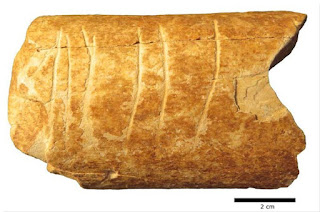 This object dats to 100,000 years ago in contemporary Israel
 Neanderthals made this abstract marking at the rock of Gibraltar - around 40,000
years ago
Neanderthals made this abstract marking at the rock of Gibraltar - around 40,000
years ago
 This talley stick goes back 30,000 years ago We're pretty sure the last tally
stick, and others were numbers markings. The others may be, and push such
"theater-level" understandings of nubmers back far indeed! Here's a picture of
the famous cave paintings,
This talley stick goes back 30,000 years ago We're pretty sure the last tally
stick, and others were numbers markings. The others may be, and push such
"theater-level" understandings of nubmers back far indeed! Here's a picture of
the famous cave paintings,
 thought I'd show a picture of Göbekli Tepe,
 Göbekli Tepe is decorated with animals. They're round circles; but, I don't see
how you can consider them Astronomical. I just note that the cave paintings are
mostly animals and so is Göbekli Tepe. Mankind, in my opinion, has still not
become conscious Astronomical things. I'd like to note what Jacob Bronowski says
about the cave paintings. Jacob said at the end of the first episode of his
Ascent of Man, about the cave paintings, "Man said I have power, but what
power?" He's saying the people that made the cave paintings were trying to
excercise a kind of magic. This idea of magic reminds me of how hunter gatherors
would wear the skull of the animal they killed, and even the hide. They felt
powerful in doing so. The cave painters probably felt much the same way by
drawing the animals they lived by. I've noted Sir James Frazer's "The Golden
Bough" before. In it he shows a lot about magic. He shows a lot of folk tale
examples of magic. Magic is like what you see in the movies, with the guy who
wants to inflict pain on his enemies. so, he makes a doll that looks like his
enemy and sticks needles in it. There's examples in the Old Testament that prove
it. Numbers 21:9 - "So Moses made a bronze snake and put it up on a pole. Then
when anyone was bitten by a snake and looked at the bronze snake, they lived."
2Kings20:1-11 - "Prepare a poultice of fig, they applied it to the boil, and he
recovered." - Then Hezekiah asks what the Lords sign will be, and his prophet
replies "Shall the shadow go forward ten steps, or shall it go back ten steps?”
10 “It is a simple matter for the shadow to go forward ten steps,” said
Hezekiah. “Rather, have it go back ten steps.” 11 Then the prophet Isaiah called
on the Lord, and the Lord made the shadow go back the ten steps it had gone down
on the stairway of Ahaz." Making nature go backwards is also found in Joshua
10:13 - And the sun stood still, and the moon stayed, until the people had
avenged themselves upon their enemies. Is not this written in the book of
Jasher? So the sun stood still in the midst of heaven, and hasted not to go down
about a whole day. This passage gives scriptural authority to a book not even in
the Old Testament - Jasher. In Jasher 9:8 says Abraham's father worshipped 12
gods/figurines, which were a personification of the twelve Zodiacal
constellations. A theme will see over and over again in this Gospel of Truth.
But, there's another theme that can be found in 2Kings20:1-11 - "I will add
fifteen years to your life." This adding to your life, and really time you get
to rule is a theme in Sir James Frazer's "The Golden Bough." You get to be "King
for a day" for a period, and then they kill you and put someone else in as a
"King for the day." We'll see below that Robert Grave's "the Greek Myths" proves
Sir James Frazer's "The Golden Bough" in spades, and proves a lot of
astronomical basis to at least Greek myths. We'll see that rulers extended their
time to be "King for the day." But, I want to say something more about magic. As
Jacob Bronowski said, "man says he has power, but what power?" What I find in
Sir James Frazer's Golden Bough is that much of magic is evasive logic. I found
this one passage, in of all places "The Ancient Engineers" by L. Sprague de
Camp, "People swarm everywhere, talking of incomprehensible matters, in hovels,
streets and square, marketplaces, and crossroads. When I ask how many oboloi I
have to pay, they answer with hairsplitting arguments about the born and the
unborn. If I inquire the price of bread, I am told that the father is greater
than the son. I call a servant to tell me whether my bath is ready; he rejoins
that the son was created out of nothing." The difference between magic and
mathematics is one is constructive, the other evasive. One of the major ways of
getting rid of evil and disease by "magic" is by putting someone's soul, or the
disease on a boat, or a container, and throwing it in the sea or river - hoping
it will go far away, or sink to the bottom of the sea where nobody can get to
it. Getting back to Göbekli Tepe not being that Astronomical, and really, the
fact that by the time of the Greeks, the mythology was Astronomical, the Old
Testament starts with the creation of the Universe by God. But, before we get to
Genesis, there's how the God(s) concept evolve out of magic. Hippocrates of
Kos(of Hippocratic Oath fame) wrote "The Sacred Disease." "They who first
referred this malady to the gods appear to me to have been just such persons as
the conjurors, purificators, mountebanks, and charlatans" - "Men regard its
nature and cause as divine from ignorance and wonder," . . . But if it is
reckoned divine because it is wonderful, instead of one there are many diseases
which would be sacred" - "Such persons, then, using the divinity as a pretext
and screen of their own inability to of their own inability to afford any
assistance, have given out that the disease is sacred, adding suitable reasons
for this opinion, they have instituted a mode of treatment which is safe for
themselves, namely, by applying purifications and incantations, . . . "All these
they enjoin with reference to its divinity, as if possessed of more knowledge,
and announcing beforehand other causes so that if the person should recover,
theirs would be the honor and credit; and if he should die, they would have a
certain defense, as if the gods, and not they, were to blame," These quotes
prove so much. He proves that anything they don't know is attributed to the
god(s). He shows that if the person gets well, they say they were right, and if
the person dies, they just say "god works in mysterious ways." And, he states
the conjurors, the purificators, hence the magicians attributed the malady to
the gods. We'll get back to god(s) and magic after we show the Genesis creation
story. Consciousness of Astronomical things can be seen in the Genesis chapters
of the Bible. The first thing to consider is that it is flat-Earth. I've already
pointed out a Biblical passage proving they thought the Earth is flat-Earth. A
major highlight of the Genesis creation of the Universe account is Gen 2:2 -
"And on the seventh day God ended his work which he had made; and he rested on
the seventh day from all his work which he had made." God is suppose to be
infinit, and here God needed to rest. Infinity doesn't need to rest. Besides not
understanding the mathematics of infinity, they don't seem to be conscious of
what contradiction is. In Genesis 1, animals come before man. In Gen 1:11 and
1:25, animals are introduced first. Then, man and woman are created after in Gen
1:27. But, in Genesis 2, man comes before animals and woman. Gen 2:7 introduces
Man. Then, plants are formed later in Gen 2:8-9. Animals are made in Gen 2:19.
Woman are made from the rib of a man after plants and animals are introduced in
Gen 2:22 More creation story contradictions are that God creates living
creatures out of waters or ground respectively. In Gen 1:20, god makes living
creatures out of the water. In Gen 2:19, God creates living creatures out of the
ground. But, what really proves these contradictions is the literal translation
of God and Lord. The literal translation of God in Hebrew is Elohim - a
Canaanite God. Lord in Hebrew is Adonai - a Phoenician God. The Hebrews combined
the two to make their one god. Gen 1:26 actually equates many gods with their
one god - "And God said, Let us make man in our image, after our likeness:" God
is singuler, and he says in "our" image, which is plural. The fact that they say
"In our image" also proves that this God is made up by the Bible writers
themselves. A Xenophanes quote proves that people make up their god(s) in their
own image . . . ""But if cattle and horses and lions had hands or could paint
with their hands and create works such as men do, horses like horses and cattle
like cattle also would depict the gods' shapes and make their bodies of such a
sort as the form they themselves have. ... Ethiopians say that their gods are
snub–nosed [σιμούς] and black Thracians that they are pale and red-haired." Even
more explicit statements that the Bible's god is made up in in Psalms 115:2-4.
Psalms 115:2 - "Wherefore should the heathen say, Where is now their God?" - But
our God is in the heavens: . . . Their idols are silver and gold, the work of
men's hands." This says the Heathens invented their gods as silver and gold
statues, and the Hebrews invented their God and placed him in the Heavens, where
they hoped he'd be safe from being disproven. But my goal here is not just
debunking, but showing the relation between Mythology and Mathematics and the
growht of knowledge from before written history to Mathematical Science. See,
Elohim has a Goddess wife - Asherah. And, a couple of big things that generally
don't get talked about in Churches is that the Old Testament is 1) trying to get
rid of magic, and 2) Asherah(and other gods like Baal).
Göbekli Tepe is decorated with animals. They're round circles; but, I don't see
how you can consider them Astronomical. I just note that the cave paintings are
mostly animals and so is Göbekli Tepe. Mankind, in my opinion, has still not
become conscious Astronomical things. I'd like to note what Jacob Bronowski says
about the cave paintings. Jacob said at the end of the first episode of his
Ascent of Man, about the cave paintings, "Man said I have power, but what
power?" He's saying the people that made the cave paintings were trying to
excercise a kind of magic. This idea of magic reminds me of how hunter gatherors
would wear the skull of the animal they killed, and even the hide. They felt
powerful in doing so. The cave painters probably felt much the same way by
drawing the animals they lived by. I've noted Sir James Frazer's "The Golden
Bough" before. In it he shows a lot about magic. He shows a lot of folk tale
examples of magic. Magic is like what you see in the movies, with the guy who
wants to inflict pain on his enemies. so, he makes a doll that looks like his
enemy and sticks needles in it. There's examples in the Old Testament that prove
it. Numbers 21:9 - "So Moses made a bronze snake and put it up on a pole. Then
when anyone was bitten by a snake and looked at the bronze snake, they lived."
2Kings20:1-11 - "Prepare a poultice of fig, they applied it to the boil, and he
recovered." - Then Hezekiah asks what the Lords sign will be, and his prophet
replies "Shall the shadow go forward ten steps, or shall it go back ten steps?”
10 “It is a simple matter for the shadow to go forward ten steps,” said
Hezekiah. “Rather, have it go back ten steps.” 11 Then the prophet Isaiah called
on the Lord, and the Lord made the shadow go back the ten steps it had gone down
on the stairway of Ahaz." Making nature go backwards is also found in Joshua
10:13 - And the sun stood still, and the moon stayed, until the people had
avenged themselves upon their enemies. Is not this written in the book of
Jasher? So the sun stood still in the midst of heaven, and hasted not to go down
about a whole day. This passage gives scriptural authority to a book not even in
the Old Testament - Jasher. In Jasher 9:8 says Abraham's father worshipped 12
gods/figurines, which were a personification of the twelve Zodiacal
constellations. A theme will see over and over again in this Gospel of Truth.
But, there's another theme that can be found in 2Kings20:1-11 - "I will add
fifteen years to your life." This adding to your life, and really time you get
to rule is a theme in Sir James Frazer's "The Golden Bough." You get to be "King
for a day" for a period, and then they kill you and put someone else in as a
"King for the day." We'll see below that Robert Grave's "the Greek Myths" proves
Sir James Frazer's "The Golden Bough" in spades, and proves a lot of
astronomical basis to at least Greek myths. We'll see that rulers extended their
time to be "King for the day." But, I want to say something more about magic. As
Jacob Bronowski said, "man says he has power, but what power?" What I find in
Sir James Frazer's Golden Bough is that much of magic is evasive logic. I found
this one passage, in of all places "The Ancient Engineers" by L. Sprague de
Camp, "People swarm everywhere, talking of incomprehensible matters, in hovels,
streets and square, marketplaces, and crossroads. When I ask how many oboloi I
have to pay, they answer with hairsplitting arguments about the born and the
unborn. If I inquire the price of bread, I am told that the father is greater
than the son. I call a servant to tell me whether my bath is ready; he rejoins
that the son was created out of nothing." The difference between magic and
mathematics is one is constructive, the other evasive. One of the major ways of
getting rid of evil and disease by "magic" is by putting someone's soul, or the
disease on a boat, or a container, and throwing it in the sea or river - hoping
it will go far away, or sink to the bottom of the sea where nobody can get to
it. Getting back to Göbekli Tepe not being that Astronomical, and really, the
fact that by the time of the Greeks, the mythology was Astronomical, the Old
Testament starts with the creation of the Universe by God. But, before we get to
Genesis, there's how the God(s) concept evolve out of magic. Hippocrates of
Kos(of Hippocratic Oath fame) wrote "The Sacred Disease." "They who first
referred this malady to the gods appear to me to have been just such persons as
the conjurors, purificators, mountebanks, and charlatans" - "Men regard its
nature and cause as divine from ignorance and wonder," . . . But if it is
reckoned divine because it is wonderful, instead of one there are many diseases
which would be sacred" - "Such persons, then, using the divinity as a pretext
and screen of their own inability to of their own inability to afford any
assistance, have given out that the disease is sacred, adding suitable reasons
for this opinion, they have instituted a mode of treatment which is safe for
themselves, namely, by applying purifications and incantations, . . . "All these
they enjoin with reference to its divinity, as if possessed of more knowledge,
and announcing beforehand other causes so that if the person should recover,
theirs would be the honor and credit; and if he should die, they would have a
certain defense, as if the gods, and not they, were to blame," These quotes
prove so much. He proves that anything they don't know is attributed to the
god(s). He shows that if the person gets well, they say they were right, and if
the person dies, they just say "god works in mysterious ways." And, he states
the conjurors, the purificators, hence the magicians attributed the malady to
the gods. We'll get back to god(s) and magic after we show the Genesis creation
story. Consciousness of Astronomical things can be seen in the Genesis chapters
of the Bible. The first thing to consider is that it is flat-Earth. I've already
pointed out a Biblical passage proving they thought the Earth is flat-Earth. A
major highlight of the Genesis creation of the Universe account is Gen 2:2 -
"And on the seventh day God ended his work which he had made; and he rested on
the seventh day from all his work which he had made." God is suppose to be
infinit, and here God needed to rest. Infinity doesn't need to rest. Besides not
understanding the mathematics of infinity, they don't seem to be conscious of
what contradiction is. In Genesis 1, animals come before man. In Gen 1:11 and
1:25, animals are introduced first. Then, man and woman are created after in Gen
1:27. But, in Genesis 2, man comes before animals and woman. Gen 2:7 introduces
Man. Then, plants are formed later in Gen 2:8-9. Animals are made in Gen 2:19.
Woman are made from the rib of a man after plants and animals are introduced in
Gen 2:22 More creation story contradictions are that God creates living
creatures out of waters or ground respectively. In Gen 1:20, god makes living
creatures out of the water. In Gen 2:19, God creates living creatures out of the
ground. But, what really proves these contradictions is the literal translation
of God and Lord. The literal translation of God in Hebrew is Elohim - a
Canaanite God. Lord in Hebrew is Adonai - a Phoenician God. The Hebrews combined
the two to make their one god. Gen 1:26 actually equates many gods with their
one god - "And God said, Let us make man in our image, after our likeness:" God
is singuler, and he says in "our" image, which is plural. The fact that they say
"In our image" also proves that this God is made up by the Bible writers
themselves. A Xenophanes quote proves that people make up their god(s) in their
own image . . . ""But if cattle and horses and lions had hands or could paint
with their hands and create works such as men do, horses like horses and cattle
like cattle also would depict the gods' shapes and make their bodies of such a
sort as the form they themselves have. ... Ethiopians say that their gods are
snub–nosed [σιμούς] and black Thracians that they are pale and red-haired." Even
more explicit statements that the Bible's god is made up in in Psalms 115:2-4.
Psalms 115:2 - "Wherefore should the heathen say, Where is now their God?" - But
our God is in the heavens: . . . Their idols are silver and gold, the work of
men's hands." This says the Heathens invented their gods as silver and gold
statues, and the Hebrews invented their God and placed him in the Heavens, where
they hoped he'd be safe from being disproven. But my goal here is not just
debunking, but showing the relation between Mythology and Mathematics and the
growht of knowledge from before written history to Mathematical Science. See,
Elohim has a Goddess wife - Asherah. And, a couple of big things that generally
don't get talked about in Churches is that the Old Testament is 1) trying to get
rid of magic, and 2) Asherah(and other gods like Baal).
 This is possibly the earliest "Venus figurine." It's doubly special because
she's holding a tally stick. Archaeologists have found lots of Venus figuriens
all over the Mediterranean. They date anywhere from thirty thousand years to
4,500 B.C. As far as I know, the last Venus figurine was at the great Malta
ruins. And, we see the largest Venus figurine by far!
This is possibly the earliest "Venus figurine." It's doubly special because
she's holding a tally stick. Archaeologists have found lots of Venus figuriens
all over the Mediterranean. They date anywhere from thirty thousand years to
4,500 B.C. As far as I know, the last Venus figurine was at the great Malta
ruins. And, we see the largest Venus figurine by far!
 The Malta ruins also have amazing carved out underground chamber tombs! I leave
that for you to go check out. Before the male dominated iron age God religions,
there appears to have been 1 ) a period of magic and 2) female Earth goddesses.
We can see the transfer from Goddess religion to male dominated religion in iron
age Greek and Hebrew. The transition between Bronze age to Iron cultures was a
dark age. Out of this dark ages came the iron age Greeks and Hebrews. Before
then, Egypt was at the height of it's powers. This was the time that the
Pyramids were built, Karnak, with the rows of columns noted above, and Abu
Simbel. This was also the time of Minoan Createan culture, and the city of Troy.
The Hittites were the second greatest civilization next to Egypt. In this dark
age, there was a transition from many gods to one god - from female to male gods
- and of course from Bronze to Iron. Nobody knows exaclty what happened. But, I
can't help noting some Biblical highlights . . . The Old testament books of
Joshua and Judges are two different, contradictory versions of the same
transition period between the Bronze age and Iron age. In judges, which is
traditinally put after the book of Joshua, the Hebrews get their asses kicked.
In Joahua, the Hebrews kick everyone's asses. Note also - the book of Judges has
twelve Judges. Also there's twelve minor prophets books. Most of these prophet
books are very small. Some are a paragraph or two long; as if they just put in
filler to equal the magic number twelve. The number twelve is the number of
Zodiacal constellations. We'll see the number come up again and again throughout
history. The book of Joshua mentions Iron age chariots being a little bit of a
nuissance around Joshua 17:16-18. But, in Judges 1:19, we see that the Hebrew
God is not so powerful . . . " And the LORD was with Judah; and he drave out the
inhabitants of the mountain; but could not drive out the inhabitants of the
valley, because they had chariots of iron." Some other mentions of Iron and
Bronz in the Old Testament . . . Leviticus 26:19 And I will break the pride of
your power; and I will make your heaven as iron, and your earth as brass:
Deuteronomy 28:23 And thy heaven that is over thy head shall be brass, and the
earth that is under thee shall be iron. Iron was a technology that Bronze
couldn't match up against. There seems to be some mythological evidence that
people would keep the knowledge secret. 1Samuel13:19 - "Now there was no smith
found throughout the land of Israel; for the Philistines said, Lest the Hebrews
make them swords or spears." I found in Hephestus wiki that Hephaestus had an
epithet, "the lame one." in Norse mythology, it's "Wayland the Smith", who is
"Later, King Niðhad captured Wayland in his sleep in Nerike and ordered him
hamstrung and imprisoned on the island of Sævarstöð. There Wayland was forced to
forge items for the king." Getting back to some of the other changes from the
Bronze age to Iron age . . . As noted above, Archaeologists have found lots of
Venus figurines. There seems to be a prior Earth Goddess religions before the
Iron age male dominated religions. And, we saw in the Genesis creation stories
that God means Elohim, and noted briefly that Elohim has a Goddess wife Asherah.
One of the major things gonig on throughout the Old Testament is an effort to
wipe out the Asherahs. Asherah's are found from Deuteronomy through Judges and
the Kings books. The following cannot be an exhausting list; but, it shows a
good amount - Deut 7:5/12:3/16:21/ , Judges 3:7/6:25-6/6:28/6:30, 1Kings14:15/
1Kings14:23, 1Kings15:13, 1Kings16:21, 1Kings18:19. Asherah is also found in
2Kings23-13 - "And the high places that were before Jerusalem, which were on the
right hand of the mount of corruption, which Solomon the king of Israel had
builded for Ashtoreth the abomination of the Zidonians, and for Chemosh the
abomination of the Moabites, and for Milcom the abomination of the children of
Ammon," The Hebrews started out by combining other people's gods into one - as
shown by the above about Elohom and Asherah. But, Soon, they'd try to erase this
and act as if there's only one god. 2Kings23 also has 2Kings23:4 - "And the king
commanded Hilkiah the high priest, and the priests of the second order, and the
keepers of the door, to bring forth out of the temple of the LORD all the
vessels that were made for Baal, . . . and 2Kings23:5 - "And he put down the
idolatrous priests, whom the kings of Judah had ordained to burn incense in the
high places in the cities of Judah, and in the places round about Jerusalem;
them also that burned incense unto Baal, to the sun, and to the moon, and to the
planets, and to all the host of heaven." As the Ten Commandments says "don't
pattern your gods based on the sun, moon, and stars - Exodus 20:4. "I the LORD
thy God am a jealous God" - Exodus 20:5. But, this is all getting a bit ahead of
the story. More proof of the anti-Women in the bible though! The New Testament
reveals the true meaning of Eve in the Genesis story - "1Timothy 2:11-14, "A
woman should learn in quietness and full submission. I do not permit a woman to
teach or to assume authority over a man; she must be quiet . . . for Adam was
formed first, then Eve. And Adam was not the one deceived; it was the woman who
was deceived and became a sinner." "likewise ye wives, be in subjection to your
own husbands . . . even as Sarah obeyed Abraham, calling him lord" - 1Peter
3:1-6 In Judges 9:54, an Abimelech, asks fellow male soldiers to kill him, so
"that men say not of me, a woman slew him." The other transition from Bronze age
to Iron age is from magic to gods. This transition is also revealed in the Old
Testament. Sir James Frazer notes two types of magic - Homoeopathic and
Contageous magic. Contageous magic is where you take on an objects properties if
you come into contact with it. Homoeopathic magic is analogy magic. If you make
an idol in the form of something; then, whatever you do to it transfers,
magically to the other object. This is like what you see in Hollywood movies
where someone makes a doll of someone they don't like, and poke it with needles,
or burn it, and somehow that kills their hated rivals. One can see this in the
Genesis 31 story about Rachel stealing idols. Jacob is chasing Leban and Rachel.
Leban wants the images to control Jacob, but Rachel steals them - Gen 31:19 -
"and Rachel had stolen the images that were her father's." And in Gen 31:32,
Jacob says "With whomsoever thou findest thy gods, let him not live: before our
brethren discern thou what is thine with me, and take it to thee. For Jacob knew
not that Rachel had stolen them." Leban searches for the images but, "Now Rachel
had taken the images, and put them in the camel's furniture, and sat upon them"
- Gen 31:34 As the Hippocratic "Sacred Disease" shows how gods evolved out of
magic, and really, similarly to how they wanted to control who had the knowledge
of iron, lest someone uses it against them, the Old Testament is trying to get
rid of magic. Exodus 22:18 states, "Do not allow a sorceress to live" and Deut
18:10, "There shall not be found among you any one that maketh his son or his
daughter to pass through the fire, or that useth divination, or an observer of
times, or an enchanter, or a witch." 1Samuel9:9, "for he that is now called a
Prophet was beforetime called a Seer." Here the Bible writers inadvertantly ban
the prophets they depend on. 1Samuel28 has Saul first banning magicians. But,
when the Philistines come, he becomes very affraid, and goes to find a
witch/magician, because he can't talk to God through dreams. As Deuteronomy
chapter 13 most explicitly states, "And that prophet, or that dreamer of dreams,
shall be put to death; because he hath spoken to turn you away from the LORD
your God - Deuteronomy 13:5. Getting back to that fact that the literal
translation of God is Elohim, and Lord is Adonai . . . and that Mathematics and
Mythology share the common property of analogy . . . both Mathematics and
Mythology combine ideas. Mathematics shows how ideas transforms into one
another. Mythology combines ideas that don't make sense - kind of like in your
dreams. Suzanne K. Langer talks about how certain nouns makes sense with certain
verbs. Mathematics shows how ideas combine and transform into one another
logically. Mythology sticks bullhorns on a cadallac. For instance, there's the
famous Centaur,
The Malta ruins also have amazing carved out underground chamber tombs! I leave
that for you to go check out. Before the male dominated iron age God religions,
there appears to have been 1 ) a period of magic and 2) female Earth goddesses.
We can see the transfer from Goddess religion to male dominated religion in iron
age Greek and Hebrew. The transition between Bronze age to Iron cultures was a
dark age. Out of this dark ages came the iron age Greeks and Hebrews. Before
then, Egypt was at the height of it's powers. This was the time that the
Pyramids were built, Karnak, with the rows of columns noted above, and Abu
Simbel. This was also the time of Minoan Createan culture, and the city of Troy.
The Hittites were the second greatest civilization next to Egypt. In this dark
age, there was a transition from many gods to one god - from female to male gods
- and of course from Bronze to Iron. Nobody knows exaclty what happened. But, I
can't help noting some Biblical highlights . . . The Old testament books of
Joshua and Judges are two different, contradictory versions of the same
transition period between the Bronze age and Iron age. In judges, which is
traditinally put after the book of Joshua, the Hebrews get their asses kicked.
In Joahua, the Hebrews kick everyone's asses. Note also - the book of Judges has
twelve Judges. Also there's twelve minor prophets books. Most of these prophet
books are very small. Some are a paragraph or two long; as if they just put in
filler to equal the magic number twelve. The number twelve is the number of
Zodiacal constellations. We'll see the number come up again and again throughout
history. The book of Joshua mentions Iron age chariots being a little bit of a
nuissance around Joshua 17:16-18. But, in Judges 1:19, we see that the Hebrew
God is not so powerful . . . " And the LORD was with Judah; and he drave out the
inhabitants of the mountain; but could not drive out the inhabitants of the
valley, because they had chariots of iron." Some other mentions of Iron and
Bronz in the Old Testament . . . Leviticus 26:19 And I will break the pride of
your power; and I will make your heaven as iron, and your earth as brass:
Deuteronomy 28:23 And thy heaven that is over thy head shall be brass, and the
earth that is under thee shall be iron. Iron was a technology that Bronze
couldn't match up against. There seems to be some mythological evidence that
people would keep the knowledge secret. 1Samuel13:19 - "Now there was no smith
found throughout the land of Israel; for the Philistines said, Lest the Hebrews
make them swords or spears." I found in Hephestus wiki that Hephaestus had an
epithet, "the lame one." in Norse mythology, it's "Wayland the Smith", who is
"Later, King Niðhad captured Wayland in his sleep in Nerike and ordered him
hamstrung and imprisoned on the island of Sævarstöð. There Wayland was forced to
forge items for the king." Getting back to some of the other changes from the
Bronze age to Iron age . . . As noted above, Archaeologists have found lots of
Venus figurines. There seems to be a prior Earth Goddess religions before the
Iron age male dominated religions. And, we saw in the Genesis creation stories
that God means Elohim, and noted briefly that Elohim has a Goddess wife Asherah.
One of the major things gonig on throughout the Old Testament is an effort to
wipe out the Asherahs. Asherah's are found from Deuteronomy through Judges and
the Kings books. The following cannot be an exhausting list; but, it shows a
good amount - Deut 7:5/12:3/16:21/ , Judges 3:7/6:25-6/6:28/6:30, 1Kings14:15/
1Kings14:23, 1Kings15:13, 1Kings16:21, 1Kings18:19. Asherah is also found in
2Kings23-13 - "And the high places that were before Jerusalem, which were on the
right hand of the mount of corruption, which Solomon the king of Israel had
builded for Ashtoreth the abomination of the Zidonians, and for Chemosh the
abomination of the Moabites, and for Milcom the abomination of the children of
Ammon," The Hebrews started out by combining other people's gods into one - as
shown by the above about Elohom and Asherah. But, Soon, they'd try to erase this
and act as if there's only one god. 2Kings23 also has 2Kings23:4 - "And the king
commanded Hilkiah the high priest, and the priests of the second order, and the
keepers of the door, to bring forth out of the temple of the LORD all the
vessels that were made for Baal, . . . and 2Kings23:5 - "And he put down the
idolatrous priests, whom the kings of Judah had ordained to burn incense in the
high places in the cities of Judah, and in the places round about Jerusalem;
them also that burned incense unto Baal, to the sun, and to the moon, and to the
planets, and to all the host of heaven." As the Ten Commandments says "don't
pattern your gods based on the sun, moon, and stars - Exodus 20:4. "I the LORD
thy God am a jealous God" - Exodus 20:5. But, this is all getting a bit ahead of
the story. More proof of the anti-Women in the bible though! The New Testament
reveals the true meaning of Eve in the Genesis story - "1Timothy 2:11-14, "A
woman should learn in quietness and full submission. I do not permit a woman to
teach or to assume authority over a man; she must be quiet . . . for Adam was
formed first, then Eve. And Adam was not the one deceived; it was the woman who
was deceived and became a sinner." "likewise ye wives, be in subjection to your
own husbands . . . even as Sarah obeyed Abraham, calling him lord" - 1Peter
3:1-6 In Judges 9:54, an Abimelech, asks fellow male soldiers to kill him, so
"that men say not of me, a woman slew him." The other transition from Bronze age
to Iron age is from magic to gods. This transition is also revealed in the Old
Testament. Sir James Frazer notes two types of magic - Homoeopathic and
Contageous magic. Contageous magic is where you take on an objects properties if
you come into contact with it. Homoeopathic magic is analogy magic. If you make
an idol in the form of something; then, whatever you do to it transfers,
magically to the other object. This is like what you see in Hollywood movies
where someone makes a doll of someone they don't like, and poke it with needles,
or burn it, and somehow that kills their hated rivals. One can see this in the
Genesis 31 story about Rachel stealing idols. Jacob is chasing Leban and Rachel.
Leban wants the images to control Jacob, but Rachel steals them - Gen 31:19 -
"and Rachel had stolen the images that were her father's." And in Gen 31:32,
Jacob says "With whomsoever thou findest thy gods, let him not live: before our
brethren discern thou what is thine with me, and take it to thee. For Jacob knew
not that Rachel had stolen them." Leban searches for the images but, "Now Rachel
had taken the images, and put them in the camel's furniture, and sat upon them"
- Gen 31:34 As the Hippocratic "Sacred Disease" shows how gods evolved out of
magic, and really, similarly to how they wanted to control who had the knowledge
of iron, lest someone uses it against them, the Old Testament is trying to get
rid of magic. Exodus 22:18 states, "Do not allow a sorceress to live" and Deut
18:10, "There shall not be found among you any one that maketh his son or his
daughter to pass through the fire, or that useth divination, or an observer of
times, or an enchanter, or a witch." 1Samuel9:9, "for he that is now called a
Prophet was beforetime called a Seer." Here the Bible writers inadvertantly ban
the prophets they depend on. 1Samuel28 has Saul first banning magicians. But,
when the Philistines come, he becomes very affraid, and goes to find a
witch/magician, because he can't talk to God through dreams. As Deuteronomy
chapter 13 most explicitly states, "And that prophet, or that dreamer of dreams,
shall be put to death; because he hath spoken to turn you away from the LORD
your God - Deuteronomy 13:5. Getting back to that fact that the literal
translation of God is Elohim, and Lord is Adonai . . . and that Mathematics and
Mythology share the common property of analogy . . . both Mathematics and
Mythology combine ideas. Mathematics shows how ideas transforms into one
another. Mythology combines ideas that don't make sense - kind of like in your
dreams. Suzanne K. Langer talks about how certain nouns makes sense with certain
verbs. Mathematics shows how ideas combine and transform into one another
logically. Mythology sticks bullhorns on a cadallac. For instance, there's the
famous Centaur,

 Here's the Ram form of Ra. It's also a sunboat barge. Ra is traveling the
duat(the twelve hours of the underworld). He's flanked by Sia and Heka. Sia is
the god of writing. Heka is the god of magic! Twelve is a magic number. It gets
personified many times and is a major clue to a grwoing awareness of things
Astronomical and Mythologizing it. "I know the abysses" is thy name. I work for
you, O ye Khus-four million, six-hundred thousand, one thousand and two hundred
are they . . .[I am] over their affairs working for hours and days in setting
straight the shoulders of the "twelve Sah gods" and joining the hands of their
company . . . " - Papyrus of Nebseni, chapter/spell 64 of the "Book of the
Dead." - Getting back to combining ideas and gods into one another . . . Tribes
and Nations would resolve insurmountable conflicts back then by 1) marrying off
their daughters and 2) combining each others gods. Ruth 1:16, "thy people shall
be my people, and thy God my God:" More combining and renaming of prevous gods
can be seen at Hosea 2:16, "It will come about in that day," declares the LORD,
"That you will call Me Ishi And will no longer call Me Baali." Also, God argues
in Exodus 6:3 that Moses knew him previously as El Shaddai, "I appeared to
Abraham, to Isaac, and to Jacob as El-Shaddai--'God Almighty'--but I did not
reveal my name, Yahweh, to them." As Suzanne K. Langer notes in her
"Introduction to Symbolic Logic" there's concrete ideas and abstract ideas. As
Mathematicians combine ideas, they become ever more abstract. When Sir James
Frazer wrote his "Golden Bough" he found the folk tales and Pagan gods to be
vegetation gods. He heard of ideas of solar gods; but, he argued against it. I
argue that the vegetation cycles are a concrete manifestation of the solar year.
And, in time, the vegetation god to be sacrificed at the end of the year became
sungods. A generation after Sir James Frazer came Robert Graves, who wrote "The
Greek Myths." "The Greek Myths" sounds like an encylcopedia. But, reading it
proves almst as great as reading Sir James Frazer's "The Golden Bough." In "The
Greek Myths", Robert Graves proves Sir James Frazer's Golden bough, in almost
every chapter. He shows that Greek mythology proves Sir James Frazer's Golden
Bough, and the idea of sungods. Robert Graves finds many Greek tripple
Goddesses. The first one Greek Goddess I'll introduce is Aphrodites. Considered
the eldesst of the three fates. Pausanias 1.19.2 -"Concerning the district
called The Gardens, and the temple of Aphrodite, there is no story that is told
by them, nor yet about the Aphrodite which stands near the temple. Now the shape
of it is square, like that of the Hermae, and the inscription declares that the
Heavenly Aphrodite is the oldest of those called Fates." Aphrodite is
equivalent, or analogous to the Roman Venus, and the Mesopotamian Inanna. Inanna
is probably the most ancient Earth Goddess we have any written record after the
Venus figurines. At the end of "Descent to the Underworld", is stated “Now,
alas, my ……. You for half the year and your sister for half the year: when you
are demanded, on that day you will stay, when your sister is demanded, on that
day you will be released.” Thus holy Inanna gave Dumuzi as a substitute" Here we
have Sir James Frazer's "Golden Bough", "King for the Day." Or, here, "King for
half the year, and then yous sister will rule." We also have the seasons,
although at this time they only recognized two seasons. Today, we recognize four
seasons. We can see Mankind going from two seaons, to three, and then four
seaons in Mythology. Inanna cult seems to have been spread by Sargon of Akkad.
The Moses story of being put in a basket and set adrift is analoguos to the
Sargon of Akkad story. The Sargon of Akkad story also shows elements of Sir
James Frazer's "Golden Bough." Sargon of Akkad is put in a basket to escape his
father who wants to kill him. Why? Because his father wants to rule for a longer
time period. The Sargon of Akkad "Slaughter of the Innocents" story then says "
"I will rule for four years", and let my son rule after me." The Kings from
Sargon of Akkad time, and possibly earlier, would see extensions from just
ruling for a year And, they'd use Astronomical reasons to get an extension. One
can see many "Slaughter of the Innocents stories. Cronos has one. I quote from
the Cronos Wiki - ""Cronus learned from Gaia and Uranus that he was destined to
be overcome by his own sons, just as he had overthrown his father. As a result,
although he sired the gods Demeter, Hestia, Hera, Hades and Poseidon by Rhea, he
devoured them all as soon as they were born to prevent the prophecy." There's
also a Hercules "Slaughter of the Innocents" and of course the Gospel of
Matthew, chapter two. Here's a later Greek "Slaughter of the Innocents, which
proves they extended the time of rule from a year to three years. Melisseus -
"Melisseus was the eldest and leader of the nine Kuretes of Crete. They were
chthonic daimones of Mount Ida, who clashed their spears and shields to drown
out the wails of infant Zeus, whom they received from the Great Goddess, Rhea,
his mother. The infant-god was hidden from his cannibal father." Apollodorus
1.3.1 proves the three triple Goddesses corresponds to the three seasons -
""Zeus had daughters in threes, the muses, graces, and with By Themis, daughter
of Sky, he had daughters, "the Seasons", to wit, Peace, Order, and Justice." The
Greek Mythology alone has many analgous triple Goddesses. Below is a picture of
the three Horea,
Here's the Ram form of Ra. It's also a sunboat barge. Ra is traveling the
duat(the twelve hours of the underworld). He's flanked by Sia and Heka. Sia is
the god of writing. Heka is the god of magic! Twelve is a magic number. It gets
personified many times and is a major clue to a grwoing awareness of things
Astronomical and Mythologizing it. "I know the abysses" is thy name. I work for
you, O ye Khus-four million, six-hundred thousand, one thousand and two hundred
are they . . .[I am] over their affairs working for hours and days in setting
straight the shoulders of the "twelve Sah gods" and joining the hands of their
company . . . " - Papyrus of Nebseni, chapter/spell 64 of the "Book of the
Dead." - Getting back to combining ideas and gods into one another . . . Tribes
and Nations would resolve insurmountable conflicts back then by 1) marrying off
their daughters and 2) combining each others gods. Ruth 1:16, "thy people shall
be my people, and thy God my God:" More combining and renaming of prevous gods
can be seen at Hosea 2:16, "It will come about in that day," declares the LORD,
"That you will call Me Ishi And will no longer call Me Baali." Also, God argues
in Exodus 6:3 that Moses knew him previously as El Shaddai, "I appeared to
Abraham, to Isaac, and to Jacob as El-Shaddai--'God Almighty'--but I did not
reveal my name, Yahweh, to them." As Suzanne K. Langer notes in her
"Introduction to Symbolic Logic" there's concrete ideas and abstract ideas. As
Mathematicians combine ideas, they become ever more abstract. When Sir James
Frazer wrote his "Golden Bough" he found the folk tales and Pagan gods to be
vegetation gods. He heard of ideas of solar gods; but, he argued against it. I
argue that the vegetation cycles are a concrete manifestation of the solar year.
And, in time, the vegetation god to be sacrificed at the end of the year became
sungods. A generation after Sir James Frazer came Robert Graves, who wrote "The
Greek Myths." "The Greek Myths" sounds like an encylcopedia. But, reading it
proves almst as great as reading Sir James Frazer's "The Golden Bough." In "The
Greek Myths", Robert Graves proves Sir James Frazer's Golden bough, in almost
every chapter. He shows that Greek mythology proves Sir James Frazer's Golden
Bough, and the idea of sungods. Robert Graves finds many Greek tripple
Goddesses. The first one Greek Goddess I'll introduce is Aphrodites. Considered
the eldesst of the three fates. Pausanias 1.19.2 -"Concerning the district
called The Gardens, and the temple of Aphrodite, there is no story that is told
by them, nor yet about the Aphrodite which stands near the temple. Now the shape
of it is square, like that of the Hermae, and the inscription declares that the
Heavenly Aphrodite is the oldest of those called Fates." Aphrodite is
equivalent, or analogous to the Roman Venus, and the Mesopotamian Inanna. Inanna
is probably the most ancient Earth Goddess we have any written record after the
Venus figurines. At the end of "Descent to the Underworld", is stated “Now,
alas, my ……. You for half the year and your sister for half the year: when you
are demanded, on that day you will stay, when your sister is demanded, on that
day you will be released.” Thus holy Inanna gave Dumuzi as a substitute" Here we
have Sir James Frazer's "Golden Bough", "King for the Day." Or, here, "King for
half the year, and then yous sister will rule." We also have the seasons,
although at this time they only recognized two seasons. Today, we recognize four
seasons. We can see Mankind going from two seaons, to three, and then four
seaons in Mythology. Inanna cult seems to have been spread by Sargon of Akkad.
The Moses story of being put in a basket and set adrift is analoguos to the
Sargon of Akkad story. The Sargon of Akkad story also shows elements of Sir
James Frazer's "Golden Bough." Sargon of Akkad is put in a basket to escape his
father who wants to kill him. Why? Because his father wants to rule for a longer
time period. The Sargon of Akkad "Slaughter of the Innocents" story then says "
"I will rule for four years", and let my son rule after me." The Kings from
Sargon of Akkad time, and possibly earlier, would see extensions from just
ruling for a year And, they'd use Astronomical reasons to get an extension. One
can see many "Slaughter of the Innocents stories. Cronos has one. I quote from
the Cronos Wiki - ""Cronus learned from Gaia and Uranus that he was destined to
be overcome by his own sons, just as he had overthrown his father. As a result,
although he sired the gods Demeter, Hestia, Hera, Hades and Poseidon by Rhea, he
devoured them all as soon as they were born to prevent the prophecy." There's
also a Hercules "Slaughter of the Innocents" and of course the Gospel of
Matthew, chapter two. Here's a later Greek "Slaughter of the Innocents, which
proves they extended the time of rule from a year to three years. Melisseus -
"Melisseus was the eldest and leader of the nine Kuretes of Crete. They were
chthonic daimones of Mount Ida, who clashed their spears and shields to drown
out the wails of infant Zeus, whom they received from the Great Goddess, Rhea,
his mother. The infant-god was hidden from his cannibal father." Apollodorus
1.3.1 proves the three triple Goddesses corresponds to the three seasons -
""Zeus had daughters in threes, the muses, graces, and with By Themis, daughter
of Sky, he had daughters, "the Seasons", to wit, Peace, Order, and Justice." The
Greek Mythology alone has many analgous triple Goddesses. Below is a picture of
the three Horea,
 The three Horea are being led by the male God Dionysius. The three Horea have
many diffeent names - "Thallo, Auxo and Carpo", "Eunomia Dike, and Eirene.",
"Pherusa, Euporie, and Orthosie" Each set of triples has different properties
attached to them. These properties are like the Greek elments of
Earth/Wind/Fire/Water. How do all these elements transform into one another?
They are flat-Earth view of how the Universe works. And the properties each
triple Goddesses have are like Greek elements understanding of those properties.
Inanna had many contradictory properties, or epithets attached to her. Likewise
for all God(s). Jesus is the alpha and the omega, the lamb, the light of truth
and a whole bunch more. The Horea correspond to the hours - 9/12/24. There's a
four seasons Horae - "Eiar(spring), Theros(summer), Phthinoporon(Autumn),
Kheimon(winter)" There's a two season's Horae - Auxesia and Damia. The three
Horae were the half-sisters of the three Muses - Moira. The three Muses, or the
Moira are Zeus/Olympus gods. The Sirens are also a Greek triple goddesses, that
are pre-male God Zeus and Mount Olympus. The Sirens loose a singing contest to
the Muses - " On the market-place of Coroneia I found two remarkable things, . .
. A little lower down is a sanctuary of Hera with an ancient image, the work of
Pythodorus of Thebes; in her hand she carries Sirens. For the story goes that
the daughters of Achelous were persuaded by Hera to compete with the Muses in
singing. The Muses won, plucked out the Sirens' feathers (so they say) and made
crowns for themselves out of them." Pausanias [9.34.3] THe fact that the older
triple Goddesses of the Sirens are being replaced by the Zeus Muses is one
mythological reflection of a Earth Goddess past. As Herodotus says - i, 173
"they take their names not from their fathers but from their mothers," I'd like
to share some more of these residues of a Earth Goddess past in Greek mythology,
"Apollodorus, [2.4.1] "When Acrisius inquired of the oracle how he should get
male children, the god said that his daughter would give birth to a son who
would kill him." This King Acrisius is from the Danae story. Mother of Perseus.
The three Horea are being led by the male God Dionysius. The three Horea have
many diffeent names - "Thallo, Auxo and Carpo", "Eunomia Dike, and Eirene.",
"Pherusa, Euporie, and Orthosie" Each set of triples has different properties
attached to them. These properties are like the Greek elments of
Earth/Wind/Fire/Water. How do all these elements transform into one another?
They are flat-Earth view of how the Universe works. And the properties each
triple Goddesses have are like Greek elements understanding of those properties.
Inanna had many contradictory properties, or epithets attached to her. Likewise
for all God(s). Jesus is the alpha and the omega, the lamb, the light of truth
and a whole bunch more. The Horea correspond to the hours - 9/12/24. There's a
four seasons Horae - "Eiar(spring), Theros(summer), Phthinoporon(Autumn),
Kheimon(winter)" There's a two season's Horae - Auxesia and Damia. The three
Horae were the half-sisters of the three Muses - Moira. The three Muses, or the
Moira are Zeus/Olympus gods. The Sirens are also a Greek triple goddesses, that
are pre-male God Zeus and Mount Olympus. The Sirens loose a singing contest to
the Muses - " On the market-place of Coroneia I found two remarkable things, . .
. A little lower down is a sanctuary of Hera with an ancient image, the work of
Pythodorus of Thebes; in her hand she carries Sirens. For the story goes that
the daughters of Achelous were persuaded by Hera to compete with the Muses in
singing. The Muses won, plucked out the Sirens' feathers (so they say) and made
crowns for themselves out of them." Pausanias [9.34.3] THe fact that the older
triple Goddesses of the Sirens are being replaced by the Zeus Muses is one
mythological reflection of a Earth Goddess past. As Herodotus says - i, 173
"they take their names not from their fathers but from their mothers," I'd like
to share some more of these residues of a Earth Goddess past in Greek mythology,
"Apollodorus, [2.4.1] "When Acrisius inquired of the oracle how he should get
male children, the god said that his daughter would give birth to a son who
would kill him." This King Acrisius is from the Danae story. Mother of Perseus.
 Here's Danae showered with gold. King Acrisius shut her up in a Bronze room to
keep her so, so that no child of hers could replace him at some yearly festival.
But Zeus pregnated her with a shower of gold. Danae gave birth to Perseus.
Perseus went on to slay a Titan with Medussa's head. The Medussa is one of the
Gorgon Goddess triple. She was turned ugly. This signifies the Sacred Kings
changing the religion from female Earth goddesses to a male god. Then,
Bellerophon also rode Pegasus as did Perseus. Hence, Bellerophon is a redo of
Perseus, this time to kill the Chimera. The Chimera is a composite beast. The
Chimera has three parts - lion's head, a goat's body, and a serpent's tail. The
suggestion is the Chimera is a calendar beast. Or, at least Robert Graves does
in his "The Greek Myths." There's no explicit statement about this in Greek or
any other mythology. It's just a logical hunch. If true, the Chimera represents
the seasons just like the Greek triple Goddesses. Robert Graves suggests it
represents going from the three seasons era to the four seasons era.
Here's Danae showered with gold. King Acrisius shut her up in a Bronze room to
keep her so, so that no child of hers could replace him at some yearly festival.
But Zeus pregnated her with a shower of gold. Danae gave birth to Perseus.
Perseus went on to slay a Titan with Medussa's head. The Medussa is one of the
Gorgon Goddess triple. She was turned ugly. This signifies the Sacred Kings
changing the religion from female Earth goddesses to a male god. Then,
Bellerophon also rode Pegasus as did Perseus. Hence, Bellerophon is a redo of
Perseus, this time to kill the Chimera. The Chimera is a composite beast. The
Chimera has three parts - lion's head, a goat's body, and a serpent's tail. The
suggestion is the Chimera is a calendar beast. Or, at least Robert Graves does
in his "The Greek Myths." There's no explicit statement about this in Greek or
any other mythology. It's just a logical hunch. If true, the Chimera represents
the seasons just like the Greek triple Goddesses. Robert Graves suggests it
represents going from the three seasons era to the four seasons era.
 Picture of Bellerophon slaying the Chimera on a Greek Vase.
 At Morocco Volubilis, much later, around 300 B.C. there's a four seasons Bacchss
fresco Autonoe and Aristaeus had a son Actaeon, who was bred by Chiron to be a
hunter and then afterwards was devoured on Cithaeron by his own dogs.47 He
perished in that way, according to Acusilaus, because Zeus was angry at him for
wooing Semele; but according to the more general opinion, it was because he saw
Artemis bathing. And they say that the goddess at once transformed him into a
deer, and drove mad the fifty dogs in his pack, which devoured him unwittingly.
Actaeon being gone, the dogs sought their master howling lamentably, and in the
search they came to the cave of Chiron, who fashioned an image of Actaeon, which
soothed their grief." Apollodorus [3.4.4] Anchises is a mortal lover of
Aphrodite. Aphrodite gets pregnant. She warns him not to tell anyone, or Zeus
will strike you with a thunderbolt. He ends up telling someone and gets struck
by a thunderbolt. There's a "Judgement of Paris" which indicates,
mythologically, that the Trojan War was due to a transition from these Earth
Goddess triples to a male god religion. In Greece, that would be Zeus and the
Mount Olympus twelve. I've mentioned the Sirens as one of the pre-Zeus/Olympus
triples. Then there's the Gorgons. The main Zeus/Olympus God's Goddess triples
are Hera/Athena/Aphrodite. Hero by the way has been shown to have a slight
linguistic relation to Hero. Another residue of the transition from the female
Earth Goddesses to the male dominated Iron age. But, getting back to the
Judgement of Paris . . . There was a big Gods/Goddesses party, and Eris, Goddess
of discord wasn't invited. Se she made a contest for the three Goddesses
Hera/Athena/Aphrodite. But, Zeus intervened, and handed the contest over to
Hermes. He chose Aphrodite because she promised him Hellene(Hellen of Troy).
Which triggered the Trojan War. We've seen a little bit of the male Kings
finding Astronomical reasons to extend their rule before they are sacrificed and
a new "King for the Day" is put in his place. We see this and the transition
from female to male ran Olympic games . . . The Olympic games were originally
ran by girls to be priestesses for Hera, then the males later took over!
Pausanias v16-2 "Every fourth year there is woven for Hera a robe by the Sixteen
women, and the same also hold games called Heraea. The games consist of
foot-races for maidens. " . . . v16 - 4 " The games of the maidens too are
traced back to ancient times; " . . . v 16 - 6 "The cities from which they chose
the women were Elis," . . . then, when the male centered Greeks took over, the
males took part in the Olympic games - Pinder Pythian Odes ix - 40, " You ask me
from what race the girl comes, lord Apollo?" . . . " There she will bear a
child, whom famous Hermes [60] will take from beneath his own dear mother and
carry to the Seasons on their lovely thrones and to Gaia." . . . For right away
he stood the whole band of suitors at the end of a course, [115] and told them
to decide with a footrace which of the heroes, who came to be bridegrooms, would
take which bride." . . . Pausanias 5-6 "As for the Olympic games, the most
learned antiquaries of Elis say that Cronus was the first king of heaven, and
that in his honor a temple was built in Olympia by the men of that age, who were
named the Golden Race. When Zeus was born, Rhea entrusted the guardianship of
her son to the Dactyls of Ida, who are the same as those called Curetes" In the
much later Argonautica, we see a lament for a Goddess past . . . "Listen,
friends; as I lay in my grief, three goddesses girded with goat-skins from the
neck downwards round the back and waist, like maidens, stood over my head nigh
at hand; and they uncovered me, drawing my cloak away with light hand, and they
bade me rise up myself and go and rouse you, and pay to our mother a bounteous
recompense for all her travail when she bare us so long in her womb, when
Amphitrite shall have loosed Poseidon's swift-wheeled car. But I cannot fully
understand concerning this divine message. They said indeed that they were
heroines, Libya's warders and daughters; and all the toils that we endured
aforetime by land. So, we've seen that the transition from the Bronze age to
Iron age brougth a transition from many to one god; from female dominated gods
to a male god - from magic to religion. When they transition, they combine old
gods. I've shown some of this above. But, I'd like to point out some more, and
then some more evidence of sungods before describing the Iron age cultures that
came out of the dark ages, resulting from the Bronze age collapse. Well, I'd
like to point out some animal and human sacrifices in the Old Testament because
of the proofs of Sir James Frazer's Sacrificial Kings in Greek Mythology above.
Noah makes an animal sacrifice, and the Lord says - "And the LORD smelled a
sweet savour; and the LORD said in his heart, I will not again curse the ground
any more for man's sake; for the imagination of man's heart is evil from his
youth;" - Genesis 8:21 - "God" tells Adam and Eve to not eat of the tree of
knowledge. "He" then makes a flood to kill all his evil creations - Gen 6:6 "And
it repented the LORD that he had made man on the earth," God repents so many
times throughout the Old Testament, that God says "I am weary with repenting" in
Jeremiah 15:6. This passage shows that sacrifice is for making Mankind obedient
by making him imperfect. As Romans 11:32 most expicitly states - "For God has
consigned all to disobedience, that he may have mercy on all." There's also
Human sacrifice. Exodus 22:29 - "the firstborn of thy sons shalt thou give unto
me." - Numbers 31:25-54 has God telling Moses how to distribute the war bounty.
In Numbers 31:35 is "And thirty and two thousand persons in all, of women that
had not known man by lying with him." - Judges 11:29-40 has a Jephthah, who
sacrifices his virgin daughter because he accepts Gods commandment to sacrifice
whoever comes out to meet him first, after slaughtering some
canaanites(Ammonites). The only Bronze age culture to survive the Bronze age
collapse was the Egyptians. I've already shown some proof of the personification
of the twelve Zodiacal constellations in the Egyptian "Book of the Dead." I
thought I'd just mention one Egyptian mythology here. The Leiden Hymn to Amun, -
All Gods are three, Amun, Re, Ptah they have no equal. His name is hidden as
Amun, He is Re in the face, and his body is Ptah. In Mythology, 3=1. I'd like to
point out more combining of each others gods, and reexpressing previous gods
some more . . . Herodotus 2:42 - "For no gods are worshipped by all Egyptians in
common except Isis and Osiris, who they say is Dionysus" Diodorus 1:23 - For
they say that Orpheus, upon visiting Egypt and participating in the initiation
and mysteries of Dionysus . . . further, in 1:11 - "conceived that two gods were
both eternal and first, namely, the sun and the moon, whom they called
respectively Osiris and Isis . . . And the words of the poet . . . And of the
ancient Greek writers of mythology some give to Osiris the name Dionysus or,
with a slight change in form, Sirius. . . . Even more from Diodorus Some say
that Osiris is also represented with the cloak of fawn-skin about his
shoulders22 as imitating the sky spangled with the stars. As for Isis, when
translated the word means "ancient," the name having been given her because her
birth was from everlasting and ancient. And they put horns on her head both
because of the appearance which she has to the eye when the moon is
crescent-shaped, and because among the Egyptians a cow is held sacred to her.
Eusebius, preparatio evangelic 10.8 "Thus Orpheus, they say, brought away from
the Egyptians most of the mystic rites, . . . For the rite of Osiris is the same
as that of Dionysus" Diodorus, 1:15.3 - "Osiris, they add, also built a temple
to his parents, Zeus and Hera "Consequently, since Dionysus was reared in Nysa,
he received the name he bears from Zeus and Nysa." - Diodorus 4.2.4 The two
major cultures to come out of the Bronze age collapse are the Hebrews and the
Greeks. The Greeks, as we've seen above, were alread there, just in the from of
Minoans, Myceneans, and the city of Troy. But, the Classical Greeks of
Pythagoras and Plato, the Delian league and Athens came after the Hebrews went
through a lot and were exhiled. So, I'm going to start with them first.
Archaeologists discovered a Merneptah Stele around 1896. It says . . . "The
Canaan has been plundered into every sort of woe: Ashkelon has been overcome;
Gezer has been captured; Yano'am is made non-existent. Israel is laid waste and
his seed is not;" This suggests that Israel is one of four Canaanite groups. The
Judahites would distinguish themselves from the Canaanites. But, they also
distinguish themselves from the Northern Israel Kingdom. And yet, they always
dreamed of having a unified Israel/Judah "Monarchy." So, it's safe to ignore
what the Judahites say they are compared to the northern Israelites and
associated Canaanite regions. It's highly probably that the Judahites and
Israelites both emerged out of the Bronze Age Canaanite culture. We can already
see that when discussing the Old Testament and the Hebrews, we have to realize
the Old Testament is, for the most part, told from the perspective of the
Southern Judahites. Genesis 49:10 says "The sceptre shall not depart from Judah"
- not Israel, or the Unified Monarchy of David. It doesn't say the scepter shall
depart from Egypt, doens't knwo of the Greeks, the Chinese, or of the Africans.
It says southern Judah is the center of the Universe! The Old Testament is
clearly from a Judahite perspective. But Judah was not advanced enough in terms
of making literature till King Josiah around 640 to 610 B.C. Scholars are able
to find many instances of place names and people, and events that reflects a 600
B.C. reality. Abraham, for one says his father was a Chaldean in Genesis 11:28
"And Haran died before his father Terah in the land of his nativity, in Ur of
the Chaldees." The Chaldean Babylon was from 900 to 600 B.C. This proves that
Abraham is made up by the Judahite writers of 600 B.C. timeframe. In 2Kings22:8
- "And Hilkiah the high priest said unto Shaphan the scribe, I have found the
book of the law in the house of the LORD. And Hilkiah gave the book to Shaphan,
and he read it." - More like he wrote it and then came out and said "look what I
found in the back of my room!" The reason the southern Judahites are the ones to
write the history is because the northern Israelites were conquered and taken
away - never to be seen again. The Neo-Assyrian empire conquered and took the
northern Israelites in 720 B.C. - 2 Kings 24:14 – “He carried away all
Jerusalem, and all the princes, and all the might men of valor, ten thousand
captives, and all the craftsmen and the smiths; none remained, except the
poorest people of the land.” See, back then, states went to war to get slaves
and skilled workers to make their temples and do the farming and so forth.
Israel became prosperous around 800 to 720 B.C. and hence became a target.
Southern Judah was left alone becaue they had no skilled labor at that time.
2Kings14:9 has a northern Kingdom Israelite calling Judah a thistle "And Jehoash
the king of Israel sent to Amaziah king of Judah, saying, The thistle that was
in Lebanon sent to the cedar that was in Lebanon," A hundred years later, Judah
developed, and they tried to explain why God failed them. Instead of saying
there was no God, they said the northern Israelites sinned and went whoring
after Baal and other gods and such. They have four covenents in the Old
Testament - Abraham, Noah, Moses, and David, for each time someone conquered
them, or their God failed them in some way. In the Noah covenant, God makes a
flood to erase all his mistakes(already noted above). The Judahites are taking
from the Epic of Gilgamesh flood story. In the Epic of Gilgamesh, they question
the ethics of the flood. "But what shall answer the city, the populace, and the
elders?. A few pages later, "How could I say evil things in the assembly of the
gods. ordering a catastrophe to destroy my people!" The Babylonian version
argues that surely not everyone in the surrounding cultures are bad. There's
probably just a few bad people. But, the Old Testament version says all other
than Judahites are evil and causes a flood to wipe them all out. And really, the
Judahite makes the flood story to wipe out all non-believers. in the book of
Jasher, which I showed above, the book of Joshua gave scriptural authority, book
6:19 - "And Noah, with a loud voice, answered them from the ark, saying, Have
you not all rebelled against the Lord, and said that he does not exist? and
therefore the Lord brought upon you this evil, to destroy and cut you off from
the face of the earth." One of the major theological writings that reflects
these changes is Moses and the Exodus. The Exodus gets dated variously from 1500
to 1200 B.C. depending on what argument is disproved by Archaeology, or just
looking at the Old Testament. The Archaeological disproof is almost easy;
there's no Egyptian records of such an event ever taking place. Not just records
inside Egypt - but, the Egyptians had walls towards Sinai, called "the way of
Horus." There was one road in and out of Egypt from Sinai, and the Egyptians
blocked it. Inscriptions at Karnak says they had eleven fortresses with walls
connecting them. Here's one picture of these walls and fortresses . . .
At Morocco Volubilis, much later, around 300 B.C. there's a four seasons Bacchss
fresco Autonoe and Aristaeus had a son Actaeon, who was bred by Chiron to be a
hunter and then afterwards was devoured on Cithaeron by his own dogs.47 He
perished in that way, according to Acusilaus, because Zeus was angry at him for
wooing Semele; but according to the more general opinion, it was because he saw
Artemis bathing. And they say that the goddess at once transformed him into a
deer, and drove mad the fifty dogs in his pack, which devoured him unwittingly.
Actaeon being gone, the dogs sought their master howling lamentably, and in the
search they came to the cave of Chiron, who fashioned an image of Actaeon, which
soothed their grief." Apollodorus [3.4.4] Anchises is a mortal lover of
Aphrodite. Aphrodite gets pregnant. She warns him not to tell anyone, or Zeus
will strike you with a thunderbolt. He ends up telling someone and gets struck
by a thunderbolt. There's a "Judgement of Paris" which indicates,
mythologically, that the Trojan War was due to a transition from these Earth
Goddess triples to a male god religion. In Greece, that would be Zeus and the
Mount Olympus twelve. I've mentioned the Sirens as one of the pre-Zeus/Olympus
triples. Then there's the Gorgons. The main Zeus/Olympus God's Goddess triples
are Hera/Athena/Aphrodite. Hero by the way has been shown to have a slight
linguistic relation to Hero. Another residue of the transition from the female
Earth Goddesses to the male dominated Iron age. But, getting back to the
Judgement of Paris . . . There was a big Gods/Goddesses party, and Eris, Goddess
of discord wasn't invited. Se she made a contest for the three Goddesses
Hera/Athena/Aphrodite. But, Zeus intervened, and handed the contest over to
Hermes. He chose Aphrodite because she promised him Hellene(Hellen of Troy).
Which triggered the Trojan War. We've seen a little bit of the male Kings
finding Astronomical reasons to extend their rule before they are sacrificed and
a new "King for the Day" is put in his place. We see this and the transition
from female to male ran Olympic games . . . The Olympic games were originally
ran by girls to be priestesses for Hera, then the males later took over!
Pausanias v16-2 "Every fourth year there is woven for Hera a robe by the Sixteen
women, and the same also hold games called Heraea. The games consist of
foot-races for maidens. " . . . v16 - 4 " The games of the maidens too are
traced back to ancient times; " . . . v 16 - 6 "The cities from which they chose
the women were Elis," . . . then, when the male centered Greeks took over, the
males took part in the Olympic games - Pinder Pythian Odes ix - 40, " You ask me
from what race the girl comes, lord Apollo?" . . . " There she will bear a
child, whom famous Hermes [60] will take from beneath his own dear mother and
carry to the Seasons on their lovely thrones and to Gaia." . . . For right away
he stood the whole band of suitors at the end of a course, [115] and told them
to decide with a footrace which of the heroes, who came to be bridegrooms, would
take which bride." . . . Pausanias 5-6 "As for the Olympic games, the most
learned antiquaries of Elis say that Cronus was the first king of heaven, and
that in his honor a temple was built in Olympia by the men of that age, who were
named the Golden Race. When Zeus was born, Rhea entrusted the guardianship of
her son to the Dactyls of Ida, who are the same as those called Curetes" In the
much later Argonautica, we see a lament for a Goddess past . . . "Listen,
friends; as I lay in my grief, three goddesses girded with goat-skins from the
neck downwards round the back and waist, like maidens, stood over my head nigh
at hand; and they uncovered me, drawing my cloak away with light hand, and they
bade me rise up myself and go and rouse you, and pay to our mother a bounteous
recompense for all her travail when she bare us so long in her womb, when
Amphitrite shall have loosed Poseidon's swift-wheeled car. But I cannot fully
understand concerning this divine message. They said indeed that they were
heroines, Libya's warders and daughters; and all the toils that we endured
aforetime by land. So, we've seen that the transition from the Bronze age to
Iron age brougth a transition from many to one god; from female dominated gods
to a male god - from magic to religion. When they transition, they combine old
gods. I've shown some of this above. But, I'd like to point out some more, and
then some more evidence of sungods before describing the Iron age cultures that
came out of the dark ages, resulting from the Bronze age collapse. Well, I'd
like to point out some animal and human sacrifices in the Old Testament because
of the proofs of Sir James Frazer's Sacrificial Kings in Greek Mythology above.
Noah makes an animal sacrifice, and the Lord says - "And the LORD smelled a
sweet savour; and the LORD said in his heart, I will not again curse the ground
any more for man's sake; for the imagination of man's heart is evil from his
youth;" - Genesis 8:21 - "God" tells Adam and Eve to not eat of the tree of
knowledge. "He" then makes a flood to kill all his evil creations - Gen 6:6 "And
it repented the LORD that he had made man on the earth," God repents so many
times throughout the Old Testament, that God says "I am weary with repenting" in
Jeremiah 15:6. This passage shows that sacrifice is for making Mankind obedient
by making him imperfect. As Romans 11:32 most expicitly states - "For God has
consigned all to disobedience, that he may have mercy on all." There's also
Human sacrifice. Exodus 22:29 - "the firstborn of thy sons shalt thou give unto
me." - Numbers 31:25-54 has God telling Moses how to distribute the war bounty.
In Numbers 31:35 is "And thirty and two thousand persons in all, of women that
had not known man by lying with him." - Judges 11:29-40 has a Jephthah, who
sacrifices his virgin daughter because he accepts Gods commandment to sacrifice
whoever comes out to meet him first, after slaughtering some
canaanites(Ammonites). The only Bronze age culture to survive the Bronze age
collapse was the Egyptians. I've already shown some proof of the personification
of the twelve Zodiacal constellations in the Egyptian "Book of the Dead." I
thought I'd just mention one Egyptian mythology here. The Leiden Hymn to Amun, -
All Gods are three, Amun, Re, Ptah they have no equal. His name is hidden as
Amun, He is Re in the face, and his body is Ptah. In Mythology, 3=1. I'd like to
point out more combining of each others gods, and reexpressing previous gods
some more . . . Herodotus 2:42 - "For no gods are worshipped by all Egyptians in
common except Isis and Osiris, who they say is Dionysus" Diodorus 1:23 - For
they say that Orpheus, upon visiting Egypt and participating in the initiation
and mysteries of Dionysus . . . further, in 1:11 - "conceived that two gods were
both eternal and first, namely, the sun and the moon, whom they called
respectively Osiris and Isis . . . And the words of the poet . . . And of the
ancient Greek writers of mythology some give to Osiris the name Dionysus or,
with a slight change in form, Sirius. . . . Even more from Diodorus Some say
that Osiris is also represented with the cloak of fawn-skin about his
shoulders22 as imitating the sky spangled with the stars. As for Isis, when
translated the word means "ancient," the name having been given her because her
birth was from everlasting and ancient. And they put horns on her head both
because of the appearance which she has to the eye when the moon is
crescent-shaped, and because among the Egyptians a cow is held sacred to her.
Eusebius, preparatio evangelic 10.8 "Thus Orpheus, they say, brought away from
the Egyptians most of the mystic rites, . . . For the rite of Osiris is the same
as that of Dionysus" Diodorus, 1:15.3 - "Osiris, they add, also built a temple
to his parents, Zeus and Hera "Consequently, since Dionysus was reared in Nysa,
he received the name he bears from Zeus and Nysa." - Diodorus 4.2.4 The two
major cultures to come out of the Bronze age collapse are the Hebrews and the
Greeks. The Greeks, as we've seen above, were alread there, just in the from of
Minoans, Myceneans, and the city of Troy. But, the Classical Greeks of
Pythagoras and Plato, the Delian league and Athens came after the Hebrews went
through a lot and were exhiled. So, I'm going to start with them first.
Archaeologists discovered a Merneptah Stele around 1896. It says . . . "The
Canaan has been plundered into every sort of woe: Ashkelon has been overcome;
Gezer has been captured; Yano'am is made non-existent. Israel is laid waste and
his seed is not;" This suggests that Israel is one of four Canaanite groups. The
Judahites would distinguish themselves from the Canaanites. But, they also
distinguish themselves from the Northern Israel Kingdom. And yet, they always
dreamed of having a unified Israel/Judah "Monarchy." So, it's safe to ignore
what the Judahites say they are compared to the northern Israelites and
associated Canaanite regions. It's highly probably that the Judahites and
Israelites both emerged out of the Bronze Age Canaanite culture. We can already
see that when discussing the Old Testament and the Hebrews, we have to realize
the Old Testament is, for the most part, told from the perspective of the
Southern Judahites. Genesis 49:10 says "The sceptre shall not depart from Judah"
- not Israel, or the Unified Monarchy of David. It doesn't say the scepter shall
depart from Egypt, doens't knwo of the Greeks, the Chinese, or of the Africans.
It says southern Judah is the center of the Universe! The Old Testament is
clearly from a Judahite perspective. But Judah was not advanced enough in terms
of making literature till King Josiah around 640 to 610 B.C. Scholars are able
to find many instances of place names and people, and events that reflects a 600
B.C. reality. Abraham, for one says his father was a Chaldean in Genesis 11:28
"And Haran died before his father Terah in the land of his nativity, in Ur of
the Chaldees." The Chaldean Babylon was from 900 to 600 B.C. This proves that
Abraham is made up by the Judahite writers of 600 B.C. timeframe. In 2Kings22:8
- "And Hilkiah the high priest said unto Shaphan the scribe, I have found the
book of the law in the house of the LORD. And Hilkiah gave the book to Shaphan,
and he read it." - More like he wrote it and then came out and said "look what I
found in the back of my room!" The reason the southern Judahites are the ones to
write the history is because the northern Israelites were conquered and taken
away - never to be seen again. The Neo-Assyrian empire conquered and took the
northern Israelites in 720 B.C. - 2 Kings 24:14 – “He carried away all
Jerusalem, and all the princes, and all the might men of valor, ten thousand
captives, and all the craftsmen and the smiths; none remained, except the
poorest people of the land.” See, back then, states went to war to get slaves
and skilled workers to make their temples and do the farming and so forth.
Israel became prosperous around 800 to 720 B.C. and hence became a target.
Southern Judah was left alone becaue they had no skilled labor at that time.
2Kings14:9 has a northern Kingdom Israelite calling Judah a thistle "And Jehoash
the king of Israel sent to Amaziah king of Judah, saying, The thistle that was
in Lebanon sent to the cedar that was in Lebanon," A hundred years later, Judah
developed, and they tried to explain why God failed them. Instead of saying
there was no God, they said the northern Israelites sinned and went whoring
after Baal and other gods and such. They have four covenents in the Old
Testament - Abraham, Noah, Moses, and David, for each time someone conquered
them, or their God failed them in some way. In the Noah covenant, God makes a
flood to erase all his mistakes(already noted above). The Judahites are taking
from the Epic of Gilgamesh flood story. In the Epic of Gilgamesh, they question
the ethics of the flood. "But what shall answer the city, the populace, and the
elders?. A few pages later, "How could I say evil things in the assembly of the
gods. ordering a catastrophe to destroy my people!" The Babylonian version
argues that surely not everyone in the surrounding cultures are bad. There's
probably just a few bad people. But, the Old Testament version says all other
than Judahites are evil and causes a flood to wipe them all out. And really, the
Judahite makes the flood story to wipe out all non-believers. in the book of
Jasher, which I showed above, the book of Joshua gave scriptural authority, book
6:19 - "And Noah, with a loud voice, answered them from the ark, saying, Have
you not all rebelled against the Lord, and said that he does not exist? and
therefore the Lord brought upon you this evil, to destroy and cut you off from
the face of the earth." One of the major theological writings that reflects
these changes is Moses and the Exodus. The Exodus gets dated variously from 1500
to 1200 B.C. depending on what argument is disproved by Archaeology, or just
looking at the Old Testament. The Archaeological disproof is almost easy;
there's no Egyptian records of such an event ever taking place. Not just records
inside Egypt - but, the Egyptians had walls towards Sinai, called "the way of
Horus." There was one road in and out of Egypt from Sinai, and the Egyptians
blocked it. Inscriptions at Karnak says they had eleven fortresses with walls
connecting them. Here's one picture of these walls and fortresses . . .
 One can find historical and literary evidence to disprove both the Exodus and
Moses. Psalms 78 is an Exodus without Moses. Instead of Moses parting the seas,
God does. Psalms 78:13 "He divided the sea, and caused them to pass through; and
he made the waters to stand as an heap." . . . Psalms 78:16 "He brought streams
also out of the rock, and caused waters to run down like rivers." . . . Psalms
78:24 "And had rained down manna upon them to eat, and had given them of the
corn of heaven." . . . Psalms 78:44 "And had turned their rivers into blood; and
their floods, that they could not drink." . . . Psalms 78:51 "And smote all the
firstborn in Egypt;" There's an Exodus in Homer's Iliad - "Homer's Iliad shows a
Lycurgus do a Moses like exodus, "But and if thou art one of the immortals come
down from heaven, then will I not fight with the heavenly gods. [130] Nay, for
even the son of Dryas, mighty Lycurgus, lived not long, seeing that he strove
with heavenly gods—he that on a time drave down over the sacred mount of Nysa
the nursing mothers of mad Dionysus; and they all let fall to the ground their
wands, smitten with an ox-goad by man-slaying Lycurgus. [135] But Dionysus fled,
and plunged beneath the wave of the sea, and Thetis received him in her bosom,
filled with dread, for mighty terror gat hold of him at the man's threatenings.
Then against Lycurgus did the gods that live at ease wax wroth, and the son of
Cronos made him blind; [140] and he lived not for long, seeing that he was hated
of all the immortal gods." - Homer Iliad, 6:129-143 We've alreaday seen that the
Moses childhood story is analogous to Sargon of Akkad. We can further show that
Moses is one of many law-givers . . . "We must speak also of the lawgivers who
have arisen in Egypt and who instituted customs unusual and strange. After the
establishment of settled life in Egypt in early times, which took place,
according to the mythical account, in the period of the gods and heroes, the
first, they say, to persuade the multitudes to use written laws was Mneves,43 a
man not only great of soul but also in his life the most public-spirited of all
lawgivers whose names are recorded. According to the tradition he claimed that
Hermes had given the laws to him, with the assurance that they would be the
cause of great blessings, just as among the Greeks, they say, Minos did in Crete
and Lycurgus among the Lacedaemonians, the former saying that he received his
laws from Zeus and the latter his from Apollo. 2 Also among several other
peoples tradition says that this kind of a device was used and was the cause of
much good to such as p321 believed it. Thus it is recorded that among the Arians
Zathraustes44 claimed that the Good Spirit gave him his laws, among the people
known as the Getae who represent themselves to be immortal Zalmoxis45 asserted
the same of their common goddess Hestia, and among the Jews Moyses referred his
laws to the god who is invoked as Iao.46 They all did this either because they
believed that a conception which would help humanity was marvellous and wholly
divine, or because they held that the common crowd would be more likely to obey
the laws if their gaze were directed towards the majesty and power of those to
whom their laws were ascribed." - Diodorus Siculus - Antiquities of Egypt, 1:94
"For this is natural; and it is common to the Greeks and to the barbarians; for,
being members of states, they live under common mandates; for otherwise it would
be impossible for the mass of people in any country to do one and the same thing
in harmony with one another, which is precisely what life in a free state means,
or in any other way to live a common life. And the mandates are twofold; for
they come either from gods or from men; 762and the ancients, at least, held
those from the gods in greater honour and veneration; and on this account men
who consulted oracles were much in evidence at that time — men who ran to Dodona
"to hear the will of Zeus from the high-tressed oak,"101 thus using Zeus as
their counsellor, and also to Delphi, "seeking to learn whether the child which
had been exposed to die was no longer alive;"102 but the child himself "was on
his way to the home of Phoebus, wishing to discover his parents."103 And among
the Cretans Minos "reigned as king, who held converse with great Zeus every
ninth year,"104 every nine years, as Plato says, when he would go up to the cave
of Zeus and receive decrees from him and carry them to the people. And
Lycurgus,105 his emulator, did likewise; for oftentimes, as it appears, he would
go abroad to inquire of the Pythian priestess what ordinances it was proper for
him to report to the Lacedaemonians. p289 39 For these things, whatever truth
there may be in them, have at least been believed and sanctioned among men; and
for this reason the prophets too were held in so much honour that they were
deemed worthy to be kings, on the ground that they promulgated to us ordinances
and amendments from the gods, not only when they were alive, but also when they
were dead, as, for example, Teiresias, "to whom even in death Persephone granted
reason, that he alone should have understanding, whereas the others flit about
as shadows."106 Such, also, were Amphiaraüs, Trophonius, Orpheus, Musaeus, and
the god among the Getae, who in ancient times was Zamolxis,107 a Pythagoreian,
and in my time was Decaeneus,108 the diviner of Byrebistas; and, among the
Bosporeni, Achaecarus; and, among the Indians, the Gymnosophists; and, among the
Persians, the Magi and the necromancers, as also the dish-diviners and
water-diviners, as they are called; and, among the Assyrians, the Chaldaeans;
and, among the Romans, the Tyrrhenian nativity-casters.109 Moses was such a
person as these, as also his successors, who, with no bad beginning, turned out
for the worse." Stabo - Geography 16:38-40 Here we see that Moses like other
lawgivers are divine. They want the law to be from something divine to give it
authority. And, they want these divine laws to keep people in line. The idea of
hell is one form of this as shown here - Diodorus of Sicily(30 B.C.) says in
book 1.2.2. ”For if it be true that the myths which are related about Hades, in
spite of the fact that their subject-matter is fictitious, contribute greatly to
fostering piety and justice among men,” Moses is the lawgiver who gets the Ten
Commandments from God. Out of everything the almight can give, it's not Quantum
Gravity, the Mathematics of how life can come from non-life. He doesn't even
give the ethics of rational thought. It's common sense things like "don't kill",
don't rape, don't steal. But, before then, God says "Thou shalt have no other
gods before me." Exodus 20:3 . . . "Thou shalt not make unto thee any graven
image, or any likeness of any thing that is in heaven above, or that is in the
earth beneath, or that is in the water under the earth." Exodus 20:4 . . . Thou
shalt not bow down thyself to them, nor serve them: for I the LORD thy God am a
jealous God, visiting the iniquity of the fathers upon the children unto the
third and fourth generation of them that hate me; And shewing mercy unto
thousands of them that love me," Exodus 20:5-6 . . . Thou shalt not take the
name of the LORD thy God in vain;" Exodus 20:7 So, don't pattern your gods on
the sun, moon, and stars because He's a Jealous God. As Deuteronomy 4:19(Deut
chapter 4 is a commentary on the Ten Commandments) says "And lest thou lift up
thine eyes unto heaven, and when thou seest the sun, and the moon, and the
stars, even all the host of heaven, shouldest be driven to worship them, and
serve them, which the LORD thy God hath divided unto all nations under the whole
heaven." In other words, don't look up, don't wonder and think about the stars.
As Proverbs 3:5 says "Trust in the LORD with all thine heart; and lean not unto
thine own understanding." We've already seen plenty of evidence that Religion is
mind control. But, the Ten Commandments is more proof. What's more the Ten
Commandments even says "if you believe in me, I'll love you. If you don't, I'll
hate you." This is Communist love. What's more it says "Do not take my name in
vain." Hence, do not question me. This is the language of Communist truth. As
1Samuel-15:22 says - "behold, obedience is better than sacrifice." The books of
Job and Ecclesiastes give this Communist truth. They say give up on reason and
bow down to your Lord . . . Ecclesiastes- 1:14 - "I have seen all the things
that are done under the sun, and have found them all to be futile, a pursuit of
the wind. - 1:15 - "What is crooked cannot be straightened; what is lacking
cannot be counted." 3:11 - "yet so that he cannot find out what God has done
from the beginning to the end." 8:17 - "No one can comprehend what goes on under
the sun. Despite all their efforts to search it out, no one can discover its
meaning. Even if the wise claim they know, they cannot really comprehend it."
and the most famous Biblical statement which was echoed all through the European
dark ages, 1:9 - "there is nothing new under the sun." There's also proof that
the Hebrews though the Earth was flat in Ecclesiastes 1:5 - "The sun rises and
the sun sets, and hurries back to where it rises." The book of Job - Job
complains, "how can there be a god, when I was born into this harsh world, both
natural and wicked men", they say, but god moves the Universe; surely, you don't
want to stand in his way. . . . "May the day of my birth perish, 3:10 "May its
morning stars grow dark . . . for it did not shut the doors of the womb on me to
hide trouble from my eyes." 4:9 - "At the breath of God they perish; at the
blast of his anger they are no more." . . . 4:20 Between dawn and dusk they are
broken to pieces; unnoticed, they perish forever." 7:14 - "even then you
frighten me with dreams and terrify me with visions," 7:20 - "Why have you made
me your mark? Why have I become a burden to you?" 10:18 - ""Why then did you
bring me out of the womb? I wish I had died before any eye saw me. - Job 25:4 -
"How can he who is born of woman be pure?" 31:15 - " And did not one fashion us
in the womb?" 5:8 - " I would appeal to God; I would lay my cause before him. .
. . 5:9 - "He performs wonders that cannot be fathomed, miracles that cannot be
counted" 9:6 - "He shakes the earth from its place and makes its pillars
tremble. . . . 9:9 - "He is the Maker of the Bear and Orion, the Pleiades and
the constellations of the south." Job 12:24 - "He deprives the leaders of the
earth of their reason; he makes them wander in a trackless waste." Job 22:12 -
"Is not God in the heights of heaven? 27:8 - "For what is the hope of the
godless when God cuts him off, when God takes away his life?" 28:12 - "“But
where shall wisdom be found? And where is the place of understanding?" 31:4 -
"Does not he see my ways and number all my steps?" 38:31 - "“Can you bind the
chains of the Pleiades or loose the cords of Orion?" 38:32 - "Can you bring
forth the constellations in their seasons or lead out the Bear and her cubs?"
Despite Job being God's beating boy(and Humanity in general), Job is beaten so
bad, and figuring out Nature is too hard according to Ecclesiastes, that he(and
God believers in general) forgo reason and submit to their Lord. God hardens
hearts in Exodus 4:2-1, 7:4-5, Deut 2:30; in this one, God hardens some
tribeman's heart so that Moses has to strike him down. He does it again at
Joshua 11:20. - but, because God has beaten them up so bad, they ignore these
things and believe anyways! The Book of Job also has Job asking "who else can
control Orion and the Bear" at Job 38:31 and 9:9. The Pleiades are a real
grouping of stars; stars that came from the same gas cloud. Orion and the Bear
constellations on the other hand are an artificial grouping of stars - made by
Man. What is god doing controlling an artificial grouping of stars made by man?
Another passage of God controlling Orion is Amos 5:8 - Seek him that maketh the
seven stars and Orion, and turneth the shadow of death into the morning, and
maketh the day dark with night: that calleth for the waters of the sea, and
poureth them out upon the face of the earth: The LORD is his name" More
Astrotheology found in the Old Testament before getting to the Iron Age Greeks .
. . Genesis 1:14 says the Sun and Moon are for the Seasons "And God said, Let
there be lights in the firmament of the heaven to divide the day from the night;
and let them be for signs, and for seasons, and for days, and years:" Psalm
104:19 also states this - "He appointed the moon for seasons: the sun knoweth
his going down." Isaiah 47:13 explicitly mentions astrology - "Thou art wearied
in the multitude of thy counsels. Let now the astrologers, the stargazers, the
monthly prognosticators, stand up, and save thee from these things that shall
come upon thee." Josephus shows that the twelve tribes of Israel are just a
personification of the twelve Zodiacal constellations. "Antiquities of the Jews"
book 3 chapter 7 section 7. -Rueben = aquarius because of "the beginning of my
strength . . . unstable as water." -Simen and Levi = Gemini because of the twins
of Gemini -Judah = Leo beause of the "lions welp" -Zebulun = libra because of
"who shall be far an haven of ships; or the ship sign, ark" -Issachar = Taurus
because of "strong ass, workhorse" -Dan = Scorpio because it is between
sagitarrious and capricornious -Gad = Pisces because Gad is the reversal of dag,
a fish god -Asher = Virgo because of "rich food or fat bread" -Naphtali =
Capricornus because he's a "hind let loose, the goat -Joseph = Safittarious
because he was fiercely attacked by archers -Benjamoin = Aries becuase "the
ravenous wolf who divides the spoils" Twelve shows up again in 1Kings 7:25 -
"The Sea stood on twelve bulls, three facing north, three facing west, three
facing south and three facing east." This not only shows more personification of
the twelve Zodiacal constellations, but is another instance of flat Earth - "The
Sea stood on twelve bulls." And 1 Kings 4:7 - "Solomon had twelve district
governors over all Israel, who supplied provisions for the king and the royal
household. Each one had to provide supplies for one month in the year." Right
before 1Kings 7:25 is the mentioning of Pi in the Bible - "And he made a molten
sea, ten cubits from the one brim to the other: it was round all about, and his
height was five cubits: and a line of thirty cubits did compass it round about."
- IKings23 This is one of the only instance of Mathematics mentioned in the
Bible, other than just saying the word number. In Job 36:26, God is equated with
infinity, "Behold, God is great, and we know him not, neither can the number of
his years be searched out." Well, God is suppose to be beyond finite numbers.
Like in Psalms 115, God is being placed somewhere where he cannot be detected -
in heaven or off to infinity. They do not want their god questioned. Every
culture has a spectrum of people from left to right. I would call the left those
who question ideas, and the right as those who don't. What happened with the
Hebrews, is the Northern Israelite left were conquered and taken away into
slavery, leaving the Southern Judahite right. This did not happen with the
Greeks. It almost happened In fact, the battles the Greeks had with huge empires
trying to stamp out the left are amongst the most famous in Human history -
There was the battle of Marathon, where a Greek ran a Marathon to warn and try
to get other Greek city-states to join in the fight; only, when these other
city-states arrived, they found the other Greeks had miraculously survived and
held off the Persians. Then, there's the battle of Thermopylae, where like 300
Spartans held off a massive Persian force. Interestingly here is the right-wing
Spartans were convinced to help the left-wing Athenians, at least for this
battle. The Greeks also built trireme boats, and stopped another Persian force
at sea. Xerxes I was the son of Cyrus the Great, who let the Judahites go after
they were originally exhiled. Cyrus the Great is mentioned as seeing eye to eye
with the Hebrew god in 2Chronicles 36:23 - "Thus saith Cyrus, king of Persia:
All the kingdoms of the earth hath the LORD, the God of heaven given me; and He
hath charged me to build Him a house in Jerusalem, which is in Judah. Whosoever
there is among you of all His people – the LORD, his God, be with him – let him
go there" Just like in the books of Kings, if the Judahite King, or northern
Israelite allows Asherah and other gods to enter, they must be bad; but, if they
destroy them, then they must be good. Greek Mathematics really started before
the Athens Delian league and these great wars. But, I have to wonder if the
Greeks, like Thales and Pythagoras, who went traveling around Mesoppotamia and
Egypt, collecting all the knowledge, both Mathematics and Mythology, didn't sit
well with the Persians. One thing is for certain; the Greeks were growing in
power due to their growing technology. One of the greatest examples of this
growing technological ability is the Tunnel of Samos,
One can find historical and literary evidence to disprove both the Exodus and
Moses. Psalms 78 is an Exodus without Moses. Instead of Moses parting the seas,
God does. Psalms 78:13 "He divided the sea, and caused them to pass through; and
he made the waters to stand as an heap." . . . Psalms 78:16 "He brought streams
also out of the rock, and caused waters to run down like rivers." . . . Psalms
78:24 "And had rained down manna upon them to eat, and had given them of the
corn of heaven." . . . Psalms 78:44 "And had turned their rivers into blood; and
their floods, that they could not drink." . . . Psalms 78:51 "And smote all the
firstborn in Egypt;" There's an Exodus in Homer's Iliad - "Homer's Iliad shows a
Lycurgus do a Moses like exodus, "But and if thou art one of the immortals come
down from heaven, then will I not fight with the heavenly gods. [130] Nay, for
even the son of Dryas, mighty Lycurgus, lived not long, seeing that he strove
with heavenly gods—he that on a time drave down over the sacred mount of Nysa
the nursing mothers of mad Dionysus; and they all let fall to the ground their
wands, smitten with an ox-goad by man-slaying Lycurgus. [135] But Dionysus fled,
and plunged beneath the wave of the sea, and Thetis received him in her bosom,
filled with dread, for mighty terror gat hold of him at the man's threatenings.
Then against Lycurgus did the gods that live at ease wax wroth, and the son of
Cronos made him blind; [140] and he lived not for long, seeing that he was hated
of all the immortal gods." - Homer Iliad, 6:129-143 We've alreaday seen that the
Moses childhood story is analogous to Sargon of Akkad. We can further show that
Moses is one of many law-givers . . . "We must speak also of the lawgivers who
have arisen in Egypt and who instituted customs unusual and strange. After the
establishment of settled life in Egypt in early times, which took place,
according to the mythical account, in the period of the gods and heroes, the
first, they say, to persuade the multitudes to use written laws was Mneves,43 a
man not only great of soul but also in his life the most public-spirited of all
lawgivers whose names are recorded. According to the tradition he claimed that
Hermes had given the laws to him, with the assurance that they would be the
cause of great blessings, just as among the Greeks, they say, Minos did in Crete
and Lycurgus among the Lacedaemonians, the former saying that he received his
laws from Zeus and the latter his from Apollo. 2 Also among several other
peoples tradition says that this kind of a device was used and was the cause of
much good to such as p321 believed it. Thus it is recorded that among the Arians
Zathraustes44 claimed that the Good Spirit gave him his laws, among the people
known as the Getae who represent themselves to be immortal Zalmoxis45 asserted
the same of their common goddess Hestia, and among the Jews Moyses referred his
laws to the god who is invoked as Iao.46 They all did this either because they
believed that a conception which would help humanity was marvellous and wholly
divine, or because they held that the common crowd would be more likely to obey
the laws if their gaze were directed towards the majesty and power of those to
whom their laws were ascribed." - Diodorus Siculus - Antiquities of Egypt, 1:94
"For this is natural; and it is common to the Greeks and to the barbarians; for,
being members of states, they live under common mandates; for otherwise it would
be impossible for the mass of people in any country to do one and the same thing
in harmony with one another, which is precisely what life in a free state means,
or in any other way to live a common life. And the mandates are twofold; for
they come either from gods or from men; 762and the ancients, at least, held
those from the gods in greater honour and veneration; and on this account men
who consulted oracles were much in evidence at that time — men who ran to Dodona
"to hear the will of Zeus from the high-tressed oak,"101 thus using Zeus as
their counsellor, and also to Delphi, "seeking to learn whether the child which
had been exposed to die was no longer alive;"102 but the child himself "was on
his way to the home of Phoebus, wishing to discover his parents."103 And among
the Cretans Minos "reigned as king, who held converse with great Zeus every
ninth year,"104 every nine years, as Plato says, when he would go up to the cave
of Zeus and receive decrees from him and carry them to the people. And
Lycurgus,105 his emulator, did likewise; for oftentimes, as it appears, he would
go abroad to inquire of the Pythian priestess what ordinances it was proper for
him to report to the Lacedaemonians. p289 39 For these things, whatever truth
there may be in them, have at least been believed and sanctioned among men; and
for this reason the prophets too were held in so much honour that they were
deemed worthy to be kings, on the ground that they promulgated to us ordinances
and amendments from the gods, not only when they were alive, but also when they
were dead, as, for example, Teiresias, "to whom even in death Persephone granted
reason, that he alone should have understanding, whereas the others flit about
as shadows."106 Such, also, were Amphiaraüs, Trophonius, Orpheus, Musaeus, and
the god among the Getae, who in ancient times was Zamolxis,107 a Pythagoreian,
and in my time was Decaeneus,108 the diviner of Byrebistas; and, among the
Bosporeni, Achaecarus; and, among the Indians, the Gymnosophists; and, among the
Persians, the Magi and the necromancers, as also the dish-diviners and
water-diviners, as they are called; and, among the Assyrians, the Chaldaeans;
and, among the Romans, the Tyrrhenian nativity-casters.109 Moses was such a
person as these, as also his successors, who, with no bad beginning, turned out
for the worse." Stabo - Geography 16:38-40 Here we see that Moses like other
lawgivers are divine. They want the law to be from something divine to give it
authority. And, they want these divine laws to keep people in line. The idea of
hell is one form of this as shown here - Diodorus of Sicily(30 B.C.) says in
book 1.2.2. ”For if it be true that the myths which are related about Hades, in
spite of the fact that their subject-matter is fictitious, contribute greatly to
fostering piety and justice among men,” Moses is the lawgiver who gets the Ten
Commandments from God. Out of everything the almight can give, it's not Quantum
Gravity, the Mathematics of how life can come from non-life. He doesn't even
give the ethics of rational thought. It's common sense things like "don't kill",
don't rape, don't steal. But, before then, God says "Thou shalt have no other
gods before me." Exodus 20:3 . . . "Thou shalt not make unto thee any graven
image, or any likeness of any thing that is in heaven above, or that is in the
earth beneath, or that is in the water under the earth." Exodus 20:4 . . . Thou
shalt not bow down thyself to them, nor serve them: for I the LORD thy God am a
jealous God, visiting the iniquity of the fathers upon the children unto the
third and fourth generation of them that hate me; And shewing mercy unto
thousands of them that love me," Exodus 20:5-6 . . . Thou shalt not take the
name of the LORD thy God in vain;" Exodus 20:7 So, don't pattern your gods on
the sun, moon, and stars because He's a Jealous God. As Deuteronomy 4:19(Deut
chapter 4 is a commentary on the Ten Commandments) says "And lest thou lift up
thine eyes unto heaven, and when thou seest the sun, and the moon, and the
stars, even all the host of heaven, shouldest be driven to worship them, and
serve them, which the LORD thy God hath divided unto all nations under the whole
heaven." In other words, don't look up, don't wonder and think about the stars.
As Proverbs 3:5 says "Trust in the LORD with all thine heart; and lean not unto
thine own understanding." We've already seen plenty of evidence that Religion is
mind control. But, the Ten Commandments is more proof. What's more the Ten
Commandments even says "if you believe in me, I'll love you. If you don't, I'll
hate you." This is Communist love. What's more it says "Do not take my name in
vain." Hence, do not question me. This is the language of Communist truth. As
1Samuel-15:22 says - "behold, obedience is better than sacrifice." The books of
Job and Ecclesiastes give this Communist truth. They say give up on reason and
bow down to your Lord . . . Ecclesiastes- 1:14 - "I have seen all the things
that are done under the sun, and have found them all to be futile, a pursuit of
the wind. - 1:15 - "What is crooked cannot be straightened; what is lacking
cannot be counted." 3:11 - "yet so that he cannot find out what God has done
from the beginning to the end." 8:17 - "No one can comprehend what goes on under
the sun. Despite all their efforts to search it out, no one can discover its
meaning. Even if the wise claim they know, they cannot really comprehend it."
and the most famous Biblical statement which was echoed all through the European
dark ages, 1:9 - "there is nothing new under the sun." There's also proof that
the Hebrews though the Earth was flat in Ecclesiastes 1:5 - "The sun rises and
the sun sets, and hurries back to where it rises." The book of Job - Job
complains, "how can there be a god, when I was born into this harsh world, both
natural and wicked men", they say, but god moves the Universe; surely, you don't
want to stand in his way. . . . "May the day of my birth perish, 3:10 "May its
morning stars grow dark . . . for it did not shut the doors of the womb on me to
hide trouble from my eyes." 4:9 - "At the breath of God they perish; at the
blast of his anger they are no more." . . . 4:20 Between dawn and dusk they are
broken to pieces; unnoticed, they perish forever." 7:14 - "even then you
frighten me with dreams and terrify me with visions," 7:20 - "Why have you made
me your mark? Why have I become a burden to you?" 10:18 - ""Why then did you
bring me out of the womb? I wish I had died before any eye saw me. - Job 25:4 -
"How can he who is born of woman be pure?" 31:15 - " And did not one fashion us
in the womb?" 5:8 - " I would appeal to God; I would lay my cause before him. .
. . 5:9 - "He performs wonders that cannot be fathomed, miracles that cannot be
counted" 9:6 - "He shakes the earth from its place and makes its pillars
tremble. . . . 9:9 - "He is the Maker of the Bear and Orion, the Pleiades and
the constellations of the south." Job 12:24 - "He deprives the leaders of the
earth of their reason; he makes them wander in a trackless waste." Job 22:12 -
"Is not God in the heights of heaven? 27:8 - "For what is the hope of the
godless when God cuts him off, when God takes away his life?" 28:12 - "“But
where shall wisdom be found? And where is the place of understanding?" 31:4 -
"Does not he see my ways and number all my steps?" 38:31 - "“Can you bind the
chains of the Pleiades or loose the cords of Orion?" 38:32 - "Can you bring
forth the constellations in their seasons or lead out the Bear and her cubs?"
Despite Job being God's beating boy(and Humanity in general), Job is beaten so
bad, and figuring out Nature is too hard according to Ecclesiastes, that he(and
God believers in general) forgo reason and submit to their Lord. God hardens
hearts in Exodus 4:2-1, 7:4-5, Deut 2:30; in this one, God hardens some
tribeman's heart so that Moses has to strike him down. He does it again at
Joshua 11:20. - but, because God has beaten them up so bad, they ignore these
things and believe anyways! The Book of Job also has Job asking "who else can
control Orion and the Bear" at Job 38:31 and 9:9. The Pleiades are a real
grouping of stars; stars that came from the same gas cloud. Orion and the Bear
constellations on the other hand are an artificial grouping of stars - made by
Man. What is god doing controlling an artificial grouping of stars made by man?
Another passage of God controlling Orion is Amos 5:8 - Seek him that maketh the
seven stars and Orion, and turneth the shadow of death into the morning, and
maketh the day dark with night: that calleth for the waters of the sea, and
poureth them out upon the face of the earth: The LORD is his name" More
Astrotheology found in the Old Testament before getting to the Iron Age Greeks .
. . Genesis 1:14 says the Sun and Moon are for the Seasons "And God said, Let
there be lights in the firmament of the heaven to divide the day from the night;
and let them be for signs, and for seasons, and for days, and years:" Psalm
104:19 also states this - "He appointed the moon for seasons: the sun knoweth
his going down." Isaiah 47:13 explicitly mentions astrology - "Thou art wearied
in the multitude of thy counsels. Let now the astrologers, the stargazers, the
monthly prognosticators, stand up, and save thee from these things that shall
come upon thee." Josephus shows that the twelve tribes of Israel are just a
personification of the twelve Zodiacal constellations. "Antiquities of the Jews"
book 3 chapter 7 section 7. -Rueben = aquarius because of "the beginning of my
strength . . . unstable as water." -Simen and Levi = Gemini because of the twins
of Gemini -Judah = Leo beause of the "lions welp" -Zebulun = libra because of
"who shall be far an haven of ships; or the ship sign, ark" -Issachar = Taurus
because of "strong ass, workhorse" -Dan = Scorpio because it is between
sagitarrious and capricornious -Gad = Pisces because Gad is the reversal of dag,
a fish god -Asher = Virgo because of "rich food or fat bread" -Naphtali =
Capricornus because he's a "hind let loose, the goat -Joseph = Safittarious
because he was fiercely attacked by archers -Benjamoin = Aries becuase "the
ravenous wolf who divides the spoils" Twelve shows up again in 1Kings 7:25 -
"The Sea stood on twelve bulls, three facing north, three facing west, three
facing south and three facing east." This not only shows more personification of
the twelve Zodiacal constellations, but is another instance of flat Earth - "The
Sea stood on twelve bulls." And 1 Kings 4:7 - "Solomon had twelve district
governors over all Israel, who supplied provisions for the king and the royal
household. Each one had to provide supplies for one month in the year." Right
before 1Kings 7:25 is the mentioning of Pi in the Bible - "And he made a molten
sea, ten cubits from the one brim to the other: it was round all about, and his
height was five cubits: and a line of thirty cubits did compass it round about."
- IKings23 This is one of the only instance of Mathematics mentioned in the
Bible, other than just saying the word number. In Job 36:26, God is equated with
infinity, "Behold, God is great, and we know him not, neither can the number of
his years be searched out." Well, God is suppose to be beyond finite numbers.
Like in Psalms 115, God is being placed somewhere where he cannot be detected -
in heaven or off to infinity. They do not want their god questioned. Every
culture has a spectrum of people from left to right. I would call the left those
who question ideas, and the right as those who don't. What happened with the
Hebrews, is the Northern Israelite left were conquered and taken away into
slavery, leaving the Southern Judahite right. This did not happen with the
Greeks. It almost happened In fact, the battles the Greeks had with huge empires
trying to stamp out the left are amongst the most famous in Human history -
There was the battle of Marathon, where a Greek ran a Marathon to warn and try
to get other Greek city-states to join in the fight; only, when these other
city-states arrived, they found the other Greeks had miraculously survived and
held off the Persians. Then, there's the battle of Thermopylae, where like 300
Spartans held off a massive Persian force. Interestingly here is the right-wing
Spartans were convinced to help the left-wing Athenians, at least for this
battle. The Greeks also built trireme boats, and stopped another Persian force
at sea. Xerxes I was the son of Cyrus the Great, who let the Judahites go after
they were originally exhiled. Cyrus the Great is mentioned as seeing eye to eye
with the Hebrew god in 2Chronicles 36:23 - "Thus saith Cyrus, king of Persia:
All the kingdoms of the earth hath the LORD, the God of heaven given me; and He
hath charged me to build Him a house in Jerusalem, which is in Judah. Whosoever
there is among you of all His people – the LORD, his God, be with him – let him
go there" Just like in the books of Kings, if the Judahite King, or northern
Israelite allows Asherah and other gods to enter, they must be bad; but, if they
destroy them, then they must be good. Greek Mathematics really started before
the Athens Delian league and these great wars. But, I have to wonder if the
Greeks, like Thales and Pythagoras, who went traveling around Mesoppotamia and
Egypt, collecting all the knowledge, both Mathematics and Mythology, didn't sit
well with the Persians. One thing is for certain; the Greeks were growing in
power due to their growing technology. One of the greatest examples of this
growing technological ability is the Tunnel of Samos,
 The Tunnel of Samos is a nearly mile long aqueduct built in the 500 B.C. time.
They used mathematics to figure out how to make a nearly straight tunnel through
a small mountain. They kept track of right angles coming from two selected
points of the mountain to cut. They kept track of horizontal and vertical lines,
added and subtracted where appropriate to get the vertical and horizontal lines
of a right angle. Then, the hypotenuse of this right angle is the straight line
through the mountain. I bring up the Tunnel of Samos before talking about Thales
because it suggests that there were more Greeks gathering Mathematical knowledge
than just Thales and Pythagoras. These two are generally credited for
kick-starting Greek Mathematics - Thales of Miletus being first. Thales is most
famous for predicting a solar eclipse and calculating the height of the great
Egyptian pyramid. Even if true, his real Mathematical significance is
introducing logical proof into Mathematics. There's some debate on whether the
Baylonians had logically proved the Pythagorean theorem before the Pythagorean
discovery, and the introduction of deductive logic by Thales. One thing is for
sure, there's no Babylonian tablet explaining Modus Ponens Syllogissms, and
showing how to use this new magical tool to prove, logically, the Pythagorean
theorem. They don't show where they get the result from; they just use the
Pythagorean formula to calculate Pythagorean triplets. The Babylonian and
Egyptian Mathematics was a form of having the solution first, and working your
way backwards - listing results as tables. In Egyptian division for instance.
They would make tables of multiplications, and then notice that a certain table
corresponded to a certain division. The Babylonians did the same for Algebraic
equations. They had listed tables of squares and even cubes, and inverses, and
in almost a cartesian graph of, go over so many spots, and up so many spots, and
that's yoru solution, they'd solve Quadratic and even Cubic equations! It must
have been surreal for the calculator to go through a library of these tablets
arranged on shelves, for various tables and getting the calculation for this or
that star position. That's what they did. The Iron age Greeks went and collected
all this knowledge, and somehow thought of logical proof. The Greek Philosophers
took to Mathematics and logical proof, and caught a glimps of learning nature
without the God hypothesis. But, as we'll see, they could not make the
Mathematical philosophy, Mathematics as teh Holisitc viewpoint, as I'm showing
here, before the right-wing Romans, and others closed in. Getting back to Thales
. . . Thales reportedly proved the following theorems. Diameter bisects a circle
- base angles of an Isosceles triangle are equal(the theorem that I show the
proof of at the beginning of this Gospel of Truth!) - vertical angles are
equal/if you cross two lines, the opposite angles formed are equal, no matter
their size. - two angles and a side of a triangle makes triangles congruent.
this is the theorem Thales used to calculate the height of the great pyramid and
how far a ship is out in sea - any angle in a semi-circle is a right angle. This
last theorem uses the Isosceles base angles are equal theorem. Draw a line from
the center point of the semi-circles diameter to a point on the semi-cirlce.
Then draw lines from that semi-circle point to the semi-circles endpoints, on
the diamter. Now, you have two Isosceles triangles in the semi-circle. Adding up
angles a+b+(a+b) gives 2a+2b. Factoring out the 2 gives 2(a+b). The right angle
is 1/2 the triangle 2(a+b), so the 2 cancels, out, leaving a+b. It's curious
that Thales is not credited with discoving the Pythagorean theorem. Of course,
we know that Pythagoras likely got his knowledge from the same source as Thales
got his - the Babylonians. One has to wonder if he came up with the first
logical proof of it first thought. And as we saw above, the Greeks were building
the tunnel of Samos at the same time as Thales was "discovering" his
mathematics. So, the Greek as a whole had to of known of the Pythagorean theorem
before Pythagoras. I'm thinking Pythagoras real claim to fame here is in
actually proving it; whereas before, the Babylonians and the Greeks who built
the tunnel of Samos used an empirical version of it. The Pythagorean proof
probably consistes of moving equal sized right angle triangles in a square, such
as to form two rectangles. There's four of these right angle triangles that you
start with. You match up them up to form two rectangles, and position them in
such a way that you can see a large square on the side of the long leg of the
right triangle, and a small square on the short leg of the right triangle. If
you rearrange the triangles back to where each of the long legs of each triangle
corresponds to a side of the square, you shold see an even bigger square on each
triangles hypotenuse. This shows that the square of the hypotenuse is the sum of
the squares on the short and long legs of the right triangle. If you did this
without being cognizant of wwhat logical proof is; you've probably miss the
significance of what you just did. Pythagoras then appears to have invented the
mathematics of musical scales. And he founded a Mathematical Philosophy school,
where "everything is number." This Pythagoras school is generally credited with
first recognizing Mathematics as an abstraction. They noted the nature of
Abstraction in Mathematics - that two birds and two stones are concrete
manifestations of the same abstract concept. And, they tried to think of
everything as number and fit it in with spiritual concepts of resurrection and
spirituality. Later, Plato would be heavilty influenced by the Pythagorean
philosophy. The Pythagoreans would logically prove the irrationality of the
square root of two. Because this destroyed their faith that "everything was
number", they took Hippasus, the Pythagorean who made this logical proof, out to
sea and drowned him. The logical proof of the irrationality of the square root
of two is a classic. So, I have to show this. Start by radical(or square root)
2= a/b. They equate it to a rational number, because the Pythagoreans thought
everything could be simple numbers. To take the radical off the square root of
2, we square the equation - getting 2= a^2/b^2. Multiple this equation by b^2
to get rid of the fraction - gives 2(b^2)=a^2. a^2 must be even, so we can
write a=2b and substitute back in our last algebraic reexpresion - gives
4b^2=2(b^2). Dividing out by two, gives 2b^2=b^2. We can do this the other way
gives b^2 is even, which means we can reduce further, contradicting that that we
can't reduce futher. Which suggests an un-ending sequence of numbers - an
irrational number. Theodorus would use much the same logical argument to prove
the irrationality of the square root of 3 up to 17, and in doing so construct a
spiral. Much of this theory would make up book 10 of Euclid's Elements. The
Pythagoreans also proved that the five Platonis solids are the only possible
three dimentional solids. Some say HIppasus was taken out to sea because of this
discovery - whatever the case may be! Hippocrates of Chios squared the lune. He
thought he squared the circle. Not till the 1800s did mathematicians prove that
pie is a transcendental number. He also thought of Axiomatics, and came up with
the first Axiomatic treatment of all Mathematics of his time. This work has not
come down to us. Euclid's Elements would be the Greek Axiomatic treatment of
much Greek Matheamtics, and really Babylonian. All the major Mathematical
results from Babylonian times through Greek would be crysalized in Euclid's
Elements. Archimedes would make the first proof and calculation of Pie beyond
the Babylonian hexagon calculation of 3. He'd square the parabola, calculate the
centers of gravity of various geometric figures, do a little bit of integral and
even differential calculus(we're talking about very specialized cases), and he's
use a screw to move water from the bottom of a well. Apollonius of Perga would
make a deductive treatment of the conics. The Greeks Mathematis of Conics,
Number theory, irrational numbers, and trigonometry, and the Axiomatic
treatemnet puts them light years ahead of all prevous cultures up to their time.
Diophantus compiled a lot of number theory - Pythagorean triples, Finding number
theory solutions to equations, meaning sets of numbers that solve an algebraic
equation, and not just a single solution. These types of number theory problems
occupy Mathematicians today. Diophantus's book might not be an axiomatic
treatment as in the works above; but, the various techniques to solve a variety
of number theory problems are amazing! Hipparchus and Ptolemy wrote on
trigonometry and Astronomy. The Greek exploration of Astronomy takes us back to
the interplay between Mathematical Science and Mythology. I start with Homer -
Thomas Heath quotes a Plato dialogue Epinomis which says astronomy really began
when mathematics was applied, "the true astronomer will not be the man who
cultivates astronomy in the manner of Hesiod(close but later contemporary of
Homer) and many other writers of that type(Homer!), concerning himself only with
such things as settings and risings, but the man who will investigate the seven
revolutions in the eight revolutions and each describing the same circular
orbit[i.e. the separate motions of the sun, moon, and the five planets combined
with the eighth motion, that of the sphere of the fixed stars, or the daily
rotation] which speculations can never be easily mastered by the ordinary person
but demand extraordinary powers." And as stated much later, "It will be proper
to discuss this, in order that we may know whether the universe revolves and the
earth stands still, or the universe stands still and the earth rotates. For
there have been those who asserted that it is we whom the order of nature causes
to move without our being aware of it, and that risings and settings do not
occur by virtue of the motion of the heaven, but that we ourselves rise and set.
The subject is worthy of consideration, in order that we may know in what
conditions we live, whether the abode allotted to us is the most slowly or the
mosty quickly moving, whether God moves everything around us, or ourselves
instead." - Seneca(nat.quaest. vii.2.3 through Thomas Heath's Aristarchus of
Samos, page 308) While it's true that Astronomy becomes more interesting by a
Mathematical investigation, it's good to see where the Greeks were at before
Mathematical Astronomy. Some Astronomical things mentioned by Homer, Book 23 of
Iliad mentions a morning star, "But at the time when the morning star goes forth
to tell that light is coming over the Earth" Thomas Heath relates in his
"Aristarchus of Samos" book that Pythagoras(or Pythagoreans who followed him)
figured out that the morning star that rises at different years, and sets at
other years is the same star! Researchers have shown that the Babylonians were
the first to figure out that this morning star is the same as the setting star.
Homer mentions in book/chapter 18 of his Iliad, "Upon it he wrought the Earth,
and the Sky, and the Sea, the untiring Sun and the full Moon, and all the Stars
that encircle the sky- Pleides and Hyades, Orion the mighty hunter and the
Bear(which mean also call the wain), which revolves in its place and watches
Orion, . . ." Once again, we see he Pleides and the constellations Orion and the
Bear mentioned. At least he doesn't say some God controls them like in the book
of Job(and Amos 5:8). And, we have to note that the Pleides is mentioned again.
From the Nebra Sky disk to the Bible and Homer, the Pleides seems worthy of
note. Homer's Iliad is most remarkable for its nature-poetry. Homer, mostly in
the Iliad, but some in the Odyssey as well, uses a lot of nature observations to
explain a lot of human behaviors, or to set the scene. The Iliad I found was
very dense in these. So, I can't give all. I'll share two examples . . . "But as
soon as Alexandros saw him come out in front, his heart sank and he slunk back
into the ranks to save himself. He might have been some one walking through the
woods who suddenly sees a snake, and jumps back all of a tremble pale with
fear." (in book/chapter 3, near the beginning) "Diomedes shuddered when he saw
Ares. As a man after a long march stops helpless when he sees a furious river
foaming and flowing along, and leaps back, so Diomedes leapt back, and cried out
to his people:" (book/chapter 5) This is the type of creative thinking Jacob
Bronowski shows in his "Science and Human Values." Jacob notes some observations
about how hikers recognize and match up different sids of a mountain - "On the
morning of the 27th we turned into the Lobujya Khola, the valley which contains
the Khombu Glacier(which flows from the south and south-west side of Everest).
As we climbed into the valley we saw at its head the line of the main watershed.
I recognized immediately the peaks and saddles so familiar to us from the
Rongbuk(the north side): Pumori, Lingtren, the Lho La, the North Peak and the
west shoulder of Everest. It is curious that Angtarkey, who knew these features
as well as I did from the other side and had spent many years of his boyhood
grazing yaks in this valley, had never recognized them as the same; nor did he
do so now until I pointed them out to him." - Eric Shipton (through Jacob
Bronowski's "Science and Human Values", page 30) Perception is like two
complementary surfaces. Either the surfaces match, or they don't. - Jacob
Bronowski points out that true and false exists at the proposition level and not
the formation of abstractions/concepts level. Once the sense data is put into a
concept form, then we ask what is true. "If this is really a mountain, we say,
then the bearing of that landmark should be due east;" I'd like to quote the
Shakespear he also quotes as well, "Is this a dagger, which I see before me, the
Handle toward my Hand? Come, let me clutch thee- Come, let me clutch thee: I
haue(have?) thee not, and yet I see thee still. Art thou not fatall Vision,
sensible To feeling, as to sight? or art thou but A dagger of the Minde, a false
Creation?" Suzanne K. Langer talks about "defining forms" of Classes in her
"Introduciton to Symbolic Logic", page 116. Each defining form is like a
complementary surface to a class. She gives a quick example of the class
mortals, and the defining form of "x must die." I just find the Nature poetry
shown by Homer to be like what Jacob Bronowski describes, and more formally in
Suzanne K. Langer's "Introduction to Symbolic Logic." Alexandros jumping back in
the ranks is like the defining form of someone walking through the woods and
suddenly seeing a snake. Kind of like Jacob Bronowski's examples above of "If
this is really a mountain, we say, then the bearing of that landmark should be
due east;" or even the Shakespear asking a question to test the concept, there's
an example in Homer's Iliad of testing the perception - "There speaks Aineias,
the wise councellor! Indeed yon man is exactly like Diomedes, if I may judge by
the shield and the vizard, and I can see his horses. But I am not sure he is not
really a god. If he is only a man, the clever son of Tydeus does not run mad
like this without a god to back him. There must be some god beside him
invisible, and he turned the shot aside even as it hit the man. For I have tried
already, and I hit the right shoulder through the corselet-plate. I thought I
should send him to hades, but yet I did not bring him down. It must be some
angry god." - Pandaros(through Homer Iliad, chapter/book 5) The amount of
progress on Astronomical knowledge was so slow that our next great thinker after
Homer is Thales. Thales Astronomical knowledge isn't nearly as significant as
his Mathematics. What's interesting about Thales ideas is how similar they are
to Genesis chapter 1 in the Old Testament. The idea of the Universe here is the
Earth is created by the parting of the waters, and the sky is blue becaue they
are waters in the sky. Thales contributions were, according to the Greeks, he
came up with logical proof and that he inspired others to also travel through
Babylon and Egypt and bring back what knowledge they could find. Pythagoras is
the next most significant Mathematician to discuss. We've kind of already
discussed Pythagoras Mathematics. Pythagoras, or Pythagoreans came to see the
Earth as a Sphere. Aristotle relates that they might have come to this
conclusion by noting a boat out in sea dips below the horizon. Pythagoras
thought to combine Music and Mathematics, and the term "Music of the Spheres" is
attributed to him. Today, we know music has nothing to do with the motions of
the Planets. But, the idea may have led the Greeks to think that the planets had
different sized orbits. Each Planet has a different speed, and hence a different
sound, so each planet must be at different distances! A Pythagorean, Philolaus,
thought of a counter-Earth to explain the eclipses and phases of the Moon. It's
a wrong idea that would later be corrected by an Anaxagoras. But, I'll describe
him a little later. Another Greek thinker in the Thales circle as Anaximander .
. . Anaximander thought the Earth was not being supported by anything; but still
thought the Earth was the center of the Universe. He thought the universe was
made by some arbitrary substance other than "Earth/Wind/Sea/Fire", and that it
was infinite; how else could the universe keep on going? He appears to be the
first person to make the Sun-Dial. I'm not sure if he thought of this based on
Mathematics; but, it is known that the Gnomon is the basis of much of Greek
Geometric Algebra. The Gnomon comes from the Babylonian infinit series of
figurate numbers. Take the square numbers 1+3+5+7 . . . so, 1+3=4=2^2,
4=5=9=3^2, 9+7=16=4^2. If you you tak a dot which equals 1, and then arrange 3
more dots to form a square to get 2^2, and then arrange 5 around the square
array of four dots, you get a larger square. You'll see a Gnomon, or a
carpenters square. The carpenters square is what they use to make a smooth
surface. The Gnomon is a right angle. And, He used it to make a sun-dial, as
already mentioned. And, the Gnomon was used in Greek Geometric Algebra, as
Axiomatized in book two of Euclid's Elements. And, Anaximander thought of
Evolution. He noted that a baby is helpless at birth. But, animals are not. To
go from self-reliant to helpless needed evolution. He even thought life must
have come from mud. Anaximander thought there was infinite worlds, but not, as
St Augustine complained later, "did he, any more than Thales, attribute the
cause of all this ceaseless activity to a divine mind." Empedicles thought the
Universe was powered by love/hate relationships. We'll get to the significance
of this much later with Kepler. Empedicles did come up with something
scientifically significant by discovering air. He took a hollow sphere, with a
hole on top and the bottom. He'd dip it in water till it filled up. He pulled
the sphere out and watched the water fall back out. But, then, another time, he
filled it up and kept his finger on the top hole of the sphere, and pulled the
sphere out. This time the water didn't pour out even though the bottom hole was
still open. Somehow, something below the sphere filled with water was preventing
the water from coming out. Even more amazing was when he drained he sphere, put
his finger on the top hole, and tried to put the sphere in the water. This time,
the sphere resisted being put in the water and didn't fill up. It was almost as
if there was something in the sphere already. Empedicles had discovered air was
something. Air was made of something so small that he, or anybody couldn't see
it. Democritus is generally credited by thinking of matter being made of atoms.
He also thought of the Milky Way as being composed of millions of stars.
Basically, he is noted for believing in a lot of discovering by others. He was
also written out of history by Plato; we'll get to Plato later. Parmenides is
generally credited with saying the moon shown by the light of the sun.
Anaxagoras, who lived around 510 to 428 B.C. made the connection between this
Parmenides idea and the phases of the moon and how eclipses work. Anaxagoras was
jailed for his idea: this theory "fritter away the deity into unreasoning
causes, blind forces, and necessary properties." The Greeks were close to the
heliocentric hypothesis. But, Hanno, a carthegenian, sailed to the edge of the
Mediterraenean, a little past the rock of Gibraltar(which they'd of called the
twin pillars of Hercules), and a little out into the Atlantic ocean and reported
no counter Earth! Likewise, other Greeks travelled to India and reported no
counter earth; so, the Greeks stuck to the Earth centered theorizing! So, they
continued to believe in a concentric sphere's model of the planetary motion by a
Mathematian Eudoxus. Eudoxus most lasting contribution was in Mathematics.
Because of the Pythagorean proof of irrational numbers, the Greeks didn't
believe in numbers as the unified theory of the Universe. Eudoxus fixed that. He
came up with a lot of generalizations of proportions. Book 5 of Euclid's
Elements, on proportions was written by him. He talks about a lot more than the
easy a/b=c/d. For instnace, he comes up with ma/nb=mc/nd. Or, how about a
transitive proportions - a/b=c/d, c/d=e/f, therefore a/b=e/f. He does a kind of
inequalities proportions - like these symbols <>. Or, there's a (a=b)/b=(c=d)/d.
And, he actually kind of comes up with a Dedekind cut. He defined irrational
numbers with proportions. But, he also made this concentric sphere's model of
planetary motions. Eudoxus was supposedly taught by Archytas. Archytas does this
really elaboroate geometric figures intersection contruct. He did so to solve
the duplication of the cube problem. As Thomas Heath says, "Eudoxus was
influenced to make his concentric spheres theory based on Archytas intersection
of various surfaces." Cleomedes was a follower of Eudoxus. He improved the
Eudoxus system a little bit, but he appears to have made a greater discovery -
atmospheric refraction. Cleomedes notes that earlier astronomers noticed some
odd lunar eclipses. Some of them occurred while the sun was still up. How can
this be? Cleomedes answer - atmospheric refraction. After Eudoxuses time,
Heraclides observed that mercury and venus follow the sun, while Mars, Jupiter,
and Saturn do not. Aristarchus of Samos did think of the Heliocentric model of
the Solar System. But a certain great Mathematian, Archimedes, laughed him off
the stage. Archimedes, in his Sand Reckoner, which otherwise is an amazing
intellectual accomplishment. You'd have to see it, to believe it, says that "if
Aristarchus of Samos was right, then the Stars would have to be rediculoulsy far
away." Euclid wrote on a lot more than the Elements. He wrote on Optics,
Mirrors, and some other works. In his spherical geometry book, he derives the
sphericity of the Earth and the Heaven's by risings, settings, and great
circles. Great circles are when their radius/diameter goes through the center.
Because of this property, all great circles bisect one another. Euclid observed,
or got from someone else not said, that because of the way the zodiacal
constellations are divided into six at a time and other such astronomical
observations about risings and settings, that various circular patterns in the
sky are great circles; hence, the Earth and the circle the stars rotate on must
be circular! Eratosthenes calculated the circumference of the Earth! He first
noted that sticks cast no shadows on June 21st. He then found that elsewhere, at
the same time, sticks do cast shadows. Hence, another observational proof that
the Earth is circular. He then figured out how to calculate the size the Earth
from such considerations. The angle of the stick with no shadows, and the stick
with shadows that he did physically measure was seven degrees. Seven degrees is
1/50ths of 360 degres of the circle. He knew the distance between
Alexandria(where he was and sticks cast no shadows on the 21st of June), and
Syene was 800 kilometers. 800 times 50 is 40,000 kilomters. Eratosthenes made a
poem of the twelve zodiacal constellations. At least according to Sir Thomas
Heath; but, I have not been able to find it. But, I have seen another
mythologizing of the twelve Zodiacal constellations. The Aratus Phaenomenon,
which mentioned both the Muses and the Meton cycle. I pointed out above about
how Sacrificial Kings tried to get extentions of the time they get to be King
before being sacrificed. I mentioned the Dial of Ahaz in passing. 2 Kings 20:6
"I will add fifteen years to your life." If you add four years, then he rules
for 19 years before being sacrificed. The Meton Cycle is when the Moon's cycles
and the Sun's coincide every 19 years. Diodorus Siculus, book II-47.6 says their
God Apollo comes around every nineteen years, and that this is when the stars
align, and they call it the Meton cycle. Wel, Robert Graves, in his "The Greek
Myths" shows that the Greek Kings eventually got an extension on the time they
rule based on the Meton cycle. And, if you believe that the fiteen years is
added to a prevous four years for the King in 2Kings 20:6, then that's also more
proof of the Sacrificial Kings in Sir James Frazer's "The Golden Bough", and the
extensions they'd make. It should be further noted that the Antykthera mechanism
is based on the Meton cycle.
The Tunnel of Samos is a nearly mile long aqueduct built in the 500 B.C. time.
They used mathematics to figure out how to make a nearly straight tunnel through
a small mountain. They kept track of right angles coming from two selected
points of the mountain to cut. They kept track of horizontal and vertical lines,
added and subtracted where appropriate to get the vertical and horizontal lines
of a right angle. Then, the hypotenuse of this right angle is the straight line
through the mountain. I bring up the Tunnel of Samos before talking about Thales
because it suggests that there were more Greeks gathering Mathematical knowledge
than just Thales and Pythagoras. These two are generally credited for
kick-starting Greek Mathematics - Thales of Miletus being first. Thales is most
famous for predicting a solar eclipse and calculating the height of the great
Egyptian pyramid. Even if true, his real Mathematical significance is
introducing logical proof into Mathematics. There's some debate on whether the
Baylonians had logically proved the Pythagorean theorem before the Pythagorean
discovery, and the introduction of deductive logic by Thales. One thing is for
sure, there's no Babylonian tablet explaining Modus Ponens Syllogissms, and
showing how to use this new magical tool to prove, logically, the Pythagorean
theorem. They don't show where they get the result from; they just use the
Pythagorean formula to calculate Pythagorean triplets. The Babylonian and
Egyptian Mathematics was a form of having the solution first, and working your
way backwards - listing results as tables. In Egyptian division for instance.
They would make tables of multiplications, and then notice that a certain table
corresponded to a certain division. The Babylonians did the same for Algebraic
equations. They had listed tables of squares and even cubes, and inverses, and
in almost a cartesian graph of, go over so many spots, and up so many spots, and
that's yoru solution, they'd solve Quadratic and even Cubic equations! It must
have been surreal for the calculator to go through a library of these tablets
arranged on shelves, for various tables and getting the calculation for this or
that star position. That's what they did. The Iron age Greeks went and collected
all this knowledge, and somehow thought of logical proof. The Greek Philosophers
took to Mathematics and logical proof, and caught a glimps of learning nature
without the God hypothesis. But, as we'll see, they could not make the
Mathematical philosophy, Mathematics as teh Holisitc viewpoint, as I'm showing
here, before the right-wing Romans, and others closed in. Getting back to Thales
. . . Thales reportedly proved the following theorems. Diameter bisects a circle
- base angles of an Isosceles triangle are equal(the theorem that I show the
proof of at the beginning of this Gospel of Truth!) - vertical angles are
equal/if you cross two lines, the opposite angles formed are equal, no matter
their size. - two angles and a side of a triangle makes triangles congruent.
this is the theorem Thales used to calculate the height of the great pyramid and
how far a ship is out in sea - any angle in a semi-circle is a right angle. This
last theorem uses the Isosceles base angles are equal theorem. Draw a line from
the center point of the semi-circles diameter to a point on the semi-cirlce.
Then draw lines from that semi-circle point to the semi-circles endpoints, on
the diamter. Now, you have two Isosceles triangles in the semi-circle. Adding up
angles a+b+(a+b) gives 2a+2b. Factoring out the 2 gives 2(a+b). The right angle
is 1/2 the triangle 2(a+b), so the 2 cancels, out, leaving a+b. It's curious
that Thales is not credited with discoving the Pythagorean theorem. Of course,
we know that Pythagoras likely got his knowledge from the same source as Thales
got his - the Babylonians. One has to wonder if he came up with the first
logical proof of it first thought. And as we saw above, the Greeks were building
the tunnel of Samos at the same time as Thales was "discovering" his
mathematics. So, the Greek as a whole had to of known of the Pythagorean theorem
before Pythagoras. I'm thinking Pythagoras real claim to fame here is in
actually proving it; whereas before, the Babylonians and the Greeks who built
the tunnel of Samos used an empirical version of it. The Pythagorean proof
probably consistes of moving equal sized right angle triangles in a square, such
as to form two rectangles. There's four of these right angle triangles that you
start with. You match up them up to form two rectangles, and position them in
such a way that you can see a large square on the side of the long leg of the
right triangle, and a small square on the short leg of the right triangle. If
you rearrange the triangles back to where each of the long legs of each triangle
corresponds to a side of the square, you shold see an even bigger square on each
triangles hypotenuse. This shows that the square of the hypotenuse is the sum of
the squares on the short and long legs of the right triangle. If you did this
without being cognizant of wwhat logical proof is; you've probably miss the
significance of what you just did. Pythagoras then appears to have invented the
mathematics of musical scales. And he founded a Mathematical Philosophy school,
where "everything is number." This Pythagoras school is generally credited with
first recognizing Mathematics as an abstraction. They noted the nature of
Abstraction in Mathematics - that two birds and two stones are concrete
manifestations of the same abstract concept. And, they tried to think of
everything as number and fit it in with spiritual concepts of resurrection and
spirituality. Later, Plato would be heavilty influenced by the Pythagorean
philosophy. The Pythagoreans would logically prove the irrationality of the
square root of two. Because this destroyed their faith that "everything was
number", they took Hippasus, the Pythagorean who made this logical proof, out to
sea and drowned him. The logical proof of the irrationality of the square root
of two is a classic. So, I have to show this. Start by radical(or square root)
2= a/b. They equate it to a rational number, because the Pythagoreans thought
everything could be simple numbers. To take the radical off the square root of
2, we square the equation - getting 2= a^2/b^2. Multiple this equation by b^2
to get rid of the fraction - gives 2(b^2)=a^2. a^2 must be even, so we can
write a=2b and substitute back in our last algebraic reexpresion - gives
4b^2=2(b^2). Dividing out by two, gives 2b^2=b^2. We can do this the other way
gives b^2 is even, which means we can reduce further, contradicting that that we
can't reduce futher. Which suggests an un-ending sequence of numbers - an
irrational number. Theodorus would use much the same logical argument to prove
the irrationality of the square root of 3 up to 17, and in doing so construct a
spiral. Much of this theory would make up book 10 of Euclid's Elements. The
Pythagoreans also proved that the five Platonis solids are the only possible
three dimentional solids. Some say HIppasus was taken out to sea because of this
discovery - whatever the case may be! Hippocrates of Chios squared the lune. He
thought he squared the circle. Not till the 1800s did mathematicians prove that
pie is a transcendental number. He also thought of Axiomatics, and came up with
the first Axiomatic treatment of all Mathematics of his time. This work has not
come down to us. Euclid's Elements would be the Greek Axiomatic treatment of
much Greek Matheamtics, and really Babylonian. All the major Mathematical
results from Babylonian times through Greek would be crysalized in Euclid's
Elements. Archimedes would make the first proof and calculation of Pie beyond
the Babylonian hexagon calculation of 3. He'd square the parabola, calculate the
centers of gravity of various geometric figures, do a little bit of integral and
even differential calculus(we're talking about very specialized cases), and he's
use a screw to move water from the bottom of a well. Apollonius of Perga would
make a deductive treatment of the conics. The Greeks Mathematis of Conics,
Number theory, irrational numbers, and trigonometry, and the Axiomatic
treatemnet puts them light years ahead of all prevous cultures up to their time.
Diophantus compiled a lot of number theory - Pythagorean triples, Finding number
theory solutions to equations, meaning sets of numbers that solve an algebraic
equation, and not just a single solution. These types of number theory problems
occupy Mathematicians today. Diophantus's book might not be an axiomatic
treatment as in the works above; but, the various techniques to solve a variety
of number theory problems are amazing! Hipparchus and Ptolemy wrote on
trigonometry and Astronomy. The Greek exploration of Astronomy takes us back to
the interplay between Mathematical Science and Mythology. I start with Homer -
Thomas Heath quotes a Plato dialogue Epinomis which says astronomy really began
when mathematics was applied, "the true astronomer will not be the man who
cultivates astronomy in the manner of Hesiod(close but later contemporary of
Homer) and many other writers of that type(Homer!), concerning himself only with
such things as settings and risings, but the man who will investigate the seven
revolutions in the eight revolutions and each describing the same circular
orbit[i.e. the separate motions of the sun, moon, and the five planets combined
with the eighth motion, that of the sphere of the fixed stars, or the daily
rotation] which speculations can never be easily mastered by the ordinary person
but demand extraordinary powers." And as stated much later, "It will be proper
to discuss this, in order that we may know whether the universe revolves and the
earth stands still, or the universe stands still and the earth rotates. For
there have been those who asserted that it is we whom the order of nature causes
to move without our being aware of it, and that risings and settings do not
occur by virtue of the motion of the heaven, but that we ourselves rise and set.
The subject is worthy of consideration, in order that we may know in what
conditions we live, whether the abode allotted to us is the most slowly or the
mosty quickly moving, whether God moves everything around us, or ourselves
instead." - Seneca(nat.quaest. vii.2.3 through Thomas Heath's Aristarchus of
Samos, page 308) While it's true that Astronomy becomes more interesting by a
Mathematical investigation, it's good to see where the Greeks were at before
Mathematical Astronomy. Some Astronomical things mentioned by Homer, Book 23 of
Iliad mentions a morning star, "But at the time when the morning star goes forth
to tell that light is coming over the Earth" Thomas Heath relates in his
"Aristarchus of Samos" book that Pythagoras(or Pythagoreans who followed him)
figured out that the morning star that rises at different years, and sets at
other years is the same star! Researchers have shown that the Babylonians were
the first to figure out that this morning star is the same as the setting star.
Homer mentions in book/chapter 18 of his Iliad, "Upon it he wrought the Earth,
and the Sky, and the Sea, the untiring Sun and the full Moon, and all the Stars
that encircle the sky- Pleides and Hyades, Orion the mighty hunter and the
Bear(which mean also call the wain), which revolves in its place and watches
Orion, . . ." Once again, we see he Pleides and the constellations Orion and the
Bear mentioned. At least he doesn't say some God controls them like in the book
of Job(and Amos 5:8). And, we have to note that the Pleides is mentioned again.
From the Nebra Sky disk to the Bible and Homer, the Pleides seems worthy of
note. Homer's Iliad is most remarkable for its nature-poetry. Homer, mostly in
the Iliad, but some in the Odyssey as well, uses a lot of nature observations to
explain a lot of human behaviors, or to set the scene. The Iliad I found was
very dense in these. So, I can't give all. I'll share two examples . . . "But as
soon as Alexandros saw him come out in front, his heart sank and he slunk back
into the ranks to save himself. He might have been some one walking through the
woods who suddenly sees a snake, and jumps back all of a tremble pale with
fear." (in book/chapter 3, near the beginning) "Diomedes shuddered when he saw
Ares. As a man after a long march stops helpless when he sees a furious river
foaming and flowing along, and leaps back, so Diomedes leapt back, and cried out
to his people:" (book/chapter 5) This is the type of creative thinking Jacob
Bronowski shows in his "Science and Human Values." Jacob notes some observations
about how hikers recognize and match up different sids of a mountain - "On the
morning of the 27th we turned into the Lobujya Khola, the valley which contains
the Khombu Glacier(which flows from the south and south-west side of Everest).
As we climbed into the valley we saw at its head the line of the main watershed.
I recognized immediately the peaks and saddles so familiar to us from the
Rongbuk(the north side): Pumori, Lingtren, the Lho La, the North Peak and the
west shoulder of Everest. It is curious that Angtarkey, who knew these features
as well as I did from the other side and had spent many years of his boyhood
grazing yaks in this valley, had never recognized them as the same; nor did he
do so now until I pointed them out to him." - Eric Shipton (through Jacob
Bronowski's "Science and Human Values", page 30) Perception is like two
complementary surfaces. Either the surfaces match, or they don't. - Jacob
Bronowski points out that true and false exists at the proposition level and not
the formation of abstractions/concepts level. Once the sense data is put into a
concept form, then we ask what is true. "If this is really a mountain, we say,
then the bearing of that landmark should be due east;" I'd like to quote the
Shakespear he also quotes as well, "Is this a dagger, which I see before me, the
Handle toward my Hand? Come, let me clutch thee- Come, let me clutch thee: I
haue(have?) thee not, and yet I see thee still. Art thou not fatall Vision,
sensible To feeling, as to sight? or art thou but A dagger of the Minde, a false
Creation?" Suzanne K. Langer talks about "defining forms" of Classes in her
"Introduciton to Symbolic Logic", page 116. Each defining form is like a
complementary surface to a class. She gives a quick example of the class
mortals, and the defining form of "x must die." I just find the Nature poetry
shown by Homer to be like what Jacob Bronowski describes, and more formally in
Suzanne K. Langer's "Introduction to Symbolic Logic." Alexandros jumping back in
the ranks is like the defining form of someone walking through the woods and
suddenly seeing a snake. Kind of like Jacob Bronowski's examples above of "If
this is really a mountain, we say, then the bearing of that landmark should be
due east;" or even the Shakespear asking a question to test the concept, there's
an example in Homer's Iliad of testing the perception - "There speaks Aineias,
the wise councellor! Indeed yon man is exactly like Diomedes, if I may judge by
the shield and the vizard, and I can see his horses. But I am not sure he is not
really a god. If he is only a man, the clever son of Tydeus does not run mad
like this without a god to back him. There must be some god beside him
invisible, and he turned the shot aside even as it hit the man. For I have tried
already, and I hit the right shoulder through the corselet-plate. I thought I
should send him to hades, but yet I did not bring him down. It must be some
angry god." - Pandaros(through Homer Iliad, chapter/book 5) The amount of
progress on Astronomical knowledge was so slow that our next great thinker after
Homer is Thales. Thales Astronomical knowledge isn't nearly as significant as
his Mathematics. What's interesting about Thales ideas is how similar they are
to Genesis chapter 1 in the Old Testament. The idea of the Universe here is the
Earth is created by the parting of the waters, and the sky is blue becaue they
are waters in the sky. Thales contributions were, according to the Greeks, he
came up with logical proof and that he inspired others to also travel through
Babylon and Egypt and bring back what knowledge they could find. Pythagoras is
the next most significant Mathematician to discuss. We've kind of already
discussed Pythagoras Mathematics. Pythagoras, or Pythagoreans came to see the
Earth as a Sphere. Aristotle relates that they might have come to this
conclusion by noting a boat out in sea dips below the horizon. Pythagoras
thought to combine Music and Mathematics, and the term "Music of the Spheres" is
attributed to him. Today, we know music has nothing to do with the motions of
the Planets. But, the idea may have led the Greeks to think that the planets had
different sized orbits. Each Planet has a different speed, and hence a different
sound, so each planet must be at different distances! A Pythagorean, Philolaus,
thought of a counter-Earth to explain the eclipses and phases of the Moon. It's
a wrong idea that would later be corrected by an Anaxagoras. But, I'll describe
him a little later. Another Greek thinker in the Thales circle as Anaximander .
. . Anaximander thought the Earth was not being supported by anything; but still
thought the Earth was the center of the Universe. He thought the universe was
made by some arbitrary substance other than "Earth/Wind/Sea/Fire", and that it
was infinite; how else could the universe keep on going? He appears to be the
first person to make the Sun-Dial. I'm not sure if he thought of this based on
Mathematics; but, it is known that the Gnomon is the basis of much of Greek
Geometric Algebra. The Gnomon comes from the Babylonian infinit series of
figurate numbers. Take the square numbers 1+3+5+7 . . . so, 1+3=4=2^2,
4=5=9=3^2, 9+7=16=4^2. If you you tak a dot which equals 1, and then arrange 3
more dots to form a square to get 2^2, and then arrange 5 around the square
array of four dots, you get a larger square. You'll see a Gnomon, or a
carpenters square. The carpenters square is what they use to make a smooth
surface. The Gnomon is a right angle. And, He used it to make a sun-dial, as
already mentioned. And, the Gnomon was used in Greek Geometric Algebra, as
Axiomatized in book two of Euclid's Elements. And, Anaximander thought of
Evolution. He noted that a baby is helpless at birth. But, animals are not. To
go from self-reliant to helpless needed evolution. He even thought life must
have come from mud. Anaximander thought there was infinite worlds, but not, as
St Augustine complained later, "did he, any more than Thales, attribute the
cause of all this ceaseless activity to a divine mind." Empedicles thought the
Universe was powered by love/hate relationships. We'll get to the significance
of this much later with Kepler. Empedicles did come up with something
scientifically significant by discovering air. He took a hollow sphere, with a
hole on top and the bottom. He'd dip it in water till it filled up. He pulled
the sphere out and watched the water fall back out. But, then, another time, he
filled it up and kept his finger on the top hole of the sphere, and pulled the
sphere out. This time the water didn't pour out even though the bottom hole was
still open. Somehow, something below the sphere filled with water was preventing
the water from coming out. Even more amazing was when he drained he sphere, put
his finger on the top hole, and tried to put the sphere in the water. This time,
the sphere resisted being put in the water and didn't fill up. It was almost as
if there was something in the sphere already. Empedicles had discovered air was
something. Air was made of something so small that he, or anybody couldn't see
it. Democritus is generally credited by thinking of matter being made of atoms.
He also thought of the Milky Way as being composed of millions of stars.
Basically, he is noted for believing in a lot of discovering by others. He was
also written out of history by Plato; we'll get to Plato later. Parmenides is
generally credited with saying the moon shown by the light of the sun.
Anaxagoras, who lived around 510 to 428 B.C. made the connection between this
Parmenides idea and the phases of the moon and how eclipses work. Anaxagoras was
jailed for his idea: this theory "fritter away the deity into unreasoning
causes, blind forces, and necessary properties." The Greeks were close to the
heliocentric hypothesis. But, Hanno, a carthegenian, sailed to the edge of the
Mediterraenean, a little past the rock of Gibraltar(which they'd of called the
twin pillars of Hercules), and a little out into the Atlantic ocean and reported
no counter Earth! Likewise, other Greeks travelled to India and reported no
counter earth; so, the Greeks stuck to the Earth centered theorizing! So, they
continued to believe in a concentric sphere's model of the planetary motion by a
Mathematian Eudoxus. Eudoxus most lasting contribution was in Mathematics.
Because of the Pythagorean proof of irrational numbers, the Greeks didn't
believe in numbers as the unified theory of the Universe. Eudoxus fixed that. He
came up with a lot of generalizations of proportions. Book 5 of Euclid's
Elements, on proportions was written by him. He talks about a lot more than the
easy a/b=c/d. For instnace, he comes up with ma/nb=mc/nd. Or, how about a
transitive proportions - a/b=c/d, c/d=e/f, therefore a/b=e/f. He does a kind of
inequalities proportions - like these symbols <>. Or, there's a (a=b)/b=(c=d)/d.
And, he actually kind of comes up with a Dedekind cut. He defined irrational
numbers with proportions. But, he also made this concentric sphere's model of
planetary motions. Eudoxus was supposedly taught by Archytas. Archytas does this
really elaboroate geometric figures intersection contruct. He did so to solve
the duplication of the cube problem. As Thomas Heath says, "Eudoxus was
influenced to make his concentric spheres theory based on Archytas intersection
of various surfaces." Cleomedes was a follower of Eudoxus. He improved the
Eudoxus system a little bit, but he appears to have made a greater discovery -
atmospheric refraction. Cleomedes notes that earlier astronomers noticed some
odd lunar eclipses. Some of them occurred while the sun was still up. How can
this be? Cleomedes answer - atmospheric refraction. After Eudoxuses time,
Heraclides observed that mercury and venus follow the sun, while Mars, Jupiter,
and Saturn do not. Aristarchus of Samos did think of the Heliocentric model of
the Solar System. But a certain great Mathematian, Archimedes, laughed him off
the stage. Archimedes, in his Sand Reckoner, which otherwise is an amazing
intellectual accomplishment. You'd have to see it, to believe it, says that "if
Aristarchus of Samos was right, then the Stars would have to be rediculoulsy far
away." Euclid wrote on a lot more than the Elements. He wrote on Optics,
Mirrors, and some other works. In his spherical geometry book, he derives the
sphericity of the Earth and the Heaven's by risings, settings, and great
circles. Great circles are when their radius/diameter goes through the center.
Because of this property, all great circles bisect one another. Euclid observed,
or got from someone else not said, that because of the way the zodiacal
constellations are divided into six at a time and other such astronomical
observations about risings and settings, that various circular patterns in the
sky are great circles; hence, the Earth and the circle the stars rotate on must
be circular! Eratosthenes calculated the circumference of the Earth! He first
noted that sticks cast no shadows on June 21st. He then found that elsewhere, at
the same time, sticks do cast shadows. Hence, another observational proof that
the Earth is circular. He then figured out how to calculate the size the Earth
from such considerations. The angle of the stick with no shadows, and the stick
with shadows that he did physically measure was seven degrees. Seven degrees is
1/50ths of 360 degres of the circle. He knew the distance between
Alexandria(where he was and sticks cast no shadows on the 21st of June), and
Syene was 800 kilometers. 800 times 50 is 40,000 kilomters. Eratosthenes made a
poem of the twelve zodiacal constellations. At least according to Sir Thomas
Heath; but, I have not been able to find it. But, I have seen another
mythologizing of the twelve Zodiacal constellations. The Aratus Phaenomenon,
which mentioned both the Muses and the Meton cycle. I pointed out above about
how Sacrificial Kings tried to get extentions of the time they get to be King
before being sacrificed. I mentioned the Dial of Ahaz in passing. 2 Kings 20:6
"I will add fifteen years to your life." If you add four years, then he rules
for 19 years before being sacrificed. The Meton Cycle is when the Moon's cycles
and the Sun's coincide every 19 years. Diodorus Siculus, book II-47.6 says their
God Apollo comes around every nineteen years, and that this is when the stars
align, and they call it the Meton cycle. Wel, Robert Graves, in his "The Greek
Myths" shows that the Greek Kings eventually got an extension on the time they
rule based on the Meton cycle. And, if you believe that the fiteen years is
added to a prevous four years for the King in 2Kings 20:6, then that's also more
proof of the Sacrificial Kings in Sir James Frazer's "The Golden Bough", and the
extensions they'd make. It should be further noted that the Antykthera mechanism
is based on the Meton cycle.
 I mention the Aratus Phaenomenon because it's a mythologizing of the twelve
Zodiacal constellations. I've proved many times that the twelve Zodiacal
constellations get personified. Where else do we see twelve followers? Jesus
Christ! More proof that the twelve Zodiacal constellations get personified long
before Jesus Christ . . . Herodotuses Histories, book 2, he relates, "The
Egyptians, they said, were the first to discover the solar year, and to portion
out its course into twelve parts . . . The Egyptians, they went on to affirm,
first brought into use the names of the twelve gods, which the Greeks adopted
from them". Herodotus further states, in 2:46 that the 8 gods came before the 12
gods. We've seen that the mythology changes when the Astronomical knowledge
advances. We've seen the extensions from two, to three, and then four seasons.
Here we see that they thought there was just eight constellations, and just had
eight gods. Then, they figured out there was twelve constellations; so, they
made twelve gods. Twelve gods personifying the twelve Zodiacal constellations.
I mention the Aratus Phaenomenon because it's a mythologizing of the twelve
Zodiacal constellations. I've proved many times that the twelve Zodiacal
constellations get personified. Where else do we see twelve followers? Jesus
Christ! More proof that the twelve Zodiacal constellations get personified long
before Jesus Christ . . . Herodotuses Histories, book 2, he relates, "The
Egyptians, they said, were the first to discover the solar year, and to portion
out its course into twelve parts . . . The Egyptians, they went on to affirm,
first brought into use the names of the twelve gods, which the Greeks adopted
from them". Herodotus further states, in 2:46 that the 8 gods came before the 12
gods. We've seen that the mythology changes when the Astronomical knowledge
advances. We've seen the extensions from two, to three, and then four seasons.
Here we see that they thought there was just eight constellations, and just had
eight gods. Then, they figured out there was twelve constellations; so, they
made twelve gods. Twelve gods personifying the twelve Zodiacal constellations.
 This is a B.C. time sculpture of Goddess Thetis, surrounded by the zodiacal
constellations. Clement of Alexandria states the twelve followers of Jesus
Christ are a personification of the twelve Zodiacal constellations Excerpta ex
Theodotus, 25.2 "He(Valentinus) says the Apostles were substituted for the
twelve signs of the Zodiac, for, as birth is directed by them, so is rebirth by
the Apostles." and . . . Clementine homoliee, 2:23, " and as the Lord had twelve
apostles, bearing the number of the twelve months of the sun," Clement of
Alexandria's EXHORTATION TO THE HEATHEN, uses a Malachi 4.2 quote to say that
Jesus Christ is a Sungod. - CHAP. XI.--HOW GREAT ARE THE BENEFITS CONFERRED ON
MAN THROUGH THE ADVENT OF . . . "For "the Sun of Righteousness," who drives His
chariot over all, pervades equally all humanity, like "His Father, who makes His
sun to rise on all men," - the Malachi 4.2 quote “But for you who fear My name,
the sun of righteousness will rise with healing in its wings; - The Son of God
is the "Sun" of God. More proof the twelve followers of Jesus Christ are a
mythological personification of the twelve Zodiacal constellations is Mark 3:17
passage - "And James the son of Zebedee, and John the brother of James; and he
surnamed them Boanerges, which is, The sons of thunder:" Castor and Polydeuces
are the Sons of Thunder - Zeus's boys. James and John, here, are a
personification of Castor and Polydeuces. We need to back up to some more Greek
Mathematical Astronomy. Ptolemy wrote the Almagest. Ptolemy notes a lot of
problems - like retrograde motion; the back and forth motion of the Planets -
the varying brightness of the planets. He'd come up with a epi-cycle to resolve
each problem. I can't help noting this Biblical quote - 1 Corinthians 15:41 -
"There is one glory of the sun, and another glory of the moon, and another glory
of the stars: for one star differeth from another star in glory." The glory
would be like Ptolemy's epi-cycles. A glory for everything that they don't
understand. I've given enough to suggest the Greek Renaissance, as some might
put it, really was a Mathematical Renaissance. These Greeks caught a glimpse of
rational philosophy. But right-wing forces, both from within and outside of the
Greeks were to reduce this spark to a flicker. The story of Socreates is famous
as a lesson against free-thinking. Socrates was not really a Mathematician. He
was a moral philosopher. He was a kind of rational philosoher; he believed in
questioning everything. And, he was eventually put on trial for "corrupting the
minds of the youth of Athens." He was famously sent to death by poison. We
mostly know of Socrates through Plato. Plato was also not much of a
Mathematician. He was influenced by the Pythagorean idea of mixing Mythology
with Mathematics. Plato, and Pythagoras before him considered abstraction and
the attainment of abstractions as getting in touch with the spiritual world. The
real material world was a kind of dirty corrupted version of this spiritual and
pure world of ideas. "Now some say that the body(soma) is the prison(sema) of
the soul, as if it were burried in its present existence; and also because
through it the soul makes signs of whatever it has to express, for in this way
also they claim that it is rightly named from sema. In my opinion it is the
followers of Orpheus who are chiefly responsible for giving it the name, holding
that the soul is undergoing punishment for some reason or other, and has this
husk about it, like a prison, to keep it from running away." - Plato, Cratylus
400c, Phaedo, 61e-62c, Gorgias, 493a, Republic IX 586a This can further be seen
in the later Christianity . . . Romans 7:18 " For I know that in me (that is, in
my flesh,) dwelleth no good thing:" More of these are found in 1Corinthians
9:25, Romans 1:23, 1Corinthians15:53, Hebrews 9:23-24, Romans 7:25, Romans 8:3
Romans 8:4, Romans 8:8, Galatians 5:13-24, Romans 5:12, Romans 5:19, Romans
3:23, Hebrews 7:26, Hebrews "8:4, 9:23-24, Acts 14:11, Philippians 2:7-8 Plato,
and Socrates, reveals the Religious ideas of the day. He reveals much
Astro-theology . . . In fact, there's a remarkable Plato passage suggesting the
switchover from Venus Earth goddesses to male sungods - Symposium 190, has Plato
saying before there were two humans(male/female), there were three. He says
males came from the sun/ females from the Earth, and then there was the moon
god. The sun/earth gods were being unruly; so, Zues had to do something. He
couldn't destroy them and make them extinct, otherwise, he's get no
sacrifices/gifts. So, he had to limit them. He made the sun/earth gods with two
legs and invented man/woman." Apology 26d asks if Socrates doesn't believe if
the sun/moon are gods; hence, others, if not Plato did. - Laws, chapter 7-821a-d
,"we Greeks do the great gods - Sun and Moon - an injustice, if we don't
understand their motions(wanderers - Planets) - Laws, chapter 12-950d says "the
sun and other gods. Plato also proves that people derive gods existence from
ignorance of the workings of nature - Epinomis 983a mentions ignorance of how
something so big as the sun equals God's existence. Plato's Republic was found
amongst the catch of Gnostic Gospels of the Nag Hammadi library in 1946. Why
would they have Plato's Republic amongst Gnostic Gospels? Because they are
deriving their Sungod, Jesus Christ from scripture. It's called Midrash or
Pesher. And, there's what's called Gematria. Gematria is a way of prophesizing
by finding the numerical value of a natural language word. Both the Hebrews and
Greeks learned their alphabet language from the Phoenicians who innovated the
alphabetical language beyond the pictograms languages. Both the Hebrews and
Greeks used the same alphabet charactes for natural language and mathematics. A
Philo of Alexandria would, who lived before, during, and after the supposed life
of Jesus Christ, would try to derive his Logos from both Midrashing Plato and
the Old Testament, and Gematria. So, what Plato can be found in the New
Testament? "Plato’s hell is Tartarus(Plato, Phaedo 113e). Curiously, the writer
of 2Peter says tartarus at 2:4.- “keeping the soul unspotted”(Plato Republic
Book 10, 621B-C also found in Epistle of James 1:27 - ”Lake of fire”(Plato,
Phaedo, 113A also found in Revelation 20:10) - And my favorite - ”believe and
you will be saved”(Plato Republic, book 10, 621B-C also found in Luke 8:12).
This is a mental trap, almost as bad as "believe, or you'll go to hell." Not
only would the Mystics confuse Mythology with Mathematics, but those who are
only interested in using Mathematical Science for Political power and Money
would soon swamp the Greek light of reason. The Athenians were able to use the
military arm of the Geeks, the Spartans, to hold off the Persians at first. But
then, the Spartans and Persians joined forces to end the Athenian "Delian
League" which was getting to much money, and using it to build the Parthenon,
This is a B.C. time sculpture of Goddess Thetis, surrounded by the zodiacal
constellations. Clement of Alexandria states the twelve followers of Jesus
Christ are a personification of the twelve Zodiacal constellations Excerpta ex
Theodotus, 25.2 "He(Valentinus) says the Apostles were substituted for the
twelve signs of the Zodiac, for, as birth is directed by them, so is rebirth by
the Apostles." and . . . Clementine homoliee, 2:23, " and as the Lord had twelve
apostles, bearing the number of the twelve months of the sun," Clement of
Alexandria's EXHORTATION TO THE HEATHEN, uses a Malachi 4.2 quote to say that
Jesus Christ is a Sungod. - CHAP. XI.--HOW GREAT ARE THE BENEFITS CONFERRED ON
MAN THROUGH THE ADVENT OF . . . "For "the Sun of Righteousness," who drives His
chariot over all, pervades equally all humanity, like "His Father, who makes His
sun to rise on all men," - the Malachi 4.2 quote “But for you who fear My name,
the sun of righteousness will rise with healing in its wings; - The Son of God
is the "Sun" of God. More proof the twelve followers of Jesus Christ are a
mythological personification of the twelve Zodiacal constellations is Mark 3:17
passage - "And James the son of Zebedee, and John the brother of James; and he
surnamed them Boanerges, which is, The sons of thunder:" Castor and Polydeuces
are the Sons of Thunder - Zeus's boys. James and John, here, are a
personification of Castor and Polydeuces. We need to back up to some more Greek
Mathematical Astronomy. Ptolemy wrote the Almagest. Ptolemy notes a lot of
problems - like retrograde motion; the back and forth motion of the Planets -
the varying brightness of the planets. He'd come up with a epi-cycle to resolve
each problem. I can't help noting this Biblical quote - 1 Corinthians 15:41 -
"There is one glory of the sun, and another glory of the moon, and another glory
of the stars: for one star differeth from another star in glory." The glory
would be like Ptolemy's epi-cycles. A glory for everything that they don't
understand. I've given enough to suggest the Greek Renaissance, as some might
put it, really was a Mathematical Renaissance. These Greeks caught a glimpse of
rational philosophy. But right-wing forces, both from within and outside of the
Greeks were to reduce this spark to a flicker. The story of Socreates is famous
as a lesson against free-thinking. Socrates was not really a Mathematician. He
was a moral philosopher. He was a kind of rational philosoher; he believed in
questioning everything. And, he was eventually put on trial for "corrupting the
minds of the youth of Athens." He was famously sent to death by poison. We
mostly know of Socrates through Plato. Plato was also not much of a
Mathematician. He was influenced by the Pythagorean idea of mixing Mythology
with Mathematics. Plato, and Pythagoras before him considered abstraction and
the attainment of abstractions as getting in touch with the spiritual world. The
real material world was a kind of dirty corrupted version of this spiritual and
pure world of ideas. "Now some say that the body(soma) is the prison(sema) of
the soul, as if it were burried in its present existence; and also because
through it the soul makes signs of whatever it has to express, for in this way
also they claim that it is rightly named from sema. In my opinion it is the
followers of Orpheus who are chiefly responsible for giving it the name, holding
that the soul is undergoing punishment for some reason or other, and has this
husk about it, like a prison, to keep it from running away." - Plato, Cratylus
400c, Phaedo, 61e-62c, Gorgias, 493a, Republic IX 586a This can further be seen
in the later Christianity . . . Romans 7:18 " For I know that in me (that is, in
my flesh,) dwelleth no good thing:" More of these are found in 1Corinthians
9:25, Romans 1:23, 1Corinthians15:53, Hebrews 9:23-24, Romans 7:25, Romans 8:3
Romans 8:4, Romans 8:8, Galatians 5:13-24, Romans 5:12, Romans 5:19, Romans
3:23, Hebrews 7:26, Hebrews "8:4, 9:23-24, Acts 14:11, Philippians 2:7-8 Plato,
and Socrates, reveals the Religious ideas of the day. He reveals much
Astro-theology . . . In fact, there's a remarkable Plato passage suggesting the
switchover from Venus Earth goddesses to male sungods - Symposium 190, has Plato
saying before there were two humans(male/female), there were three. He says
males came from the sun/ females from the Earth, and then there was the moon
god. The sun/earth gods were being unruly; so, Zues had to do something. He
couldn't destroy them and make them extinct, otherwise, he's get no
sacrifices/gifts. So, he had to limit them. He made the sun/earth gods with two
legs and invented man/woman." Apology 26d asks if Socrates doesn't believe if
the sun/moon are gods; hence, others, if not Plato did. - Laws, chapter 7-821a-d
,"we Greeks do the great gods - Sun and Moon - an injustice, if we don't
understand their motions(wanderers - Planets) - Laws, chapter 12-950d says "the
sun and other gods. Plato also proves that people derive gods existence from
ignorance of the workings of nature - Epinomis 983a mentions ignorance of how
something so big as the sun equals God's existence. Plato's Republic was found
amongst the catch of Gnostic Gospels of the Nag Hammadi library in 1946. Why
would they have Plato's Republic amongst Gnostic Gospels? Because they are
deriving their Sungod, Jesus Christ from scripture. It's called Midrash or
Pesher. And, there's what's called Gematria. Gematria is a way of prophesizing
by finding the numerical value of a natural language word. Both the Hebrews and
Greeks learned their alphabet language from the Phoenicians who innovated the
alphabetical language beyond the pictograms languages. Both the Hebrews and
Greeks used the same alphabet charactes for natural language and mathematics. A
Philo of Alexandria would, who lived before, during, and after the supposed life
of Jesus Christ, would try to derive his Logos from both Midrashing Plato and
the Old Testament, and Gematria. So, what Plato can be found in the New
Testament? "Plato’s hell is Tartarus(Plato, Phaedo 113e). Curiously, the writer
of 2Peter says tartarus at 2:4.- “keeping the soul unspotted”(Plato Republic
Book 10, 621B-C also found in Epistle of James 1:27 - ”Lake of fire”(Plato,
Phaedo, 113A also found in Revelation 20:10) - And my favorite - ”believe and
you will be saved”(Plato Republic, book 10, 621B-C also found in Luke 8:12).
This is a mental trap, almost as bad as "believe, or you'll go to hell." Not
only would the Mystics confuse Mythology with Mathematics, but those who are
only interested in using Mathematical Science for Political power and Money
would soon swamp the Greek light of reason. The Athenians were able to use the
military arm of the Geeks, the Spartans, to hold off the Persians at first. But
then, the Spartans and Persians joined forces to end the Athenian "Delian
League" which was getting to much money, and using it to build the Parthenon,
 They were spreading Greek culture, building theaters,
 They were making plays, music, and having Democracy; they were having way to
much fun; something had to be done. So, the Spartans and Persians joined forces,
and ended the Delian League. But, then, almost out of nowhere it seemed came
Alexander the Great,
They were making plays, music, and having Democracy; they were having way to
much fun; something had to be done. So, the Spartans and Persians joined forces,
and ended the Delian League. But, then, almost out of nowhere it seemed came
Alexander the Great,
 I pick this coin because of the Rams horns. Those who try to argue that Jesus
Christ was just a Sungod point to Jesus Christ as heralding the age of Pisces.
They're talking about the Precession of the Equinoxes. There's twelve Zodiacal
constellations. The Earth is tilted and wobbles. There's equinxes and solstices.
And, in time, the the Sun rises at different constellations, and the equinoxes
changes. The pertinant constellations we worry about in Human history are
Aquarius, Pisces, Aries and Taurus. The suggestion is that Jesus Christ heralds
the age of Pisces(the fishes) from the age of Aries(the Ram). They further argue
that Moses heralded the transition from the age of Taurus to the age of Aries.
Some associate John the Baptist with Aquarius. This is the one part that I can't
find a definitive statement about. I found a quote by Philo of Alexandria which
almost proves it . . . “And the sun, the ruler of the day, making two equinoxes
every year, both in spring and autumn. The spring equinox in the constellation
of Aries, " - Philo, "on the creation"(chapter heading), XXXIV-116. We know the
precession of the equinoxes was mathematically established by Hipparchus around
130 B.C. As I showed about the Aratus Phaenomenon, the mathematical science
quickly gets mythologized. 130 B.C. is certainly early enough before the
right-wingers would begin to mythologize the precession of the equinoxes. The
best evidence for Jesus Christ as the heralder of a new age is in the New
Testament . . . Matthew 29:20 - "And surely I am with you always, to the very
end of the age.” Other mentions of age are Matthew 12:32 - Matthew 13:39 -
Matthew 24:3 - 1Corinthians3:18 - 1Corinthians10:11 More proof that Hellenistic
society was conscious of a new age are these two B.C. time passages . . . "The
Providence which rules over all has filled this man with such gifts for the
salvation of the world as designated him as savior for us and for the coming
generations; of wars he will make an end, and establish all things worthily. By
his appearing are the hopes of our forefathers fulfilled; not only has he
surpassed the good deeds of earlier times, but it is impossible that one greater
than he can ever appear. The birthday of God has brought to the world glad
tidings that are bound up in him. From his birthday a new era begins." Now for
the Virgil passage from his "Eclogue 4", "Come are those last days that the
Sybil sang: The ages' might march begins anew. Now comes the virgin, Saturn
reigns again: now from high heaven descends a wondrous race. Thou on the newborn
babe-who first shall end . . . That age of iron, bid a golden dawn . . . Upon
the broud world-chaste Lucina, smile: Now thy Apollo reigns." Whatever the case
may be with the mythologizing of the precession of the equinoxes, Alexander the
Great has Rams horns. There's lots of artwork and mythology of Bulls. I can't
help sharing this stunning Minoan Bull's head sculpture,
I pick this coin because of the Rams horns. Those who try to argue that Jesus
Christ was just a Sungod point to Jesus Christ as heralding the age of Pisces.
They're talking about the Precession of the Equinoxes. There's twelve Zodiacal
constellations. The Earth is tilted and wobbles. There's equinxes and solstices.
And, in time, the the Sun rises at different constellations, and the equinoxes
changes. The pertinant constellations we worry about in Human history are
Aquarius, Pisces, Aries and Taurus. The suggestion is that Jesus Christ heralds
the age of Pisces(the fishes) from the age of Aries(the Ram). They further argue
that Moses heralded the transition from the age of Taurus to the age of Aries.
Some associate John the Baptist with Aquarius. This is the one part that I can't
find a definitive statement about. I found a quote by Philo of Alexandria which
almost proves it . . . “And the sun, the ruler of the day, making two equinoxes
every year, both in spring and autumn. The spring equinox in the constellation
of Aries, " - Philo, "on the creation"(chapter heading), XXXIV-116. We know the
precession of the equinoxes was mathematically established by Hipparchus around
130 B.C. As I showed about the Aratus Phaenomenon, the mathematical science
quickly gets mythologized. 130 B.C. is certainly early enough before the
right-wingers would begin to mythologize the precession of the equinoxes. The
best evidence for Jesus Christ as the heralder of a new age is in the New
Testament . . . Matthew 29:20 - "And surely I am with you always, to the very
end of the age.” Other mentions of age are Matthew 12:32 - Matthew 13:39 -
Matthew 24:3 - 1Corinthians3:18 - 1Corinthians10:11 More proof that Hellenistic
society was conscious of a new age are these two B.C. time passages . . . "The
Providence which rules over all has filled this man with such gifts for the
salvation of the world as designated him as savior for us and for the coming
generations; of wars he will make an end, and establish all things worthily. By
his appearing are the hopes of our forefathers fulfilled; not only has he
surpassed the good deeds of earlier times, but it is impossible that one greater
than he can ever appear. The birthday of God has brought to the world glad
tidings that are bound up in him. From his birthday a new era begins." Now for
the Virgil passage from his "Eclogue 4", "Come are those last days that the
Sybil sang: The ages' might march begins anew. Now comes the virgin, Saturn
reigns again: now from high heaven descends a wondrous race. Thou on the newborn
babe-who first shall end . . . That age of iron, bid a golden dawn . . . Upon
the broud world-chaste Lucina, smile: Now thy Apollo reigns." Whatever the case
may be with the mythologizing of the precession of the equinoxes, Alexander the
Great has Rams horns. There's lots of artwork and mythology of Bulls. I can't
help sharing this stunning Minoan Bull's head sculpture,
 Serapis is a combining of Osiris and Apis. Apis being a bull god. Hadrian
equated Christians as Serapsis worshippers, "From Hadrian Augustus to Servianus
the consul, greeting. The land of Egypt, the praises of which you have been
recounting to me, my dear Servianus, I have found to be wholly light-minded,
unstable, and blown about by every breath of rumour. There those who worship
Serapis are, in fact, Christians, and those who call themselves bishops of
Christ are, in fact, devotees of Serapis. There is no chief of the Jewish
synagogue, no Samaritan, no Christian presbyter, who is not an astrologer, a
soothsayer, or an anointer. Even the Patriarch himself, when he comes to Egypt,
is forced by some to worship Serapis, by others to worship Christ." We know that
Serapis was invented by Ptolemy I Soter - the inheritor of the city of
Alexandria after Alexander the Great's death. The fighting between different
Greek factions formed after Alexander the Great's death allowed the Romans a
foot in the door. They took it. The Romans were only interested in political
power, money, and alcohol. They were interested in religion to keep people
farming, making weapons, and beer and wine. The Roman's didn't produce one
Mathematician. As Cicero says, "Geometry was in high esteem with them(the
Greeks), therefore, none were more honourable than mathematicians; but we have
confined this art to bare measuring and calculating." - Cicero Like Cicero, who
was maybe a kind of rational philosopher politician, there was a Roman rational
science philosopher - Lucretius. But, his "On the Nature of Things" was just a
poem of Greek atomic cosmology. This was the extent of any Roman scientist.
Lucretius did recognize the difference between rational philosphy and religion,
or politicized mythology - "This terror then and darkness of mind must be
dispelled not by the rays of the sun and glittering shafts of light, but by the
aspect and law of nature." - Lucretius. As we'll see, this warning fell on deaf
ears. We began this Iron age section with the Hebrews and Greeks being the two
main cultures that came out of it. After a thousand years, the Romans ruled the
Medierrantean. If you knew that mythologiy combines previous cultures into one
god to rule them all, and saw one culture rule over all previous cultures - like
the Romans over the Hebrews, Greeks, and Egyptians. You should hypothesize a new
single god created. And look what we find - Jesus Christ. And look here -
there's an Old Testament created by the Hebrews, and a New Testament created
during . . . Roman times. One more thing to talk about the affect of Alexander
the Great first conquering the Mediterranean. He spread the Athenian Greek
culture, and the Jews were free to roam and move to other parts of the
Mediterranean. It's called the Diaspora. There's also the Decapolis of Greek
founded city-state in the Levant. The Jews wrote the Maccabees I and II books in
responce to their victory over the Seleucid Empire. The Seleucid Empire is one
of the three empires created after the death of Alexander the Great. I can't
help note an Old Testament passage that some consider a residue from Alexander
the Great coming into Judea. Zechariah 9:10 - "And I will cut off the chariot
from Ephraim, and the horse from Jerusalem, and the battle bow shall be cut off:
and he shall speak peace unto the heathen" Here we have a Jewish book saying
"lets make peace with the Heathen." It takes some linguistic gymnastics to dig
Alexander the Great out of chapter 9 of Zechariah; but, I've seen it done. And,
of course, after their Hasmonians managed to kick the Greeks out, the Romans
took over. Which would you rather have? Greek or Roman culture? As history would
have it, the Jews ended up with the Romans . . . . The New Testametn betrays a
struggle with reconciling the Greek and Jewish cultures. Romans 1:14 - "I am
debtor both to the Greeks, and to the Barbarians; both to the wise, and to the
unwise." Paul of Tarsus calls the Jews "barbarians." "Tribulation and anguish,
upon every soul of man that doeth evil, of the Jew first, and also of the
Gentile; - Romans 2:9 and then in Romans 2:10, Paul turns around and says "But
glory, honour, and peace, to every man that worketh good, to the Jew first, and
also to the Gentile:" "So I ask, did they stumble in order that they might fall?
By no means! Rather through their trespass salvation has come to the Gentiles,
so as to make Israel jealous." - Romans 11:11 and Roman's 11:25 "Lest you be
wise in your own sight, I want you to understand this mystery, brothers: a
partial hardening has come upon Israel, until the fullness of the Gentiles has
come in." These epistle of Roman's passages certainly suggests a pre-occupation
with the contrast between the Jewish and Greek cultures. Other passages beyond
the epistle of Romans would have to do with circumcision. We'll get to some more
soon enough. Roman's 3:7 "For if the truth of God hath more abounded through my
lie unto his glory; why yet am I also judged as a sinner?" We can stop right
here; Paul of Tarsus just admitted that he doesn't bring truth, but lies. But,
there's so many more interesting things. Related to Romans 3:7 is 1Corinthians
9:20, "To the Jews I became like a Jew, to win the Jews. To those under the law
I became like one under the law (though I myself am not under the law), so as to
win those under the law." - In other words, he tells you whatever is socially,
politically correct to convert you to his side of things. There's other
preachers with their own ideas. Each side says don't listen to the other guy.
For instance Mark 13:22 "For false Christs and false prophets shall rise, and
shall shew signs and wonders, to seduce, if it were possible, even the elect." -
Matthew 7:15 "Beware of false prophets, which come to you in sheep's clothing,
but inwardly they are ravening wolves." In the PseudoClementine Homolies 11:35
"Chapter XXXV. Beware of False Prophets. - "Our Lord and Prophet, who has sent
us, declared to us that the wicked one, having disputed with Him forty days, and
having prevailed nothing against Him, promised that he would send apostles from
amongst his subjects, to deceive. Wherefore, above all, remember to shun apostle
or teacher or prophet who does not first accurately compare his preaching with
that of James, who was called the brother of my Lord, and to whom was entrusted
to administer the church of the Hebrews in Jerusalem," This says believe in
James the Just and not Paul. It would take a thousand page book to explain that
the "wicked one" in the Dead Sea Scrolls is Paul of Tarsus. Bottom line, we have
a competition between Paul of Tarsus and James the Just. James the Just is head
of the Essenes. Hegesippus words on James the Just was preserved by Eusebius -
"James, the Lord's brother, succeeds to the government of the Church, in
conjunction with the apostles. He has been universally called the Just, from the
days of the Lord down to the present time. For many bore the name of James; but
this one was holy from his mother's womb. He drank no wine or other intoxicating
liquor, nor did he eat flesh; no razor came upon his head; he did not anoint
himself with oil, nor make use of the bath. He alone was permitted to enter the
holy place: for he did not wear any woollen garment, but fine linen only. He
alone, I say, was wont to go into the temple: and he used to be found kneeling
on his knees, begging forgiveness for the people-so that the skin of his knees
became horny like that of a camel's, by reason of his constantly bending the
knee in adoration to God, and begging forgiveness for the people" James "the
Just", who was so righteous he never got drunk, he alone entered the holy place,
he wore fine linen, he was found often on his knees begging for forgiveness of
his people." In the Gospel of Mark, James the Just is "James the Less." - Mark
15:40 "There were also women looking on afar off: among whom was Mary Magdalene,
and Mary the mother of James the less " - Jerome in his "Perpetual virginity of
the blessed Mary", equates James the less with the "son of Alphæus", and Mary as
the wife of Alphaeus, and Mary who is called by John the Evangelist "Mary of
Clopas". Then, in Jerome's "De Viris Illustribus", . . ., equates James the less
with James the Just. - James the Just is being written out of history. Getting
back to the Dead Sea Scrolls. The Dead Sea Scrolls do not mention a Jesus
Christ. Instead, they mention Joshua, the Old Testament character, as the coming
Messiah to save them from the Roman empire. Paul and James the Just are
mentioned in coded form as "the wicked teacher", and "the teacher of
righteousness." The earliest city of Alexandria New Testaments is the codex
Sinaiticus, which has an epistle of Barnabas. Today's New Testament leaves this
Epistle out. The codex Sinaiticus epistle of Barnabas has Joshua as the coming
Messiah. In a later Codex Claromontanus epistle of Barnabas, Joahua is replaced
by Jesus Christ. Just some of the passages where Joshua is mentioned in the
Sinaiticus is 1.1, 2.6, 4.8, 6.9, 7.7, 8.2 - Then, there's mention of "Types of
Joshua"7.10, 7.11, 12.5, - In 12.9 says Joshua of Nun. In the Codex
Claromonanus, 12.9 says Jesus of Nun! 7:5 of the epistle of Barnabas reveals
that the twelve followers of Joshua/Jesus of Nun are the same as the twelve
tribes of Israel. Which as we see from the Josephus and Philo are a
personification of the twelve Zodiacal constellations. Hence, we've proved that
Jesus Christ is a Sungod. Barnabas derived Jesus from Gematria in his epistle
8:12 - "Mark, first the eighteen, and next the three hundred. For the numeral
letters of ten and eight are I H. And these denote Jesus." Philo of Alexander
was probably the most significant figure to be deriving his Sungod from Gematria
and Midrash. He was probably the richest of the Diasporan Jews. He practically
controlled the spice trade from the Orient into the city of Alexandria. You'd be
hard pressed to find a richer, more powerful person during the supposed life of
Jesus Chrisst than Philo of Alexandria. Philo of Alexandria mentionsa a logos,
but no Jesus Christ. He was so rich, he payed Vespasian's way onto the Imperial
throne. Vespasian, and his son Titus who sacked Jerusalem in 70 A.D. A Flavius
Josephus claimed Vespasian as the coming Messiah - "What did the most to induce
the Jews to start this war, was an ambiguous oracle that was also found in their
sacred writings, how, about that time, one from their country should become
governor of the habitable earth. The Jews took this prediction to belong to
themselves in particular, and many of the wise men were thereby deceived in
their determination. Now this oracle certainly denoted the government of
Vespasian, who was appointed emperor in Judea" - Josephus - the Jewish War 6.5.4
Flavius Josephus - how does Josephus, a Jew, get an official Roman Imperial
title attached to the front of his name? By becoming a Roman government official
- that's how. Flavius Josephus, according to his account, says he and some of
his fellow Jewish soldiers drew straws to see who was gonig to cut the others
throats and then commit suicide himself. They were doing this to avoid being
taken by the coming Roman phalanx. Josephus got the right straw; he slew all his
comrades, and then surrendered to Titus. He essentially told Titus that he
thought these Jews were trying to start a war with the Romans because of some
prophecy. And, he thought they were crazy; so, he turned Roman. Flavius Josephus
is both Jesus Christ believers and scholars who believe in a historical
Jesus(and not the Mythological one) favorite evidence for Jesus Christ. There's
two passages mentioned in Antiquities of the Jews, which I'll get to in a
moment. But, i want to quote paragraph one of his Jewish War, which everyone
misses. "while some men who were not concerned in the affairs themselves have
gotten together vain and contradictory stories by hearsay, and have written them
down after a sophistical manner; and while those that were there present have
given false accounts of things, and this either out of a humor of flattery to
the Romans, or of hatred towards the Jews;" Flavius Josephus says he wrote "The
Jewish War" to make an historically accurate description of the sacking of
Jerusalem in 70 A.D. As he says, "they made contradictory accounts of the
sacking of Jerusalem in 70 A.D . . . and anti-Jewish." And what do we find in
the New Testament? Mark 15:6-15 - Pilate says he'll give Jesus back to the Jews.
But, the Jews are made to say they'd prefer a criminal Barabbas. Mark 15:9 -
"But Pilate answered them, saying, Will ye that I release unto you the King of
the Jews?" . . . But the chief priests moved the people, that he should rather
release Barabbas unto them. And Pilate answered and said again unto them, What
will ye then that I shall do unto him whom ye call the King of the Jews? And
they cried out again, Crucify him. Then Pilate said unto them, Why, what evil
hath he done? And they cried out the more exceedingly, Crucify him. And so
Pilate, willing to content the people, released Barabbas unto them, and
delivered Jesus, when he had scourged him, to be crucified." All the Gospels
have Pilate willing to give back Jesus, but the Jews are made to prefer a
criminal instead. And, then they tell Pontus Pilate and the Romans to crucify
Jesus Christ. In Matthew, it's 27:15-26. In Matthew 27:24, Pilate cleanses his
hands of the blood of Jesus - "When Pilate saw that he could prevail nothing,
but that rather a tumult was made, he took water, and washed his hands before
the multitude, saying, I am innocent of the blood of this just person:" Then in
Matthew 27:25, the Jews take the blame for the crucifying of Jesus, even after
giving the Romans the right to do so - "Then answered all the people, and said,
His blood be on us, and on our children." In Luke, the Herodians get cleared of
all wrong doing. John 19:15 is most explicit on this - "But they cried out, Away
with him, away with him, crucify him. Pilate saith unto them, Shall I crucify
your King? The chief priests answered, We have no king but Caesar." Not only
does John 19:15 explicity stae the Jews tell Pilate to crucify Jesus Christ, but
it has the Jews prefering Caesar as their ruler! What follows is a list of ever
more New Testament, and statemens outside of the Bible that Jesus Christ is a
Roman trick - first on the Jews - to pascify the right-wing Messianic strain,
and not the left-wing Diasporan Jews like Flavius Josephus, and then the rest of
Humanity as well. Paul says in 1 Thessalonians 2:15 the Jews: Who both killed
the Lord Jesus, and their own prophets, and have persecuted us; and they please
not God, and are contrary to all men: 2:16 Forbidding us to speak to the
Gentiles that they might be saved, Romans 10:14 - "How then shall they call on
him in whom they have not believed? and how shall they believe in him of whom
they have not heard?" - The Jews did not believe, and in fact, have never heard
of Jesus. Justin Martyr midrashes that the Jews were given circumcision as
punishment for not knowing of Jesus Christ. CHAPTER XVI -- CIRCUMCISION GIVEN AS
A SIGN, THAT THE JEWS MIGHT BE DRIVEN AWAY FOR THEIR EVIL DEEDS DONE TO CHRIST
AND THE CHRISTIANS. Judas, who betrays Jesus Christ is linguistically similar to
Judah, the southern Hebrew kingdom. Papias states the following - "Judas walked
about in this world a sad example of impiety; for his body having swollen to
such an extent that he could not pass where a chariot could pass easily, he was
crushed by the chariot, so that his bowels gushed out." Judas/Judah was crushed
by the Chariot/Romans It is absurd to profess Christ Jesus, and to Judaize. For
Christianity did not embrace Judaism, but Judaism Christianity, that so every
tongue which believes might be gathered together to God. - Ignatius to the
Magnesians - section 10 Gospel of Peter, section 11 - "For it is better, say
they, for us to be guilty of the greatest sin before god, and not to fall in the
hands of the people of the Jews and to be stoned." John 8:37 has Jesus telling
the Jews they seek to kill him - "I know that ye are Abraham's seed; but ye seek
to kill me, because my word hath no place in you." . . . 8:39 "They answered and
said unto him, Abraham is our father. . . then in Joihn 8:44 - "Ye are of your
father the devil, and the lusts of your father ye will do. He was a murderer
from the beginning, and abode not in the truth, because there is no truth in
him. When he speaketh a lie, he speaketh of his own: for he is a liar, and the
father of it." Matthew 23:13-33 - pretty much calls Jews devil worshippers and
such "We christians, when we pray, say our father; He has begun to be ours, and
has ceaed to be the Father of the Jews who have forsaken him." - Cyprian, bishop
of Carthage - On the lords prayer, chapter 1-10 "they suffered because they were
very ignoble people; and althought they commanded many sins they did not suffer
from them any comparable calamities to those caused by what they had dared to
commit against our Jesus." Origen - against Celsus II-9 Mark 12:17 - "And Jesus
answering said unto them, Render to Caesar the things that are Caesar's, and to
God the things that are God's. And they marvelled at him." - and Matthew 22:21
and Luke 20:25 So, Jesus Christ is a Roman puppet to tell the Jews how t behave,
including give to Caesar what is his. Where are the Jesus Christ coins? In the
Hellenistic world, major figures and historical events got depicted on coins.
There are no Jesus Christ coins. More Gospel goodies - Mark 13:7 "And when ye
shall hear of wars and rumours of wars, be ye not troubled:" Mark 13:12 "Now the
brother shall betray the brother to death, and the father the son; and children
shall rise up against their parents, and shall cause them to be put to death."
also Matthew 10:21 Matthew 10:34 "Think not that I am come to send peace on
earth: I came not to send peace, but a sword." See also Luke 12:51 Getting back
to Flavius Josephus . . . Flavius Josephus has two mentions of a Jesus that
"fits the bill" for the New Testament Jesus Christ. Flavius Josephus mentions
many Jews who went out and tried to be the coming Messiah. Many of them were
named Jesus. The first mention has this fancy name of Testamonium Flavianum.
Scholars note some suspicious evidence to question this. They note some
linguistics of the text. They say if you take the Jesus Christ paragraph out,
the text makes sense. The subject matter from before and after the Jesus Christ
paragraph matches. And, the Jesus Christ paragraph seems to be out of place. And
then there's the fact that Eusebius is the first to mention it. More explicit
statement can be found in an Origen passage . . . "I would like to say to
Celsus, who represents the Jew as accepting somehow John as a Baptist, who
baptized Jesus, that the existence of John the Baptist, baptizing for the
remission of sins, is related by one who lived no great length of time after
John and Jesus. For in the 18th book of his Antiquities of the Jews, Josephus
bears witness to John as having been a Baptist, and as promising purification to
those who underwent the rite. Now this writer, although not believing in Jesus
as the Christ, in seeking after the cause of the fall of Jerusalem and the
destruction of the temple, whereas he ought to have said that the conspiracy
against Jesus was the cause of these calamities befalling the people, since they
put to death Christ, who was a prophet, says nevertheless— being, although
against his will, not far from the truth— that these disasters happened to the
Jews as a punishment for the death of James the Just, who was a brother of Jesus
(called Christ),— the Jews having put him to death, although he was a man most
distinguished for his justice. Paul, a genuine disciple of Jesus, says that he
regarded this James as a brother of the Lord, not so much on account of their
relationship by blood, or of their being brought up together, as because of his
virtue and doctrine. If, then, he says that it was on account of James that the
desolation of Jerusalem was made to overtake the Jews, how should it not be more
in accordance with reason to say that it happened on account (of the death) of
Jesus Christ, of whose divinity so many Churches are witnesses, composed of
those who have been convened from a flood of sins, and who have joined
themselves to the Creator, and who refer all their actions to His good
pleasure." Chapter 47 of Origen's Contra Celsus Origen, here, shows that
Josephus sees the John the Baptist passage, but says Flavius Josephus doesn't
know of a Jesus Christ. What's more, Origen says Flavius Josephus seeks after
the fall of Jerusalem and the destruction of the Temple. He says the Temple was
destroyed because of James the Just. He says James was a brother of Jesus
Christ. Notes that Paul says he wasn't a blood brother, but a follower brother
of Jesus Christ. The other mention of Jesus Christ in Flavius Josephus also
mentions James the Just. Antiquities 20:9:1, which has in it, "the brother of
Jesus, who's name is James" In other words, James is the brother of Jesus, and
not the other way around. That Jesus is the brother of James the Just. Pauline
epistles mentions of brothers - 1Corinthians 9:5 "as do the other apostles and
the Lord’s brothers and Cephas" Hebrews 2:11, "Both the one who makes people
holy and those who are made holy are of the same family. So Jesus is not ashamed
to call them brothers and sisters." Jesus not only has brothers but sisters! The
fact that is says sisters and not just brothers proves being a brother doesn't
mean blood brother, but a "follower of" brother. Mark 3:34-35 gives a remarkable
example, "behold my mother and brethren; for whoever shall do the will of god,
he is my brother, and sister, and mother" So, wer'e back to James the Just, as I
showed above, there's the psuedo-clementine passage saying believe in what James
the Just says and not Paul. Paul does this, and so do the Gsopels. We have a
competition between this James the Just and Paul of Tarsus. Paul calls himself a
Herodian - "Salute Herodion my kinsman." Romans 16:11 Paul is in cahoots with
Roman second in command Titus - "Galatians 2.3 "But neither Titus, who was with
me, being a Greek, was compelled to be circumcised:" Paul is also in cahoots
with Agrippa II - Acts 26:28 "Then Agrippa said unto Paul, Almost thou
persuadest me to be a Christian." Psuedo-Clementine Recognitions where an attack
by Paul/Saul on James the Just is revealed . . . "Chapter LXX.—Tumult Raised by
Saul. “And when matters were at that point that they should come and be
baptized, some one of our enemies,596 entering the temple with a few men, began
to cry out, and to say, ‘What mean ye, O men of Israel? Why are you so easily
hurried on? Why are ye led headlong by most miserable men, who are deceived by
Simon, a magician?’ While he was thus speaking, and adding more to the same
effect, and while James the bishop was refuting him, he began to excite the
people and to raise a tumult, so that the people might not be able to hear what
was said. Therefore he began to drive all into confusion with shouting, and to
undo what had been arranged with much labour, and at the same time to reproach
the priests, and to enrage them with revilings and abuse, and, like a madman, to
excite every one to murder, saying, ‘What do ye? Why do ye hesitate? Oh sluggish
and inert, why do we not lay hands upon them, and pull all these fellows to
pieces?’ When he had said this, he first, seizing a strong brand from the altar,
set the example of smiting. Then others also, seeing him, were carried away with
like readiness. Then ensued a tumult on either side, of the beating and the
beaten. Much blood is shed; there is a confused flight, in the midst of which
that enemy attacked James, and threw him headlong from the top of the steps; and
supposing him to be dead, he cared not to inflict further violence upon him.”
Paul mentions an Epiphroditus at Philippians 2:25 "Yet I supposed it necessary
to send to you Epaphroditus, my brother, and companion in labour," After
mentioning Epaphroditus at 4:18, we see at 4:22, that this Epaphroditus is
indeed Flavius Josephus's Epaphroditus - Philippians 4:22 - All the saints
salute you, chiefly they that are of Caesar's household." Epaphroditus is the
Imperial throne secretary of Vespasian. He funded the works of Flavius Josephus.
Both Paul and James the Just are saying Jesus will come in their lifetime. James
the Just died in 62 A.D. Paul killed him. Either these two were sixty odd years
old at the time, or they are a generation after the supposed life of Jesus
Christ. I take the latter view, and both of them, living after the supposed life
of Jesus Christ are saying Jesus Christ is coming in their lifetime. Jesus
Christ believers will apologize for this by saying this is referring to Jesus
second coming. It doesn't matter. Jesus Never came either the first time or the
second time. As Paul says at 2Thessalonians 2:2 "That ye be not soon shaken in
mind, or be troubled, neither by spirit, nor by word, nor by letter as from us,
as that the day of Christ is at hand." and here James the Just, Epistle of
James(James the Just?), says 5:7 Be patient therefore, brethren, unto the coming
of the Lord." and " 5:8 Be ye also patient; stablish your hearts: for the coming
of the Lord draweth nigh. " More passages of James the Just and Paul saying
Jesus Christ is coming, and all are "the first time" - 1Corinthians4.5,
1Corinthians11:26, 1Corinthians15:23, 2Peter1:16, 2Peter3:3, 1 Thessalonians
2:19, 1 Thessalonians 3:13, 1 Thessalonians 4:15, 1 Thessalonians 5:23, 2
Thessalonians 1:10, 2 Thessalonians 2:1-2 , 2Thessalonians2:8, Hebrews 10:37,
Revelation1:4, Revelation2:16, Revelations2:25, Revelation 3:3, Revelation22:20,
1Thessalonians1:10 , Philippians1:6 , Philippians 1:10 , 1John2:28, Colossians
3:4, 1Peter5:4 , 1Timothy 16:14 , 2Timothy4:1, Titus 2:13, 1Peter4:13, 1Peter5:1
, 2Thessalonians 1:7, 2Thessalonians 2:6, 1Peter 1:13, 1Coninthians 1:7 My
favorite of these is 2Peter3:4 – “Where is the promise of his coming.” As
Galatians 1:11 says "But I certify you, brethren, that the gospel which was
preached of me is not after man." and 1:12 "For I neither received it of man,
neither was I taught it, but by the revelation of Jesus Christ." - Paul and
James the Just didn't get their Jesus Christ from history, but from scripture -
Just like Philo of Alexandria. I show above that Barnabas derives Jesus from
Gematria. He also does midrash/pesher. Midrash and Pesher are scriptural
interpretations. The religious justify their actions and beliefs by some
scriptural interpretaion. They say "did not so and so say and do this "see some
Old Testament passage or even Plato." Hardly a page goes by in the New Testament
where they don't say "according to scripture." For instance Romans 16:25, "Now
to him that is of power to stablish you according to my gospel, and the
preaching of Jesus Christ, according to the revelation of the mystery, which was
kept secret since the world began,” Jesus Christ comes into Jerusalem on an Ass
and a Colt(Matthew 21:5, and 7, because that's what the scriptural
interpretation says(Zechariah 14:4). He's named Emmanuel because that fits what
the scriptural interpretation says. Matthew 1:22-23 Jesus Christ was born of a
Virgin because whoever did the midrahing of Isaiah 7:14 used a mistranslation.
They used the Greek translation, and midrahsed that Jesus Christ was born of a
Virgin! For I delivered unto you first of all that which I also received, how
that Christ died for our sins according to the scriptures; And that he was
buried, and that he rose again the third day according to the scriptures: -
1Corinthians15:3-4 - Jesus died for our sins, was buried, rose after three days
. . . according to scriptures. These two passages state that they derived and
argued by deriving from scripture . . . Acts 17:2 ,"And Paul, as his manner was,
went in unto them, and three sabbath days reasoned with them out of the
scriptures," 17:11 "in that they received the word with all readiness of mind,
and searched the scriptures daily, whether those things were so." I proved above
that Jesus Christ is a Sungod - he has twelve followers who are a
personification of the twelve Zodiacal constellations. There's Christian
admissions that explicitly states this, Justin Martyr ‘defended himself from
Pagans(Christians word for those who are not christian), by saying “CHAPTER XXI
— ANALOGIES TO THE HISTORY OF CHRIST. And when we say also that the Word, who is
the first-birth of God, was produced without sexual union, and that He, Jesus
Christ, our Teacher, was crucified and died, and rose again, and ascended into
heaven, we propound NOTHING DIFFERENT from WHAT YOU BELIEVE regarding those whom
you esteem sons of Jupiter. For you know how many sons your esteemed writers
ascribed to Jupiter: Mercury, the interpreting word and teacher of
all;AEsculapius, who, though he was a great physician, was struck by a
thunderbolt, and so ascended to heaven; and Bacchus too, after he had been torn
limb from limb; and Hercules, when he had committed himself to the flames to
escape his toils; and the sons of Leda, and Dioscuri; andPerseus, son of Danae;
and Bellerophon, who, though sprung from mortals, rose to heaven on the horse
Pegasus. For what shall I say of Ariadne, and those who, like her, have been
declared to be set among the stars?” I argue that Jesus Christ is a
Hellenistics/Roman Sungod over-write for James the Just. James the Just is being
written out of history as Robert Eisenman shows in his "James brother of Jesus."
But, he doesn't go so far as to say that Jesus Christ is a Sungod. There were
many Sungods before Jesus Christ. Osiris/Dionysius/Mithras. They would die and
rise again on December 25th. They'll point out that Jesus Christ birthday is not
specified in the Gospels. That Jesus birthday on December 25th was a later add
on to convert the Pagans. Hence those pagan Sungods were died and were born
three days later on December 25th. But, what sets Jesus Christ apart from all
previous Sungods is that he comes in the flesh. "then he clearly manifested
himself to be the son of god. For had he not come in the flesh, how should men
have been able looked upon him, that they might be saved?" - Epistle of Barnabas
chapter 4:13-14 He shall also judge those who describe Christ as [having become
man] only in [human] opinion. For how can they imagine that they do themselves
carry on a real discussion, when their Master was a mere imaginary being? Or how
can they receive anything steadfast from Him, if He was a merely imagined being,
and not a verity? And how can these men really be partaken of salvation, if He
in whom they profess to believe, manifested Himself as a merely imaginary
being?" Irenaeus, Against Heresies, Book IV, Chapter 33, paragraph 5 These two
quotes say they historized the mythology. When the Christains took over the
Roman empire with Emperor Constantine, they held conference after converence
debating whether Jesus came of the flesh or not. If he came of the flesh, then
he wasn't a pure platonic idea. But, if he hadn't come in the flesh, then how
were we to be saved? They midrashed to historicize the mythology. This Christian
debate on whether Jesus came in the flesh or not is like the Cretan paradox.
Remarkably, the epistle of Titus mentions this! "One of Crete's own prophets has
said it: 'Cretans are always liars, evil brutes, idle bellies'. He has surely
told the truth. For this reason correct them sternly, that they may be sound in
faith instead of paying attention to Jewish fables and to commandments of people
who turn their backs on the truth." - Titus, 1:12–13 The Cretan paradox starts
as "Epimenides was a Cretan who made one immortal statement: "All Cretans are
liars." If this statement is true, then Epimenides is a liar that all Cretans
are liars. But if this statement is false, then not all Cretans are liars. The
Christian debate, for which they held screaming conference after screaming
conference, and went to war with one another throughout the firs half of the
dark ages is of this nature. I shared the New Testament passages that being of
the body is dirty up above when talking about Plato and Pythagorianism. Like the
Christians who are in a logical quagmire with whether Jesus had to of come in
the flesh or not, those took to Platonism concluded that they should not confirm
by observations and experimentation, much less deductive logic. They therefore,
didn't want people to follow people that either have a different idea of Jesus
Christ from them, or were Philosophers and Mathematical scientists. 2
Thessalonians3:6 Now we command you, brethren, in the name of our Lord Jesus
Christ, that ye withdraw yourselves from every brother that walketh disorderly,
and not after the tradition which he received of us." and another, "3:14 And if
any man obey not our word by this epistle, note that man, and have no company
with him, that he may be ashamed." In 1Corinthians19, it is written! "I will
destroy the wisdom of the wise"(this is actually a Isaiah 29:14 midrash as
well!). Tertulian who said, "I believe because it is absurd." Further "The Son
of God was born: there is no shame, because it is shameful. And the Son of God
died: it is wholly credible, because it is unsound. And, buried, He rose again:
it is certain, because impossible." Paul says in Colossians 2:8 "Beware lest any
man spoil you through philosophy and vain deceit, after the tradition of men,
after the rudiments of the world, and not after Christ." 1Timothy6:20, "Timothy,
guard what has been entrusted to your care. Turn away from godless chatter and
the opposing ideas of what is falsely called knowledge," "Peregrinus; much money
came to him from them by reason of his imprisonment, and he procured not a
little revenue from it . . . Therefore they despise all things indiscriminately
and consider them common property, receiving such doctrines traditionally
without any definite evidence. So if any charlatan and trickster, able to profit
by occasions, comes among them, he quickly acquires sudden wealth by imposing
upon simple folk." - Lucian, chapter 13 of THE PASSING OF PEREGRINUS "the
following are the rules laid down by them. Let no one come to us who has been
instructed, or who is wise or prudent (for such qualifications are deemed evil
by us); but if there be any ignorant, or unintelligent, or uninstructed, or
foolish persons, let them come with confidence. By which words, acknowledging
that such individuals are worthy of their God, they manifestly show that they
desire and are able to gain over only the silly, and the mean, and the stupid,
with women and children." - Origen - Against Celsus. "XXXI. That it will be
necessary sometimes to use falsehood as a remedy for the benefit of those who
require such a mode of treatment(that is Eusebius Preparatio Evangelica, book
12, chapter 31." . . .that human wisdom which pretends to know the truth, whilst
it only corrupts it, and is itself divided into its own manifold heresies, by
the variety of its mutually repugnant sects. What indeed has Athens to do with
Jerusalem? What concord is there between the Academy and the Church? what
between heretics and Christians?” – Tertullian, Prescription Against Heretics
“There is another form of temptation, even more fraught with danger. This is the
disease of curiosity . . . It is this which drives us to try and discover the
secrets of nature, those secrets which are beyond our understanding, which can
avail us nothing and which man should not wish to learn.” John Chrysostom:
“Restrain our own reasoning, and empty our mind of secular learning, in order to
provide a mind swept clear for the reception of divine words.” Basil: “Let us
Christians prefer the simplicity of our faith to the demonstrations of human
reason . . . For to spend much time on research about the essence of things
would not serve the edification of the church.” Lactantius: “What purpose does
knowledge serve—for as to the knowledge of natural causes, what blessing is
there for me if I should know where the Nile rises, or whatever else under the
heavens the ‘scientists’ rave about?” Like the way the Christians would try to
convert Pagans, by taking on their symbols, holidays, and mythology, they
conquer them by putting their temples on top of Pagan temples. Here's a Mithras
basement to a Chrisitan church,
Serapis is a combining of Osiris and Apis. Apis being a bull god. Hadrian
equated Christians as Serapsis worshippers, "From Hadrian Augustus to Servianus
the consul, greeting. The land of Egypt, the praises of which you have been
recounting to me, my dear Servianus, I have found to be wholly light-minded,
unstable, and blown about by every breath of rumour. There those who worship
Serapis are, in fact, Christians, and those who call themselves bishops of
Christ are, in fact, devotees of Serapis. There is no chief of the Jewish
synagogue, no Samaritan, no Christian presbyter, who is not an astrologer, a
soothsayer, or an anointer. Even the Patriarch himself, when he comes to Egypt,
is forced by some to worship Serapis, by others to worship Christ." We know that
Serapis was invented by Ptolemy I Soter - the inheritor of the city of
Alexandria after Alexander the Great's death. The fighting between different
Greek factions formed after Alexander the Great's death allowed the Romans a
foot in the door. They took it. The Romans were only interested in political
power, money, and alcohol. They were interested in religion to keep people
farming, making weapons, and beer and wine. The Roman's didn't produce one
Mathematician. As Cicero says, "Geometry was in high esteem with them(the
Greeks), therefore, none were more honourable than mathematicians; but we have
confined this art to bare measuring and calculating." - Cicero Like Cicero, who
was maybe a kind of rational philosopher politician, there was a Roman rational
science philosopher - Lucretius. But, his "On the Nature of Things" was just a
poem of Greek atomic cosmology. This was the extent of any Roman scientist.
Lucretius did recognize the difference between rational philosphy and religion,
or politicized mythology - "This terror then and darkness of mind must be
dispelled not by the rays of the sun and glittering shafts of light, but by the
aspect and law of nature." - Lucretius. As we'll see, this warning fell on deaf
ears. We began this Iron age section with the Hebrews and Greeks being the two
main cultures that came out of it. After a thousand years, the Romans ruled the
Medierrantean. If you knew that mythologiy combines previous cultures into one
god to rule them all, and saw one culture rule over all previous cultures - like
the Romans over the Hebrews, Greeks, and Egyptians. You should hypothesize a new
single god created. And look what we find - Jesus Christ. And look here -
there's an Old Testament created by the Hebrews, and a New Testament created
during . . . Roman times. One more thing to talk about the affect of Alexander
the Great first conquering the Mediterranean. He spread the Athenian Greek
culture, and the Jews were free to roam and move to other parts of the
Mediterranean. It's called the Diaspora. There's also the Decapolis of Greek
founded city-state in the Levant. The Jews wrote the Maccabees I and II books in
responce to their victory over the Seleucid Empire. The Seleucid Empire is one
of the three empires created after the death of Alexander the Great. I can't
help note an Old Testament passage that some consider a residue from Alexander
the Great coming into Judea. Zechariah 9:10 - "And I will cut off the chariot
from Ephraim, and the horse from Jerusalem, and the battle bow shall be cut off:
and he shall speak peace unto the heathen" Here we have a Jewish book saying
"lets make peace with the Heathen." It takes some linguistic gymnastics to dig
Alexander the Great out of chapter 9 of Zechariah; but, I've seen it done. And,
of course, after their Hasmonians managed to kick the Greeks out, the Romans
took over. Which would you rather have? Greek or Roman culture? As history would
have it, the Jews ended up with the Romans . . . . The New Testametn betrays a
struggle with reconciling the Greek and Jewish cultures. Romans 1:14 - "I am
debtor both to the Greeks, and to the Barbarians; both to the wise, and to the
unwise." Paul of Tarsus calls the Jews "barbarians." "Tribulation and anguish,
upon every soul of man that doeth evil, of the Jew first, and also of the
Gentile; - Romans 2:9 and then in Romans 2:10, Paul turns around and says "But
glory, honour, and peace, to every man that worketh good, to the Jew first, and
also to the Gentile:" "So I ask, did they stumble in order that they might fall?
By no means! Rather through their trespass salvation has come to the Gentiles,
so as to make Israel jealous." - Romans 11:11 and Roman's 11:25 "Lest you be
wise in your own sight, I want you to understand this mystery, brothers: a
partial hardening has come upon Israel, until the fullness of the Gentiles has
come in." These epistle of Roman's passages certainly suggests a pre-occupation
with the contrast between the Jewish and Greek cultures. Other passages beyond
the epistle of Romans would have to do with circumcision. We'll get to some more
soon enough. Roman's 3:7 "For if the truth of God hath more abounded through my
lie unto his glory; why yet am I also judged as a sinner?" We can stop right
here; Paul of Tarsus just admitted that he doesn't bring truth, but lies. But,
there's so many more interesting things. Related to Romans 3:7 is 1Corinthians
9:20, "To the Jews I became like a Jew, to win the Jews. To those under the law
I became like one under the law (though I myself am not under the law), so as to
win those under the law." - In other words, he tells you whatever is socially,
politically correct to convert you to his side of things. There's other
preachers with their own ideas. Each side says don't listen to the other guy.
For instance Mark 13:22 "For false Christs and false prophets shall rise, and
shall shew signs and wonders, to seduce, if it were possible, even the elect." -
Matthew 7:15 "Beware of false prophets, which come to you in sheep's clothing,
but inwardly they are ravening wolves." In the PseudoClementine Homolies 11:35
"Chapter XXXV. Beware of False Prophets. - "Our Lord and Prophet, who has sent
us, declared to us that the wicked one, having disputed with Him forty days, and
having prevailed nothing against Him, promised that he would send apostles from
amongst his subjects, to deceive. Wherefore, above all, remember to shun apostle
or teacher or prophet who does not first accurately compare his preaching with
that of James, who was called the brother of my Lord, and to whom was entrusted
to administer the church of the Hebrews in Jerusalem," This says believe in
James the Just and not Paul. It would take a thousand page book to explain that
the "wicked one" in the Dead Sea Scrolls is Paul of Tarsus. Bottom line, we have
a competition between Paul of Tarsus and James the Just. James the Just is head
of the Essenes. Hegesippus words on James the Just was preserved by Eusebius -
"James, the Lord's brother, succeeds to the government of the Church, in
conjunction with the apostles. He has been universally called the Just, from the
days of the Lord down to the present time. For many bore the name of James; but
this one was holy from his mother's womb. He drank no wine or other intoxicating
liquor, nor did he eat flesh; no razor came upon his head; he did not anoint
himself with oil, nor make use of the bath. He alone was permitted to enter the
holy place: for he did not wear any woollen garment, but fine linen only. He
alone, I say, was wont to go into the temple: and he used to be found kneeling
on his knees, begging forgiveness for the people-so that the skin of his knees
became horny like that of a camel's, by reason of his constantly bending the
knee in adoration to God, and begging forgiveness for the people" James "the
Just", who was so righteous he never got drunk, he alone entered the holy place,
he wore fine linen, he was found often on his knees begging for forgiveness of
his people." In the Gospel of Mark, James the Just is "James the Less." - Mark
15:40 "There were also women looking on afar off: among whom was Mary Magdalene,
and Mary the mother of James the less " - Jerome in his "Perpetual virginity of
the blessed Mary", equates James the less with the "son of Alphæus", and Mary as
the wife of Alphaeus, and Mary who is called by John the Evangelist "Mary of
Clopas". Then, in Jerome's "De Viris Illustribus", . . ., equates James the less
with James the Just. - James the Just is being written out of history. Getting
back to the Dead Sea Scrolls. The Dead Sea Scrolls do not mention a Jesus
Christ. Instead, they mention Joshua, the Old Testament character, as the coming
Messiah to save them from the Roman empire. Paul and James the Just are
mentioned in coded form as "the wicked teacher", and "the teacher of
righteousness." The earliest city of Alexandria New Testaments is the codex
Sinaiticus, which has an epistle of Barnabas. Today's New Testament leaves this
Epistle out. The codex Sinaiticus epistle of Barnabas has Joshua as the coming
Messiah. In a later Codex Claromontanus epistle of Barnabas, Joahua is replaced
by Jesus Christ. Just some of the passages where Joshua is mentioned in the
Sinaiticus is 1.1, 2.6, 4.8, 6.9, 7.7, 8.2 - Then, there's mention of "Types of
Joshua"7.10, 7.11, 12.5, - In 12.9 says Joshua of Nun. In the Codex
Claromonanus, 12.9 says Jesus of Nun! 7:5 of the epistle of Barnabas reveals
that the twelve followers of Joshua/Jesus of Nun are the same as the twelve
tribes of Israel. Which as we see from the Josephus and Philo are a
personification of the twelve Zodiacal constellations. Hence, we've proved that
Jesus Christ is a Sungod. Barnabas derived Jesus from Gematria in his epistle
8:12 - "Mark, first the eighteen, and next the three hundred. For the numeral
letters of ten and eight are I H. And these denote Jesus." Philo of Alexander
was probably the most significant figure to be deriving his Sungod from Gematria
and Midrash. He was probably the richest of the Diasporan Jews. He practically
controlled the spice trade from the Orient into the city of Alexandria. You'd be
hard pressed to find a richer, more powerful person during the supposed life of
Jesus Chrisst than Philo of Alexandria. Philo of Alexandria mentionsa a logos,
but no Jesus Christ. He was so rich, he payed Vespasian's way onto the Imperial
throne. Vespasian, and his son Titus who sacked Jerusalem in 70 A.D. A Flavius
Josephus claimed Vespasian as the coming Messiah - "What did the most to induce
the Jews to start this war, was an ambiguous oracle that was also found in their
sacred writings, how, about that time, one from their country should become
governor of the habitable earth. The Jews took this prediction to belong to
themselves in particular, and many of the wise men were thereby deceived in
their determination. Now this oracle certainly denoted the government of
Vespasian, who was appointed emperor in Judea" - Josephus - the Jewish War 6.5.4
Flavius Josephus - how does Josephus, a Jew, get an official Roman Imperial
title attached to the front of his name? By becoming a Roman government official
- that's how. Flavius Josephus, according to his account, says he and some of
his fellow Jewish soldiers drew straws to see who was gonig to cut the others
throats and then commit suicide himself. They were doing this to avoid being
taken by the coming Roman phalanx. Josephus got the right straw; he slew all his
comrades, and then surrendered to Titus. He essentially told Titus that he
thought these Jews were trying to start a war with the Romans because of some
prophecy. And, he thought they were crazy; so, he turned Roman. Flavius Josephus
is both Jesus Christ believers and scholars who believe in a historical
Jesus(and not the Mythological one) favorite evidence for Jesus Christ. There's
two passages mentioned in Antiquities of the Jews, which I'll get to in a
moment. But, i want to quote paragraph one of his Jewish War, which everyone
misses. "while some men who were not concerned in the affairs themselves have
gotten together vain and contradictory stories by hearsay, and have written them
down after a sophistical manner; and while those that were there present have
given false accounts of things, and this either out of a humor of flattery to
the Romans, or of hatred towards the Jews;" Flavius Josephus says he wrote "The
Jewish War" to make an historically accurate description of the sacking of
Jerusalem in 70 A.D. As he says, "they made contradictory accounts of the
sacking of Jerusalem in 70 A.D . . . and anti-Jewish." And what do we find in
the New Testament? Mark 15:6-15 - Pilate says he'll give Jesus back to the Jews.
But, the Jews are made to say they'd prefer a criminal Barabbas. Mark 15:9 -
"But Pilate answered them, saying, Will ye that I release unto you the King of
the Jews?" . . . But the chief priests moved the people, that he should rather
release Barabbas unto them. And Pilate answered and said again unto them, What
will ye then that I shall do unto him whom ye call the King of the Jews? And
they cried out again, Crucify him. Then Pilate said unto them, Why, what evil
hath he done? And they cried out the more exceedingly, Crucify him. And so
Pilate, willing to content the people, released Barabbas unto them, and
delivered Jesus, when he had scourged him, to be crucified." All the Gospels
have Pilate willing to give back Jesus, but the Jews are made to prefer a
criminal instead. And, then they tell Pontus Pilate and the Romans to crucify
Jesus Christ. In Matthew, it's 27:15-26. In Matthew 27:24, Pilate cleanses his
hands of the blood of Jesus - "When Pilate saw that he could prevail nothing,
but that rather a tumult was made, he took water, and washed his hands before
the multitude, saying, I am innocent of the blood of this just person:" Then in
Matthew 27:25, the Jews take the blame for the crucifying of Jesus, even after
giving the Romans the right to do so - "Then answered all the people, and said,
His blood be on us, and on our children." In Luke, the Herodians get cleared of
all wrong doing. John 19:15 is most explicit on this - "But they cried out, Away
with him, away with him, crucify him. Pilate saith unto them, Shall I crucify
your King? The chief priests answered, We have no king but Caesar." Not only
does John 19:15 explicity stae the Jews tell Pilate to crucify Jesus Christ, but
it has the Jews prefering Caesar as their ruler! What follows is a list of ever
more New Testament, and statemens outside of the Bible that Jesus Christ is a
Roman trick - first on the Jews - to pascify the right-wing Messianic strain,
and not the left-wing Diasporan Jews like Flavius Josephus, and then the rest of
Humanity as well. Paul says in 1 Thessalonians 2:15 the Jews: Who both killed
the Lord Jesus, and their own prophets, and have persecuted us; and they please
not God, and are contrary to all men: 2:16 Forbidding us to speak to the
Gentiles that they might be saved, Romans 10:14 - "How then shall they call on
him in whom they have not believed? and how shall they believe in him of whom
they have not heard?" - The Jews did not believe, and in fact, have never heard
of Jesus. Justin Martyr midrashes that the Jews were given circumcision as
punishment for not knowing of Jesus Christ. CHAPTER XVI -- CIRCUMCISION GIVEN AS
A SIGN, THAT THE JEWS MIGHT BE DRIVEN AWAY FOR THEIR EVIL DEEDS DONE TO CHRIST
AND THE CHRISTIANS. Judas, who betrays Jesus Christ is linguistically similar to
Judah, the southern Hebrew kingdom. Papias states the following - "Judas walked
about in this world a sad example of impiety; for his body having swollen to
such an extent that he could not pass where a chariot could pass easily, he was
crushed by the chariot, so that his bowels gushed out." Judas/Judah was crushed
by the Chariot/Romans It is absurd to profess Christ Jesus, and to Judaize. For
Christianity did not embrace Judaism, but Judaism Christianity, that so every
tongue which believes might be gathered together to God. - Ignatius to the
Magnesians - section 10 Gospel of Peter, section 11 - "For it is better, say
they, for us to be guilty of the greatest sin before god, and not to fall in the
hands of the people of the Jews and to be stoned." John 8:37 has Jesus telling
the Jews they seek to kill him - "I know that ye are Abraham's seed; but ye seek
to kill me, because my word hath no place in you." . . . 8:39 "They answered and
said unto him, Abraham is our father. . . then in Joihn 8:44 - "Ye are of your
father the devil, and the lusts of your father ye will do. He was a murderer
from the beginning, and abode not in the truth, because there is no truth in
him. When he speaketh a lie, he speaketh of his own: for he is a liar, and the
father of it." Matthew 23:13-33 - pretty much calls Jews devil worshippers and
such "We christians, when we pray, say our father; He has begun to be ours, and
has ceaed to be the Father of the Jews who have forsaken him." - Cyprian, bishop
of Carthage - On the lords prayer, chapter 1-10 "they suffered because they were
very ignoble people; and althought they commanded many sins they did not suffer
from them any comparable calamities to those caused by what they had dared to
commit against our Jesus." Origen - against Celsus II-9 Mark 12:17 - "And Jesus
answering said unto them, Render to Caesar the things that are Caesar's, and to
God the things that are God's. And they marvelled at him." - and Matthew 22:21
and Luke 20:25 So, Jesus Christ is a Roman puppet to tell the Jews how t behave,
including give to Caesar what is his. Where are the Jesus Christ coins? In the
Hellenistic world, major figures and historical events got depicted on coins.
There are no Jesus Christ coins. More Gospel goodies - Mark 13:7 "And when ye
shall hear of wars and rumours of wars, be ye not troubled:" Mark 13:12 "Now the
brother shall betray the brother to death, and the father the son; and children
shall rise up against their parents, and shall cause them to be put to death."
also Matthew 10:21 Matthew 10:34 "Think not that I am come to send peace on
earth: I came not to send peace, but a sword." See also Luke 12:51 Getting back
to Flavius Josephus . . . Flavius Josephus has two mentions of a Jesus that
"fits the bill" for the New Testament Jesus Christ. Flavius Josephus mentions
many Jews who went out and tried to be the coming Messiah. Many of them were
named Jesus. The first mention has this fancy name of Testamonium Flavianum.
Scholars note some suspicious evidence to question this. They note some
linguistics of the text. They say if you take the Jesus Christ paragraph out,
the text makes sense. The subject matter from before and after the Jesus Christ
paragraph matches. And, the Jesus Christ paragraph seems to be out of place. And
then there's the fact that Eusebius is the first to mention it. More explicit
statement can be found in an Origen passage . . . "I would like to say to
Celsus, who represents the Jew as accepting somehow John as a Baptist, who
baptized Jesus, that the existence of John the Baptist, baptizing for the
remission of sins, is related by one who lived no great length of time after
John and Jesus. For in the 18th book of his Antiquities of the Jews, Josephus
bears witness to John as having been a Baptist, and as promising purification to
those who underwent the rite. Now this writer, although not believing in Jesus
as the Christ, in seeking after the cause of the fall of Jerusalem and the
destruction of the temple, whereas he ought to have said that the conspiracy
against Jesus was the cause of these calamities befalling the people, since they
put to death Christ, who was a prophet, says nevertheless— being, although
against his will, not far from the truth— that these disasters happened to the
Jews as a punishment for the death of James the Just, who was a brother of Jesus
(called Christ),— the Jews having put him to death, although he was a man most
distinguished for his justice. Paul, a genuine disciple of Jesus, says that he
regarded this James as a brother of the Lord, not so much on account of their
relationship by blood, or of their being brought up together, as because of his
virtue and doctrine. If, then, he says that it was on account of James that the
desolation of Jerusalem was made to overtake the Jews, how should it not be more
in accordance with reason to say that it happened on account (of the death) of
Jesus Christ, of whose divinity so many Churches are witnesses, composed of
those who have been convened from a flood of sins, and who have joined
themselves to the Creator, and who refer all their actions to His good
pleasure." Chapter 47 of Origen's Contra Celsus Origen, here, shows that
Josephus sees the John the Baptist passage, but says Flavius Josephus doesn't
know of a Jesus Christ. What's more, Origen says Flavius Josephus seeks after
the fall of Jerusalem and the destruction of the Temple. He says the Temple was
destroyed because of James the Just. He says James was a brother of Jesus
Christ. Notes that Paul says he wasn't a blood brother, but a follower brother
of Jesus Christ. The other mention of Jesus Christ in Flavius Josephus also
mentions James the Just. Antiquities 20:9:1, which has in it, "the brother of
Jesus, who's name is James" In other words, James is the brother of Jesus, and
not the other way around. That Jesus is the brother of James the Just. Pauline
epistles mentions of brothers - 1Corinthians 9:5 "as do the other apostles and
the Lord’s brothers and Cephas" Hebrews 2:11, "Both the one who makes people
holy and those who are made holy are of the same family. So Jesus is not ashamed
to call them brothers and sisters." Jesus not only has brothers but sisters! The
fact that is says sisters and not just brothers proves being a brother doesn't
mean blood brother, but a "follower of" brother. Mark 3:34-35 gives a remarkable
example, "behold my mother and brethren; for whoever shall do the will of god,
he is my brother, and sister, and mother" So, wer'e back to James the Just, as I
showed above, there's the psuedo-clementine passage saying believe in what James
the Just says and not Paul. Paul does this, and so do the Gsopels. We have a
competition between this James the Just and Paul of Tarsus. Paul calls himself a
Herodian - "Salute Herodion my kinsman." Romans 16:11 Paul is in cahoots with
Roman second in command Titus - "Galatians 2.3 "But neither Titus, who was with
me, being a Greek, was compelled to be circumcised:" Paul is also in cahoots
with Agrippa II - Acts 26:28 "Then Agrippa said unto Paul, Almost thou
persuadest me to be a Christian." Psuedo-Clementine Recognitions where an attack
by Paul/Saul on James the Just is revealed . . . "Chapter LXX.—Tumult Raised by
Saul. “And when matters were at that point that they should come and be
baptized, some one of our enemies,596 entering the temple with a few men, began
to cry out, and to say, ‘What mean ye, O men of Israel? Why are you so easily
hurried on? Why are ye led headlong by most miserable men, who are deceived by
Simon, a magician?’ While he was thus speaking, and adding more to the same
effect, and while James the bishop was refuting him, he began to excite the
people and to raise a tumult, so that the people might not be able to hear what
was said. Therefore he began to drive all into confusion with shouting, and to
undo what had been arranged with much labour, and at the same time to reproach
the priests, and to enrage them with revilings and abuse, and, like a madman, to
excite every one to murder, saying, ‘What do ye? Why do ye hesitate? Oh sluggish
and inert, why do we not lay hands upon them, and pull all these fellows to
pieces?’ When he had said this, he first, seizing a strong brand from the altar,
set the example of smiting. Then others also, seeing him, were carried away with
like readiness. Then ensued a tumult on either side, of the beating and the
beaten. Much blood is shed; there is a confused flight, in the midst of which
that enemy attacked James, and threw him headlong from the top of the steps; and
supposing him to be dead, he cared not to inflict further violence upon him.”
Paul mentions an Epiphroditus at Philippians 2:25 "Yet I supposed it necessary
to send to you Epaphroditus, my brother, and companion in labour," After
mentioning Epaphroditus at 4:18, we see at 4:22, that this Epaphroditus is
indeed Flavius Josephus's Epaphroditus - Philippians 4:22 - All the saints
salute you, chiefly they that are of Caesar's household." Epaphroditus is the
Imperial throne secretary of Vespasian. He funded the works of Flavius Josephus.
Both Paul and James the Just are saying Jesus will come in their lifetime. James
the Just died in 62 A.D. Paul killed him. Either these two were sixty odd years
old at the time, or they are a generation after the supposed life of Jesus
Christ. I take the latter view, and both of them, living after the supposed life
of Jesus Christ are saying Jesus Christ is coming in their lifetime. Jesus
Christ believers will apologize for this by saying this is referring to Jesus
second coming. It doesn't matter. Jesus Never came either the first time or the
second time. As Paul says at 2Thessalonians 2:2 "That ye be not soon shaken in
mind, or be troubled, neither by spirit, nor by word, nor by letter as from us,
as that the day of Christ is at hand." and here James the Just, Epistle of
James(James the Just?), says 5:7 Be patient therefore, brethren, unto the coming
of the Lord." and " 5:8 Be ye also patient; stablish your hearts: for the coming
of the Lord draweth nigh. " More passages of James the Just and Paul saying
Jesus Christ is coming, and all are "the first time" - 1Corinthians4.5,
1Corinthians11:26, 1Corinthians15:23, 2Peter1:16, 2Peter3:3, 1 Thessalonians
2:19, 1 Thessalonians 3:13, 1 Thessalonians 4:15, 1 Thessalonians 5:23, 2
Thessalonians 1:10, 2 Thessalonians 2:1-2 , 2Thessalonians2:8, Hebrews 10:37,
Revelation1:4, Revelation2:16, Revelations2:25, Revelation 3:3, Revelation22:20,
1Thessalonians1:10 , Philippians1:6 , Philippians 1:10 , 1John2:28, Colossians
3:4, 1Peter5:4 , 1Timothy 16:14 , 2Timothy4:1, Titus 2:13, 1Peter4:13, 1Peter5:1
, 2Thessalonians 1:7, 2Thessalonians 2:6, 1Peter 1:13, 1Coninthians 1:7 My
favorite of these is 2Peter3:4 – “Where is the promise of his coming.” As
Galatians 1:11 says "But I certify you, brethren, that the gospel which was
preached of me is not after man." and 1:12 "For I neither received it of man,
neither was I taught it, but by the revelation of Jesus Christ." - Paul and
James the Just didn't get their Jesus Christ from history, but from scripture -
Just like Philo of Alexandria. I show above that Barnabas derives Jesus from
Gematria. He also does midrash/pesher. Midrash and Pesher are scriptural
interpretations. The religious justify their actions and beliefs by some
scriptural interpretaion. They say "did not so and so say and do this "see some
Old Testament passage or even Plato." Hardly a page goes by in the New Testament
where they don't say "according to scripture." For instance Romans 16:25, "Now
to him that is of power to stablish you according to my gospel, and the
preaching of Jesus Christ, according to the revelation of the mystery, which was
kept secret since the world began,” Jesus Christ comes into Jerusalem on an Ass
and a Colt(Matthew 21:5, and 7, because that's what the scriptural
interpretation says(Zechariah 14:4). He's named Emmanuel because that fits what
the scriptural interpretation says. Matthew 1:22-23 Jesus Christ was born of a
Virgin because whoever did the midrahing of Isaiah 7:14 used a mistranslation.
They used the Greek translation, and midrahsed that Jesus Christ was born of a
Virgin! For I delivered unto you first of all that which I also received, how
that Christ died for our sins according to the scriptures; And that he was
buried, and that he rose again the third day according to the scriptures: -
1Corinthians15:3-4 - Jesus died for our sins, was buried, rose after three days
. . . according to scriptures. These two passages state that they derived and
argued by deriving from scripture . . . Acts 17:2 ,"And Paul, as his manner was,
went in unto them, and three sabbath days reasoned with them out of the
scriptures," 17:11 "in that they received the word with all readiness of mind,
and searched the scriptures daily, whether those things were so." I proved above
that Jesus Christ is a Sungod - he has twelve followers who are a
personification of the twelve Zodiacal constellations. There's Christian
admissions that explicitly states this, Justin Martyr ‘defended himself from
Pagans(Christians word for those who are not christian), by saying “CHAPTER XXI
— ANALOGIES TO THE HISTORY OF CHRIST. And when we say also that the Word, who is
the first-birth of God, was produced without sexual union, and that He, Jesus
Christ, our Teacher, was crucified and died, and rose again, and ascended into
heaven, we propound NOTHING DIFFERENT from WHAT YOU BELIEVE regarding those whom
you esteem sons of Jupiter. For you know how many sons your esteemed writers
ascribed to Jupiter: Mercury, the interpreting word and teacher of
all;AEsculapius, who, though he was a great physician, was struck by a
thunderbolt, and so ascended to heaven; and Bacchus too, after he had been torn
limb from limb; and Hercules, when he had committed himself to the flames to
escape his toils; and the sons of Leda, and Dioscuri; andPerseus, son of Danae;
and Bellerophon, who, though sprung from mortals, rose to heaven on the horse
Pegasus. For what shall I say of Ariadne, and those who, like her, have been
declared to be set among the stars?” I argue that Jesus Christ is a
Hellenistics/Roman Sungod over-write for James the Just. James the Just is being
written out of history as Robert Eisenman shows in his "James brother of Jesus."
But, he doesn't go so far as to say that Jesus Christ is a Sungod. There were
many Sungods before Jesus Christ. Osiris/Dionysius/Mithras. They would die and
rise again on December 25th. They'll point out that Jesus Christ birthday is not
specified in the Gospels. That Jesus birthday on December 25th was a later add
on to convert the Pagans. Hence those pagan Sungods were died and were born
three days later on December 25th. But, what sets Jesus Christ apart from all
previous Sungods is that he comes in the flesh. "then he clearly manifested
himself to be the son of god. For had he not come in the flesh, how should men
have been able looked upon him, that they might be saved?" - Epistle of Barnabas
chapter 4:13-14 He shall also judge those who describe Christ as [having become
man] only in [human] opinion. For how can they imagine that they do themselves
carry on a real discussion, when their Master was a mere imaginary being? Or how
can they receive anything steadfast from Him, if He was a merely imagined being,
and not a verity? And how can these men really be partaken of salvation, if He
in whom they profess to believe, manifested Himself as a merely imaginary
being?" Irenaeus, Against Heresies, Book IV, Chapter 33, paragraph 5 These two
quotes say they historized the mythology. When the Christains took over the
Roman empire with Emperor Constantine, they held conference after converence
debating whether Jesus came of the flesh or not. If he came of the flesh, then
he wasn't a pure platonic idea. But, if he hadn't come in the flesh, then how
were we to be saved? They midrashed to historicize the mythology. This Christian
debate on whether Jesus came in the flesh or not is like the Cretan paradox.
Remarkably, the epistle of Titus mentions this! "One of Crete's own prophets has
said it: 'Cretans are always liars, evil brutes, idle bellies'. He has surely
told the truth. For this reason correct them sternly, that they may be sound in
faith instead of paying attention to Jewish fables and to commandments of people
who turn their backs on the truth." - Titus, 1:12–13 The Cretan paradox starts
as "Epimenides was a Cretan who made one immortal statement: "All Cretans are
liars." If this statement is true, then Epimenides is a liar that all Cretans
are liars. But if this statement is false, then not all Cretans are liars. The
Christian debate, for which they held screaming conference after screaming
conference, and went to war with one another throughout the firs half of the
dark ages is of this nature. I shared the New Testament passages that being of
the body is dirty up above when talking about Plato and Pythagorianism. Like the
Christians who are in a logical quagmire with whether Jesus had to of come in
the flesh or not, those took to Platonism concluded that they should not confirm
by observations and experimentation, much less deductive logic. They therefore,
didn't want people to follow people that either have a different idea of Jesus
Christ from them, or were Philosophers and Mathematical scientists. 2
Thessalonians3:6 Now we command you, brethren, in the name of our Lord Jesus
Christ, that ye withdraw yourselves from every brother that walketh disorderly,
and not after the tradition which he received of us." and another, "3:14 And if
any man obey not our word by this epistle, note that man, and have no company
with him, that he may be ashamed." In 1Corinthians19, it is written! "I will
destroy the wisdom of the wise"(this is actually a Isaiah 29:14 midrash as
well!). Tertulian who said, "I believe because it is absurd." Further "The Son
of God was born: there is no shame, because it is shameful. And the Son of God
died: it is wholly credible, because it is unsound. And, buried, He rose again:
it is certain, because impossible." Paul says in Colossians 2:8 "Beware lest any
man spoil you through philosophy and vain deceit, after the tradition of men,
after the rudiments of the world, and not after Christ." 1Timothy6:20, "Timothy,
guard what has been entrusted to your care. Turn away from godless chatter and
the opposing ideas of what is falsely called knowledge," "Peregrinus; much money
came to him from them by reason of his imprisonment, and he procured not a
little revenue from it . . . Therefore they despise all things indiscriminately
and consider them common property, receiving such doctrines traditionally
without any definite evidence. So if any charlatan and trickster, able to profit
by occasions, comes among them, he quickly acquires sudden wealth by imposing
upon simple folk." - Lucian, chapter 13 of THE PASSING OF PEREGRINUS "the
following are the rules laid down by them. Let no one come to us who has been
instructed, or who is wise or prudent (for such qualifications are deemed evil
by us); but if there be any ignorant, or unintelligent, or uninstructed, or
foolish persons, let them come with confidence. By which words, acknowledging
that such individuals are worthy of their God, they manifestly show that they
desire and are able to gain over only the silly, and the mean, and the stupid,
with women and children." - Origen - Against Celsus. "XXXI. That it will be
necessary sometimes to use falsehood as a remedy for the benefit of those who
require such a mode of treatment(that is Eusebius Preparatio Evangelica, book
12, chapter 31." . . .that human wisdom which pretends to know the truth, whilst
it only corrupts it, and is itself divided into its own manifold heresies, by
the variety of its mutually repugnant sects. What indeed has Athens to do with
Jerusalem? What concord is there between the Academy and the Church? what
between heretics and Christians?” – Tertullian, Prescription Against Heretics
“There is another form of temptation, even more fraught with danger. This is the
disease of curiosity . . . It is this which drives us to try and discover the
secrets of nature, those secrets which are beyond our understanding, which can
avail us nothing and which man should not wish to learn.” John Chrysostom:
“Restrain our own reasoning, and empty our mind of secular learning, in order to
provide a mind swept clear for the reception of divine words.” Basil: “Let us
Christians prefer the simplicity of our faith to the demonstrations of human
reason . . . For to spend much time on research about the essence of things
would not serve the edification of the church.” Lactantius: “What purpose does
knowledge serve—for as to the knowledge of natural causes, what blessing is
there for me if I should know where the Nile rises, or whatever else under the
heavens the ‘scientists’ rave about?” Like the way the Christians would try to
convert Pagans, by taking on their symbols, holidays, and mythology, they
conquer them by putting their temples on top of Pagan temples. Here's a Mithras
basement to a Chrisitan church,

 This is the "School of Athens." It's in the Apostolic Palace of the Vatican.
 This is Basilica of Sant'Apollinare in Classe - Greek God Apollo . . .
Christianized. Below is a picture of the inside
This is Basilica of Sant'Apollinare in Classe - Greek God Apollo . . .
Christianized. Below is a picture of the inside

 here's the basilica of Santa Eulalia in Mérida - It sits on a Temple of Mars. I
can't help noting "Mars Silvanus - Mars of the Wood." Mars Silvanus is a Roman
version of Sir James Frazer's "The Golden Bough." I mention this in passing.
There's a whole wikis of Christianized sites, and Christianization of saints and
feasts. But, I suppose I should mention one Saint. Saint Catherine of the Wheel.
Saint Catherine of the Wheel is Hypatia.
here's the basilica of Santa Eulalia in Mérida - It sits on a Temple of Mars. I
can't help noting "Mars Silvanus - Mars of the Wood." Mars Silvanus is a Roman
version of Sir James Frazer's "The Golden Bough." I mention this in passing.
There's a whole wikis of Christianized sites, and Christianization of saints and
feasts. But, I suppose I should mention one Saint. Saint Catherine of the Wheel.
Saint Catherine of the Wheel is Hypatia.
 picture by Bernardino Luini – Portrait of Catherine of Alexandria Hypatia was
the last Mathematician of the library of Alexandria. The Christians scraped her
skin off by eggshells, and then torn apart; her remains were burned. The story
of Saint Catherine of the Wheel is . . . "Catherine was the daughter of Constus,
the governor of Alexandria . . . From a young age she devoted herself to study.
A vision of the Virgin Mary and the Child Jesus persuaded her to become a
Christian. When the persecutions began under Maxentius, she went to the emperor
and rebuked him for his cruelty. The emperor summoned 50 of the best pagan
philosophers and orators to dispute with her, hoping that they would refute her
pro-Christian arguments, but Catherine won the debate. Several of her
adversaries, conquered by her eloquence, declared themselves Christians and were
at once put to death. Catherine was then scourged and imprisoned. She was
scourged so cruelly and for so long that her whole body was covered with wounds,
from which the blood flowed in streams. Maxentius ordered her to be imprisoned
without food, so she would starve to death. During the confinement, angels
tended her wounds with salve. Catherine was fed daily by a dove from Heaven and
Christ also visited her, encouraging her to fight bravely, and promised her the
crown of everlasting glory. During her imprisonment more than 200 people came to
see her, including Maxentius' wife, Valeria Maximilla; all converted to
Christianity and were subsequently martyred. Twelve days later, when the dungeon
was opened, a bright light and fragrant perfume filled it and Catherine came
forth even more radiant and beautiful. Upon the failure of Maxentius to make
Catherine yield by way of torture, he tried to win the beautiful and wise
princess over by proposing marriage. Catherine refused, declaring that her
spouse was Jesus Christ, to whom she had consecrated her virginity. The furious
emperor condemned Catherine to death on a spiked breaking wheel, but, at her
touch, it shattered. Maxentius ordered her to be beheaded. Catherine herself
ordered the execution to commence." - from the Catherine of Alexandria wiki This
reminds me of what they said in the dark ages when burning a person alive -
"we're saving their souls."
picture by Bernardino Luini – Portrait of Catherine of Alexandria Hypatia was
the last Mathematician of the library of Alexandria. The Christians scraped her
skin off by eggshells, and then torn apart; her remains were burned. The story
of Saint Catherine of the Wheel is . . . "Catherine was the daughter of Constus,
the governor of Alexandria . . . From a young age she devoted herself to study.
A vision of the Virgin Mary and the Child Jesus persuaded her to become a
Christian. When the persecutions began under Maxentius, she went to the emperor
and rebuked him for his cruelty. The emperor summoned 50 of the best pagan
philosophers and orators to dispute with her, hoping that they would refute her
pro-Christian arguments, but Catherine won the debate. Several of her
adversaries, conquered by her eloquence, declared themselves Christians and were
at once put to death. Catherine was then scourged and imprisoned. She was
scourged so cruelly and for so long that her whole body was covered with wounds,
from which the blood flowed in streams. Maxentius ordered her to be imprisoned
without food, so she would starve to death. During the confinement, angels
tended her wounds with salve. Catherine was fed daily by a dove from Heaven and
Christ also visited her, encouraging her to fight bravely, and promised her the
crown of everlasting glory. During her imprisonment more than 200 people came to
see her, including Maxentius' wife, Valeria Maximilla; all converted to
Christianity and were subsequently martyred. Twelve days later, when the dungeon
was opened, a bright light and fragrant perfume filled it and Catherine came
forth even more radiant and beautiful. Upon the failure of Maxentius to make
Catherine yield by way of torture, he tried to win the beautiful and wise
princess over by proposing marriage. Catherine refused, declaring that her
spouse was Jesus Christ, to whom she had consecrated her virginity. The furious
emperor condemned Catherine to death on a spiked breaking wheel, but, at her
touch, it shattered. Maxentius ordered her to be beheaded. Catherine herself
ordered the execution to commence." - from the Catherine of Alexandria wiki This
reminds me of what they said in the dark ages when burning a person alive -
"we're saving their souls."
 Here's a picture of the insides of the Haglia Sophia. Emperor Constantine made
Christianity the official state Religion. There was like one Roman Emperor that
tried to re-open the libraries and allow Paganism, but after that, every Roman
Emperor was Christian Emperor. Emperor Constine split the empire into western
Rome, and Eastern Byzantium. The Haglia Sophia is the crown jewel of the
Byzantine Empire. The Byzantine's would send the Christianized Germans to raid
and sack Rome. "The Goths—like most Germanic peoples, with the exception of the
Franks and the Lombards—had been converted to Arian Christianity." The
Christians had been converting the Germans since 200 A.D. before the Byzantine
Empire. "Emperor Theodosius I (ruled 384–395) adopted a different policy,
granting the Goths lands and according them the legal status of allies, or
foederati, who fought within the ranks of the Roman armies as autonomous units
under their own leaders." "Furthermore, the East made good use of its resources
in gold, in native manpower, and in diplomacy while quickly learning how best to
play off one enemy against another. In the reign of Theodosius II (408–450), the
Huns under their chieftain Attila received subsidies of gold that both kept them
in a state of uneasy peace with the Eastern Empire and may have proved
profitable to those merchants of Constantinople who traded with the barbarians.
When Marcian (ruled 450–457) refused to continue the subsidies, Attila was
diverted from revenge by the prospect of conquests in the West." "Both Marcian
and his successor, Leo I (ruled 457–474), had ruled under the tutelage of
Flavius Ardaburius Aspar, but Leo resolved to challenge Aspar’s preeminence and
the influence of the Goths elsewhere in the empire by favouring the warlike
Isaurians and their chieftain, Tarasicodissa, whom he married to the imperial
princess, Ariadne. " "The Isaurian followers of Tarasicodissa, who was to
survive a stormy reign as the Emperor Zeno (474–491), were rough mountain folk
from southern Anatolia and culturally probably even more barbarous than the
Goths or the other Germans. Yet, in that they were the subjects of the Roman
emperor in the East, they were undoubtedly Romans and proved an effective
instrument to counter the Gothic challenge at Constantinople." "In the
prefecture of Illyricum, Zeno ended the menace of Theodoric the Amal by
persuading him (488) to venture with his Ostrogoths into Italy." In the end,
Theodric the Great conqured Rome. And built his resting place - Mausoleum of
Theodoric
Here's a picture of the insides of the Haglia Sophia. Emperor Constantine made
Christianity the official state Religion. There was like one Roman Emperor that
tried to re-open the libraries and allow Paganism, but after that, every Roman
Emperor was Christian Emperor. Emperor Constine split the empire into western
Rome, and Eastern Byzantium. The Haglia Sophia is the crown jewel of the
Byzantine Empire. The Byzantine's would send the Christianized Germans to raid
and sack Rome. "The Goths—like most Germanic peoples, with the exception of the
Franks and the Lombards—had been converted to Arian Christianity." The
Christians had been converting the Germans since 200 A.D. before the Byzantine
Empire. "Emperor Theodosius I (ruled 384–395) adopted a different policy,
granting the Goths lands and according them the legal status of allies, or
foederati, who fought within the ranks of the Roman armies as autonomous units
under their own leaders." "Furthermore, the East made good use of its resources
in gold, in native manpower, and in diplomacy while quickly learning how best to
play off one enemy against another. In the reign of Theodosius II (408–450), the
Huns under their chieftain Attila received subsidies of gold that both kept them
in a state of uneasy peace with the Eastern Empire and may have proved
profitable to those merchants of Constantinople who traded with the barbarians.
When Marcian (ruled 450–457) refused to continue the subsidies, Attila was
diverted from revenge by the prospect of conquests in the West." "Both Marcian
and his successor, Leo I (ruled 457–474), had ruled under the tutelage of
Flavius Ardaburius Aspar, but Leo resolved to challenge Aspar’s preeminence and
the influence of the Goths elsewhere in the empire by favouring the warlike
Isaurians and their chieftain, Tarasicodissa, whom he married to the imperial
princess, Ariadne. " "The Isaurian followers of Tarasicodissa, who was to
survive a stormy reign as the Emperor Zeno (474–491), were rough mountain folk
from southern Anatolia and culturally probably even more barbarous than the
Goths or the other Germans. Yet, in that they were the subjects of the Roman
emperor in the East, they were undoubtedly Romans and proved an effective
instrument to counter the Gothic challenge at Constantinople." "In the
prefecture of Illyricum, Zeno ended the menace of Theodoric the Amal by
persuading him (488) to venture with his Ostrogoths into Italy." In the end,
Theodric the Great conqured Rome. And built his resting place - Mausoleum of
Theodoric
 As stated before, their were Christians who believed in a Platonic Jesus Christ,
and then there were those who argued that he had to of come in the flesh. The
Christians spent the first half of the Dark Ages in heated debates and waring
over which side was correct. There was a Scandinavian backlash in the form of
the Vikings. But, then they got converted to Christianity. The second half of
the Dark Ages saw the great Cathedrals being built. The Europeans translated
Arab texts, and found Greek Mathematics and Science. The Church responded by
saying "there's two kinds of truth. One where you get mundane facts from
observation, and revealed truth that you get from church." But, that wasn't
enough, and the Spanish inquisitions started. But, all this was not enough to
stop Mathematical learning. By fifteen hundred Copernicus had thought of the
sun-centered cosmology. He said he got his ideas from Aristarchus. Copernicus
still used Ptolemaic epi-cycles, but he had the Sun at the center. The system
worked except for Mars. The Mars problem wouild be solved by Johannes Kepler.
Jacob Bronowski shows magic in the Dark Ages, in his "Magic, Science, and
Civilization". I note some highlights. Pietro Pompanazzi, who lived around 1460
to 1520, and was part of the Bologna school said - ""It is possible to justify
any experience by natural causes and natural causes alone. There is no reason
that could ever compel us to make any perception depend on demonic powers. There
is no point in introducing supernatural agents . It is ridiculous and frivolous
to abandon the evidence of natural reason and to search for things that are
neither probably nor rational." - Of Incantations Flourence was practically
ruled by House of Medici. They funded four Popes and two Queens of France. They
were pretty powerful. Cosimo Medici translated and printed out many books on
"black magic" trying to find a way to learn the universe. He had a secretary, a
Fecino. Copernicus was influenced to his sun-centered cosmology by a little book
by Fecino - of the Sun. Then in quick succession, lots of people were publishing
books on 'white' magic versus 'black' magic. A Giambattista della Parta, in
1558, published "Natural Magic." By 1620, Francis Bacon makes his famous quote,
"Knowledge is Power." Jacob Bronowski notes that Kepler was also influenced by
magic about his idea of gravitation. He tried to understand nature by both what
magical knowledge tried to accomplish things, and the way mathematics tried to
accomplish things. He tried to understand the orbits of planets by means of the
five platonic solids. Because they could be embedded in one another, they might
be the key to the different size orbits of the planets! He of course saw the
Tycho Brahe data and came to understand/appreciate a principle of science - when
the data says no, discard the theory. Kepler also had an idea of gravitation he
got from magical thinkers. Kepler got his idea from a Nicholas of Cusa . . . who
got his idea from a Pico Della Mirandola, who got his ideas from a Dionysus The
idea is that everything attracts because love permeates the universe. Everything
has love(is that true? what about hate?). The quote . . . "I transform the lover
into the beloved and the beloved into the lover. The lover becomes the beloved
because the lover dying, lives in the beloved. And the beloved becomes the lover
for he learns to know himself in the lover and gets to love himself through the
lover. And while he is thus loving himself in loving the lover he loves the
lover who himself has become the beloved." Appendix A - Scientific Humanism I'll
begin this section with the Buddha quote, "Believe nothing on heresay. Do not
believe in traditions because they are old, or in anything on the mere authority
of myself or any other teacher." You'll never see anywhere in the Bible saying
"question everything I say." - much less Jesus Christ. The Greeks are generally
credited with being the first people to think of the universe rationally -
without any supernatural explanations(which is no explanation at all; the god
concept doesn't explain or allow one to understand anything about the universe).
Of course, they were not without mixing their mathematical explanations of the
universe without mixing it up with their supernatural beliefs(see the Gospel of
Truth above). But scholars will point out interesting philosophical thoughts
that were perhaps first put down in print. Plato, in his Thaetateous book,
points out that doing mathematics "stings your assumptions." For instance, our
immediate perceptual impression of the Earth is that the Earth is flat. But
questioning the assumption, looking around to see if there's some odd things
going around, stings that assumption. When we learn, we do so from our current
perspective. When we make progress, there's often imprints of the previous
perspective left - such as number names. Deductive reasoning stings ours
assumptions(the imprints from our previous perspectives). Mathematics and
science through several ways - questioning assumptions - reversible definitions
- establishing error/significant figures - noting things like red herrings and
other such literary/linguistic hang ups, we establish objective ideas.
Mathematics establishes an objective truth away these imprints. Scholars of
ancient Greek civilization will point out that the Greeks first thought that we
must put values in our lives. We can't assume life has value. We must work hard
to be somebody. We must train - athletically, or learn mathematics to become
something. The universe is senseless. There's a famous Steven Weinberg quote,
"in a way, it's more freer . . . in a way, it's more noble, and more admirable
to give point to our lives ourselves rather than to accept it from some external
source." This is the point of Jacob Bronowski, in his "Magic, Science, and
Civilization" book. That the ethics of science doesn't come from the equations
of Quantum Mechanics or something like that, but the process of doing science
generates the scientific ethic. What are those scientific ethics? It's being
allowed to be skeptical of assumptions, or ideas. It's having courage to try new
ideas, and to question them. - and being honest when the data says otherwise on
an idea. One can't make an idea work by saying "believe, and you will believe."
We can't just say that an idea is inconvenient. Appendix B - Worlds first
logical disproof of God(s) The first property of an infinite all knowing god is
this leads to all kinds of contradictions. How does an infinitely all powerfull
god do both good and bad? Well, then the god believers will play vague
statement(see my points about the Gödel proof and the Gregorius of Nyssa example
quote of vague evasive language in my Gospel of Truth above) "god works in
mysterious ways." QED for the first definition of god. QED is what
mathematicians put to end logical proofs since Euclid's day. Part 2 of the
logical disproof of god The other direction the god believers will go is to say
God exists in some non-material world. Today, they might even say in some other
dimension. Bottom line, they try to move their god further and further away from
any material or anywhere else that can be tested or seen. First in the
"Heavens", then when astronomy found Big Bang cosmology, they go to some
extra-dimensional space(see Psalms 1:15 -2 through 4, where they point out
previous people made their god of stone, then gold. "They" put their god in the
heavens . . . where you can't see or disprove him; at least back then!). This
process takes away more and more properties of their god. Take this process of
removing any possible properties of their god to the limit equals zero
properties. Zero properties equals non-existence! QED
As stated before, their were Christians who believed in a Platonic Jesus Christ,
and then there were those who argued that he had to of come in the flesh. The
Christians spent the first half of the Dark Ages in heated debates and waring
over which side was correct. There was a Scandinavian backlash in the form of
the Vikings. But, then they got converted to Christianity. The second half of
the Dark Ages saw the great Cathedrals being built. The Europeans translated
Arab texts, and found Greek Mathematics and Science. The Church responded by
saying "there's two kinds of truth. One where you get mundane facts from
observation, and revealed truth that you get from church." But, that wasn't
enough, and the Spanish inquisitions started. But, all this was not enough to
stop Mathematical learning. By fifteen hundred Copernicus had thought of the
sun-centered cosmology. He said he got his ideas from Aristarchus. Copernicus
still used Ptolemaic epi-cycles, but he had the Sun at the center. The system
worked except for Mars. The Mars problem wouild be solved by Johannes Kepler.
Jacob Bronowski shows magic in the Dark Ages, in his "Magic, Science, and
Civilization". I note some highlights. Pietro Pompanazzi, who lived around 1460
to 1520, and was part of the Bologna school said - ""It is possible to justify
any experience by natural causes and natural causes alone. There is no reason
that could ever compel us to make any perception depend on demonic powers. There
is no point in introducing supernatural agents . It is ridiculous and frivolous
to abandon the evidence of natural reason and to search for things that are
neither probably nor rational." - Of Incantations Flourence was practically
ruled by House of Medici. They funded four Popes and two Queens of France. They
were pretty powerful. Cosimo Medici translated and printed out many books on
"black magic" trying to find a way to learn the universe. He had a secretary, a
Fecino. Copernicus was influenced to his sun-centered cosmology by a little book
by Fecino - of the Sun. Then in quick succession, lots of people were publishing
books on 'white' magic versus 'black' magic. A Giambattista della Parta, in
1558, published "Natural Magic." By 1620, Francis Bacon makes his famous quote,
"Knowledge is Power." Jacob Bronowski notes that Kepler was also influenced by
magic about his idea of gravitation. He tried to understand nature by both what
magical knowledge tried to accomplish things, and the way mathematics tried to
accomplish things. He tried to understand the orbits of planets by means of the
five platonic solids. Because they could be embedded in one another, they might
be the key to the different size orbits of the planets! He of course saw the
Tycho Brahe data and came to understand/appreciate a principle of science - when
the data says no, discard the theory. Kepler also had an idea of gravitation he
got from magical thinkers. Kepler got his idea from a Nicholas of Cusa . . . who
got his idea from a Pico Della Mirandola, who got his ideas from a Dionysus The
idea is that everything attracts because love permeates the universe. Everything
has love(is that true? what about hate?). The quote . . . "I transform the lover
into the beloved and the beloved into the lover. The lover becomes the beloved
because the lover dying, lives in the beloved. And the beloved becomes the lover
for he learns to know himself in the lover and gets to love himself through the
lover. And while he is thus loving himself in loving the lover he loves the
lover who himself has become the beloved." Appendix A - Scientific Humanism I'll
begin this section with the Buddha quote, "Believe nothing on heresay. Do not
believe in traditions because they are old, or in anything on the mere authority
of myself or any other teacher." You'll never see anywhere in the Bible saying
"question everything I say." - much less Jesus Christ. The Greeks are generally
credited with being the first people to think of the universe rationally -
without any supernatural explanations(which is no explanation at all; the god
concept doesn't explain or allow one to understand anything about the universe).
Of course, they were not without mixing their mathematical explanations of the
universe without mixing it up with their supernatural beliefs(see the Gospel of
Truth above). But scholars will point out interesting philosophical thoughts
that were perhaps first put down in print. Plato, in his Thaetateous book,
points out that doing mathematics "stings your assumptions." For instance, our
immediate perceptual impression of the Earth is that the Earth is flat. But
questioning the assumption, looking around to see if there's some odd things
going around, stings that assumption. When we learn, we do so from our current
perspective. When we make progress, there's often imprints of the previous
perspective left - such as number names. Deductive reasoning stings ours
assumptions(the imprints from our previous perspectives). Mathematics and
science through several ways - questioning assumptions - reversible definitions
- establishing error/significant figures - noting things like red herrings and
other such literary/linguistic hang ups, we establish objective ideas.
Mathematics establishes an objective truth away these imprints. Scholars of
ancient Greek civilization will point out that the Greeks first thought that we
must put values in our lives. We can't assume life has value. We must work hard
to be somebody. We must train - athletically, or learn mathematics to become
something. The universe is senseless. There's a famous Steven Weinberg quote,
"in a way, it's more freer . . . in a way, it's more noble, and more admirable
to give point to our lives ourselves rather than to accept it from some external
source." This is the point of Jacob Bronowski, in his "Magic, Science, and
Civilization" book. That the ethics of science doesn't come from the equations
of Quantum Mechanics or something like that, but the process of doing science
generates the scientific ethic. What are those scientific ethics? It's being
allowed to be skeptical of assumptions, or ideas. It's having courage to try new
ideas, and to question them. - and being honest when the data says otherwise on
an idea. One can't make an idea work by saying "believe, and you will believe."
We can't just say that an idea is inconvenient. Appendix B - Worlds first
logical disproof of God(s) The first property of an infinite all knowing god is
this leads to all kinds of contradictions. How does an infinitely all powerfull
god do both good and bad? Well, then the god believers will play vague
statement(see my points about the Gödel proof and the Gregorius of Nyssa example
quote of vague evasive language in my Gospel of Truth above) "god works in
mysterious ways." QED for the first definition of god. QED is what
mathematicians put to end logical proofs since Euclid's day. Part 2 of the
logical disproof of god The other direction the god believers will go is to say
God exists in some non-material world. Today, they might even say in some other
dimension. Bottom line, they try to move their god further and further away from
any material or anywhere else that can be tested or seen. First in the
"Heavens", then when astronomy found Big Bang cosmology, they go to some
extra-dimensional space(see Psalms 1:15 -2 through 4, where they point out
previous people made their god of stone, then gold. "They" put their god in the
heavens . . . where you can't see or disprove him; at least back then!). This
process takes away more and more properties of their god. Take this process of
removing any possible properties of their god to the limit equals zero
properties. Zero properties equals non-existence! QED
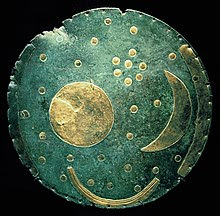


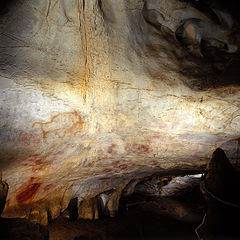


Subscribe to:
Posts (Atom)