Sunday, November 25, 2018

2010 fear/evasive language


"I seem to remember a process, where I ask you questions, and you give me answers . . . you ask me questions, and I give you answers . . . I think I read that in a manual somewhere!"

Meanwhile, all the Russian crew(this is 1980; so, they make a play on American/Russian perceptins of the day.  I just mean to show the difference between science and non-science behaviors) are squirming in their seats, uncomfortable with talking science to an American on a Russian vessel.  Evasive language(silence, and squirming).

More examples of fear, irrationality, and evasive language above.  I'll include my favorite passage that led me onto this,

"People swarm everywhere, talking of incomprehensible matters, in hovels, streets and square, marketplaces, and crossroads. When I ask how many oboloi I have to pay, they answer with hairsplitting arguments about the born and the unborn. If I inquire the price of bread, I am told that the father is greater than the son. I call a servant to tell me whether my bath is ready; he rejoins that the son was created out of nothing."

I include in the replies of this post, all my previous posts about fear, evasive language, and this difference between science and non-science behaviors.

Friday, November 23, 2018

astro picture/video for the day - soon to be gamma-ray burster identified/ Nero - Christianities first victim


Researchers think this Gamma - Ray burst is pointing away from us; otherwise, when it goes off, Earthlings could be in a bit of trouble.  The Gamm-Rays could be powerfull enough to destroy our ozone layer.  I can't believe a star explosions 8,000 light years away can wipe us out.  50 light years away is farelly safe from a supernova explosion. 

I've found a statement when they think this star system could become a "Gamma Ray burster" - 100,000 years.  I think it's safe not to worry about..


and part 2


Nero committed suicide with the help of Epaphroditus.  Copying and pasting my notes from my Gospel of Truth, which assembles all the most important quotes/facts/ inside and out of the bible, about Epaphroditus, "More curious things between Josephus and the New Testament Pauline epistles is a Epaphroditus, a roman emperor secretary. This roman secretary makes an appearence in the New Testament, Philippians 2:25 where Paul says Epaphroditus is an apostle for christianity. Epiphroditus funded the works of Josephus. There's more curious things about this friend of Josephus. Mr Eisenman's "The New Testament Code", shows some remarkable linguistic shorthands for various people in the Josephus circle; that of Timothy for Titus, a Silas as equivalent linguistic form shorthand for a Silvanus(yes, the silas of the Da Vinci Code), a Erastus could correspond to Epaphroditus. References would be acts 19:22, 2Timothy4:20, Romans 16:23. So, all these friends of Josephus appear in this linguistic shorthand except! Josephus! Where does Josephus go in the New Testament? I'd say Paul. Josephus is overwritten as Paul just like James the Just is by Jesus Christ. Epaphroditus is also mentioned in Philippians 4:18.  A little further down, "Paul" salutes the household of Caesar(Philippians 4:22.  Getting back to 4:18 above, Robert Eisenman notes that Paul describes Epaphroditus as "an odour of a sweet smell, a sacrifice acceptable, wellpleasing to God."  This is the exact language, word for word, used in the dead sea scrolls."

- This was my reply to Ken Humphries new videos above.

Sunday, October 14, 2018

astro pictures of the day - Significance of going to the Moon - Apollo 8 and 11


Image Credit - Nasa and the Apollo 8 crew.

 For all of mankind's time on Earth, we have only seen a Moon-Rise, or even a sun-rise. But, to see an Earth-rise spoke a million words!


Image Credit - Nasa/Apollo 11 - Neil Armstrong

This is Buzz Aldrin picture taken by Neil Armstrong. The significance of the picture, I'd say, is that of a new step for life comparable to life going from the sea to the land; or, even, Dinosaurs learning to fly. And, the picture here is of a Human with a spacesuit to help it breath in an environment it's not originally suited for.

As Neil Armstrong said,

"One small step for Man one giant leap for Mankind"

- Connecting the Space frontier a little more with some of the themes in my blog here . . .

In my Nature and Origin of Mathematics, which is updated in the intro to my Gospel of Truth(of all places!), I point out idealization and damming up nature in some way - clearing of the fields in agriculture, or the discovery of the vacuum by Galileo.  As Galileo showed, when any kind of friction is removed, you get a vacuum from which different masses fall at the same rate.  This was highlighted in Apollo 15(i've actually posted this Apollo 15 before; but, because this is getting brought up again, I'm including this video of Apollo 15 in this post as well!)


If this youtube video gets taken down, what this was is Apollo 15 astronaut performing the Galileo experiment of dropping a heavier and lighter object in a vacuum, and seeing them drop at the same rate of speed!  This was done in the vacuum of space on the Moon.

Going out to space is like finding that more general viewpoint from which to view nature and the universe.  This is, also, of course, symbolized by all the astronomical telescopes that get put up in orbit. Out there, they can see more clearly in the vacuum, beyond the Earth's atmosphere which distorts and keeps certain electromagnetic wavelengths from coming down to the surface of the Earth.

As some space exploration/colonization enthusiasts like Arthur C. Clarke, Carl Sagan, and Isaac Asimov would point out . . . going out to space would have a similar affect on mankind as the discovery of the Americas by 1500 Europeans.  Or, at least, you'd hope so; when they discovered Native Americans, and that they didn't know about Christianity, they just converted them.  For the most part, space exploration will lead to a more scientific existence.

Despite Religions trying to force people to their beliefs without facts/logic, they couldn't get rid of science.  They used guns and maps for navigation. Science/Mathematics is like an invisible hand, like in economics - the supply and demand - that keeps prices in check.

Humans are defined/distinguished by the other life by it's dependence on science/technology for survival. The Religions just apologize, or change their beliefs to suit the advancement of science/mathematics. Back in the times of the discovery of the Americas, they changed their beliefs to "Deism."  Even further back, the Church, reacting to the translations from Corboda Spain around 1100 A.D. said "O.k. there's two kinds of truth - humdrum everyday truth that you get from science and looking at nature, and spiritual truth."

When we colonize out in space, science/technology and mathematics will really take hold though.

Out in space, there's no nature to provide you with food.  Everything has to be understood scientifically - the food, the water supply.  You'd have to know your mathematics to do the celestial mechanics.  You'd need astronomical telescopes to study the stars; no which ones at any time are due for a supernova eruption.  You'd need gravitational wave detectors to find Black holes perhaps, or x-ray and gamma ray telescopes because the matter they are taking in will be accelerated to such velocities that x-ray and gamma rays will give off the locations of a given Black Hole. Out in space is a scientific future.

Out in space, you don't have to worry about nearly as much Nature as we've had to down here on Earth - Earthquakes, tornadoes, hurricanes, volcanoes.  With space colonies, you can really control the weather.  There's other things to worry about; but, they can also be mitigated - things like meteorite/asteroid impacts(one should note here that with a smaller more manueverable space colony, one can control being struck by an asteroid a lot easier than down here on Earth; you wouldn't think of changing the orbit of the Earth; that would make the weather too hot/too cold), cosmic rays(can be kept down possibly to lower levels by layers of water, and magnetic fields generated by nuclear fusion powered superconducting coils.  I would say a "forest fire" would be a bigger problem to worry about than just about anything else on a space colony.  But, a space colony can be equipped with advanced fire fighting systems.

And so, out in space, there won't be time for Religion.

Tuesday, August 28, 2018

leonardo da vinci


People point out that Leonardo Da Vinci was about experience, and not just "a man of letters."  What they mean by "not a man of letters" is that he wasn't formally educated. Leonardo himself says this many times(see Walter Isaacson's "Leonardo Da Vinci" which is the book I draw from for much of this.  I read his Einstein like a decade ago or so, and so, when I saw that he wrote about Leonardo Da Vinci, I had to read that book.  There's many books out lately about Leonardo; but, I knew Walter Isaacson; so, I knew this had to be the one of the better books to read about Leonardo Da Vinci)

When people think of the Renaissance, they think of Greek science and philosophy rediscovered. And, that's correct. But, the point here is that Leonardo, being "the" Renaissance figure, was actually not formally educated, was self taught, and preached a hundred years before Galileo to learn on your own, to go the source, the data.

Leonardo Da Vinci lived during the time of the discoveries of the Americas.  In fact, he knew and was friends with AmerigoVespucci.  Another famous character he knew and seemed to be on good terms with is Machiavelli.

Another major scientific/technological event during Leonardo's life was the Gutenberg printing press.  He learned of Euclid's Elements amongst so much else in his later years when the printing press made these things much more available. Leonardo was also born poor, and out in a country farmland, not some inner city.

"I am fully aware that my not being a man of letters may cause certain presumptuous people to think that they  may with reason  blame me, alleging that I am a man without learning. Foolish folk! . . . They strut about puffed up and pompous, decked out and adorned not with their own labors, but by those of others . . . . They will say that because I have no book learning I cannot properly express what I describe- but they do not know that my subjects require experience rather than the words of others." - Leonardo Da Vinci

But, the printing press actually allowed him to read books that he wanted to read and not what others wanted to him to read.  The printing press era later allowed him to read some of that standard stuff.  The important point perhaps here is that Leonardo learned not to be dogma or follow dogma.

Leonardo describes an early discovery and adventure of his childhood. "Bending back and forth, I tried to see whether I could discovery anything inside, but the darkness within prevented that. Suddenly there arose in me two contrary emotions, fear and desire- fear of the threatening dark cave, desire to see whether there was any marvelous thing within."  Leonardo then describes that he found fossils.

Leonardo studied anatomy and geology to make better paintings.  He painted both for fun and profit. But, he was also into making all kinds of mechanisms for the elaborate plays of the day.

He drew birds and studied them to learn how to make manned flight. He tried to conceive of a perpetual motion machine.  To his credit he figured out that such a machine was impossible for friction reasons. Leonardo appears to be the first to understand this - not Galileo.

He not only studied perspective geometry to make his paintings more realistic, but he studied human emotions to make emotional paintings and sculpture.

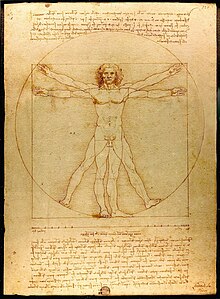
Leonardo may have been influenced by Roger Bacon.  Leonardo drew submarines, water powered cannon's, stealth black ships. . . . Leonardo observed that the sum of the branches equals the trunk of a fractal . . .  the vitruveus man is obviously inspired by a Vitruvius to picture the proportions of mankind . . .

Birds inspired Leonardo Da Vinci to think of human flight. He noticed Bernouli's principle intuitively.

Leonardo came up with the spiral metal arm to keep clocks ticking at a consistent rate. This was one of the mechanical things James Burke shows.


James Burke points out the history of clocks in episode/chapter 5 of his Connections. He mentions a sundial, and a water clock, and how these technologies have limitations of cloudy day, water freezing. James then points out a verge and foliat system


It's a gearing system that goes tick/tock.  There's a weight, and a gearing system that engages to slow the weight down. This is brilliant, but large and unweildy.  Leonardo Da Vinci came up with his spiral gear system that led to what's called the Nuremberg Egg,


As James Burke exclaims, these Nuremberg Eggs were the high technology of the day.

Machines use energy to do things. Leonardo analysed the Human body as a machine and determined how much weight each muscle can lift.  He did this analyses to design a flying machine.  But, he then went on to make such an analyses for many machines - saw mills,  wool-cleaning machines, paper mills, hammers for forgers, flour mills, knife grinding, burnishing arms, manufacture of gunpowder, silk spinners, ribbon weaving, shaping vases.

Leonardos study of machines led to try to make a perpetual motion machine. He intuitively figured out friction saps the energy - Perpetual motion is impossible  This led to Galileo noting that motion continues in a vacuum, but not where  there's friction.

In designing machines to study friction, he created machines that wouldn't be built till the 1800s - a Tribometer and ball bearings.  Leonardo seems to be the first to record a mix of metals that would reduce friction.  These anti-friction alloys wouldn't be rediscovered till 1839 by a Isaac Babbitt.

Another curious contemporary of Leonardo was Michelangelo.  The contrast of characters is striking. Leonardo is the Albert Einstein curiosity character. He did not believe in superstitions, alchemy and astrology.  He sought cause and affect.  Michelangelo was haunted by inner mystic demons.

Michelangelo, as Vasari reported, displayed "a very great disdain" toward Leonardo."  Walter Isaacson further mentions a story of Leonardo walking with friends in Florence.  They were talking about a Dante passage, when Michelangelo walked by and snickered that Leonardo ordered a hugh bronze horse to be made, but did not finish it. Michelangelo is quotes as saying "My delight is in melancholy."

My favorite Leonardo Da Vinci inventions are his musical instruments. Like the way the nineteen eighties used synthesizers to do on one instrument what was normally done on another - for instance a hand held keyboard used as a guitar, or a keyboard synthesizer to play guitar, drums, you name it, Leonardo mixed and matched different instruments to get different capabilities. He mixed a lyre  and  fiddle. It had seven strings - five were meant to be played with a bow, and two were to be plucked.  This instrument was pictured by Raphael after Leonardo's life. Lira da braccio

"Leonardo knew how to play the lyre "with rare distinction" according to the Anonimo" - Walter Isaacson.  Leonardo played music from Petrarch, and his own compositions. A Paolo Giovio mentions "He was a connoisseur and marvelous inventor of all beautiful things, especially in the field of stage performances, and sang masterfully to his own accompaniment on the lyre."

Leonardo turned a bell into a keyboard.  He had two hammers striking at different places of the bell, and four dampers to strike it differently


He created drums with different tensions to create different sounds.  He created drums with holes to be played like a flute. He even created a kind of drum keyboard.

Then, there was the viola organista, a cross between a violin and an organ. He created a looped bow that allowed the sound to be sustained unlike a regular violin.

Leonardo Da Vinci's mathematics was mostly drawing illustrations for Luca Pacioli's "On the Divine Proportion."  Geometric proportion was Leonardo's main interest in mathematics.  He tried to think of squaring the circle in terms of proportions.


The above is Leonardo Da Vinci's almost topological effort to square the circle.

Leonardo duplicated the cube, one of the three Greek classical delian problems not solved by them by a three dimensional version of the Pythagorean theorem,


Recently, it has come to light that Leonardo thought of a mechanical calculator.  But, there's no indication he ever actually built it.


- I can't help finishing this writeup of Leonardo Da Vinci by noting that he seems to have influenced a Gerolamo Cardano.  Leonardo Da Vinci was good friends with a Fazio Cardano.

Most people today have seen the quadratic formula. If you can either memorize the quadratic formula, or, if you know how to derive it, you can solve any second degree equation just by plugging in values.  The Greeks solved this geometrically. Through a long evolution of mathematics going from one culture to another, this became symbolized algebraically.  Archimedes did solve a special case of the third degree equation - by intersection of conics.  But, in one of the most Renaissance like stories, the third degree equation was finally solved as a closed form solution like the quadratic formula. Cardano got the formula from a Tartaglia.  But, Cardano figured he got it from someone else.  He eventually found the true discoverer of the general third degree formula - Scipione del Ferro

Cardano had a Ferrari colleague.  This Ferrari solved the general fourth degree equation.  I've done the general third degree, but have only taken stabs at the general fourth. Well, Gerolamo did invent complex numbers and used them effectively with solutions to the general third degree equation.  Gerolamo also was the first to introduce the binomial formula.  He did probability theory from his gambling days.  But, it's his mechanical inventions(and that he's the son of a former friend of Leonardo) that makes me want to point out Gerolamo Cardano here.

Gerolamo invented a gyroscope, a combination lock, shaft with universal joints which allows transmission of forces at different angles; this is still used in vehicles today.  And, he used hypocycloids to make for faster printing presses. 

Wednesday, August 22, 2018

astro picture for the day/ Terrence Deacon's "The Symbolic Species"


Image Credit: VIMS TeamU. ArizonaU. NantesESANASA - These are pictures stitched together over a period of years of Titan. Titan is a moon of Saturn.  It's atmosphere prevented us from seeing its surface.  We sent a space probe all the way out there, and got enough data to put these pictures together!


"Though the analysis of brain organization and function in modern species can tell us a great deal about the human/non-human difference with respect to language, it leaves open questions concerning the evolutionary transition from nonlanguage to language communication." - Terrence W. Deacon, in his "The Symbolic Species."

Terrence Deacon's main finding about human language is that kids learn how to speak without learning the grammar and rules of language.  Human language seems to be quite different from the language of other animals.  But, human language must evolve from non-Human language. As the quote above indicates, he does not know of or offer exactly how this Human language could have evolved out of non-Human language. 

Terrence mentions many things like brain/body ratios. He suggests that life body plans are different based on size, and likewise, the brain and nervous system evolves differently based on the body itself. Well, maybe.

Terrence suggests many times that language must be based on some Mnemonic like affects. He says "how else can we spit out such a large vocabulary all in some grammar harmony?"(that's a paraphrase). 

What's interesting to me about his Mnemonic language suggestion is that he argues against talking about mathematics.  He says that stuff comes later. Also, the Mnemonic basis for human language is similar to the "Metaphors we live by" by George Lakoff.

The Metaphors we live by book suggests that the words we use is often based on some central metaphor. George Lakoff gives an example of argument is war,

"ARGUMENT IS WAR  -

Your claims are indefensible. He attacked every weak point in my argument. His criticisms were right on target. I demolished his argument. I've never won an argument with him. You disagree? Okay, shoot! If you use that strategy, he'll wipe you out. He shot down all of my arguments."

Keeping my posts short and to the point, as usual, Terrence touches on the idea of there being some kind of mnemonic at the core of human language, which would allow Humans to pick out the right word out of tens of thousands of words vocabulary. And, the one example I quote above from George Lakoff's "Metaphors we live by" would further suggest a kind of Mnemonic nature to human language. This idea further relates to Jacob Bronowski's "Origins of Knowledge and Imagination."

Terrence mostly talks about language studies with Chimpanzees.  And, there's some good stuff there. For instance, there was a Kanzi.  Researchers were trying to teach Kanzi's mother language; but, she never quite picked it up.  But Kanzi, who was just hanging around while they were working with his mother picked up on  language!  This reminds me of the feral children I posted before. Only, this is a little bit in reverse. Instead of a human becoming say chimpanzee, the chimpanzee becomes human just by being raised in a human environment.

Anyways, Jacob Bronowski is coming from learning about the nature of all knowledge - poetry, mathematics, science, and seeing the analogies. Terrence doesn't see this, and suggests there is no way to understand how Human language can evolve from non-Human language - which it must have.

As Jacob says in chapter two, mankind could generalize and specialize to decode words out of the instruction language that life started out with. For instance, there can be hawk danger in the air, and leopard danger on the ground. Non-Human language often has separate noises for danger in each case.  But, humans have generalised and abstracted away the concept of danger from the concrete particulars.

I'd like to further note that for any living thing to survive in the world, it must have some kind of understanding of the outside world. It must no when, for instance a food is a poison or not. But, most life is adapted to a particular environment.  It doesn't stray from the ecosystems life-cycle. You won't see a polar bear decide to go live in the Sahara desert for the summer for instance. Homo Erectus, we know for sure, was the first Human species, anyways, that was general, that could live in different environments and survive.

- Terrence for the most part finishes up with suggesting that Homo Habilis at least could have relied on marriage as a symbolic solution to a biological problem.  Before then, as far as mankind has been able to find, no life had made a symbolic solution to a problem. It was always a biological adaptation that locked us into some ecological niche.

He points out that Human male/female relationships is unique in the natural world.  The rest of the natural world doesn't have wife/husband relationships. 

He suggests that meat eating presented a problem. This meat economy is like the Knight/Horse economy in the second half of the dark ages. Like the way the whole social hierarchy of surfs and lords and Kings were organised around the raising horses and the metallurgy to make the Knights armor, the evolution from vegetation to eating meat presented a problem between the males and the females.  I'm keeping his whole argument short.  But, he's saying that Homo Habilis, at least, must have invented, ritually, marriage for the females and the males to make sure that everyone knew that when the male hunts and brings back the meat, that hunters wife will get fed.

Well, maybe - But, I can't help noting a more contemporary example.  Terrence notes a peace festival in the South Americas. The Yanomamo indians of Venezuela and northern Brazil would have a peace festival.  They allow a warring faction to come to their festival.  If the other tribe doesn't kill anyone, after circling around them, then they sit down and have a feast.

- I was intrigued by Terrence's marriage symbol idea.  It seems plausible just because other life doesn't have the Human male/female relationships. The other reason why I was intrigued was that I've been thinking of knowledge as the missing feedback loop that keeps us alive.

There's transhumanists who want to upload themselves to a nano-crystal computer.  They think a nanocomputer can get their pattern, and therefore, by uploading, they can attain eternal life. My idea is to keep the biological life going.

I suppose I could put a video I made a few months back. I describe my ideas of Transhumanism there. I put some stuff that I didn't get around to integrating in the video, in the replies section. But, the Terrence W. Deacon's "The Symbolic Species" marriage idea, if correct, leads to my more biological Transhumanism,


As I describe in the video, the first life was autopoietic.  It's a cyle of chemicals that makes each other. So long as the energy and materials keep flowing into the cell, the cell can live forever. Multi-cellular life breaks this pattern.  Biologists often say themselves that multi-cellular life invents death. 

I'm saying mankind is the science/technologically dependent species, and that knowledge is how we survive, and soon perhaps, the missing feedback loop to keep our biological selves going.

Monday, July 16, 2018

astro picture for the day/ Isaac Asimov's "Rare Earth Hypothesis"


Image Credit - MeerKat radio telescope - the Event Horizon Telescope guys want to keep people from getting excited; they think the image "may disappoint."  I think we can rest any fears of disappointment.  Right now, they're keeping the images to themselves till they get the scientific papers out(publish or perish)

- Peter Ward and Donald Brownlee published "Rare Earth" in 2000.  At the time, the idea that despite the billions of stars in a galaxy, Earth's and technological civilizations could be rare was new.  But, I actually grew up having read Isaac Asimov's "Extraterrestrial Civilizations." Ward and Brownlee don't reference Isaac's book. I wanted to re-read Isaac's book and "Rare Earth" in the light of a recent finding furthering the "Rare Earth Hypothesis."

Appears that Supernova don't all produce the same amount of Phosphorus. Phosphorus is an essential element for life as we know it. I'll link one artilce here --> Phosphorus shortage may make alien life very rare

This finding is just the latest property of our solar system and Earth that Astronomers have found which would indicate that Earth's and Extraterrestrial Civilizations might be rare. As indicated above, Isaac Asimov, and not Ward/Brownlee was the first to think of this Rare Earth hypothesis.  Curiously, he doesn't mention Fermi's Paradox. So, I'll start this review of the Rare Earth hypothesis with Fermi's Paradox.

In the 1950's, Fermi was sitting down with a few physicist friends, talking about the recent Big Bang theory of the universe(note, this was over a decade before even cosmologists took the Big Bang seriously), and asked "Where are they?"

What he was getting at is if there was a Big Bang 10 to 20 billion years ago(The Big Bang is well dated in todays' Hubble Space Telescope era - 13.7 billion years), and the Earth is dated to 4.5 billion years old, then shouldn't there be E.T's swarming the galaxy?  Shouldn't the galaxy be settled by now?

A further technicality of the Fermi Paradox is that for there to be rocky planets, you need a generation or two of supernova.  The Big Bang only produces hydrogen and helium.  Elements essential to making stars, but not rocky planets. Supernova go off in about a hundred million years.  Factor in the recombination event after the Big Bang, when the universe cooled down enough for light to disentangle from electrons and allow atoms to appear, and you still have billions of years since the Big Bang for E.T's to swarm the universe.

UFO and E.T. enthusiasts have of course had a field day with this one.  They've hypothesized everything from they're among us(Einstein was an Alien hypothesis) to making the Egyptian pyramids to there's just getting ready to wipe us out. Getting to Isaac Asimov's "Rare Earth" hypothesis.

Isaac Asimov gets to his Rare Earth hypothesis by means of rational philosophy.  He points out the remarkable similarity between the UFO craze and Religions who want there to be a God to save them.  Whereas the God believers want a savior god Jesus(or Osirus, or Dionysius, or Mithras . . . see my Gospel of Truth), the UFO guys want E.T.'s to come down to Earth and reveal all their science and technology so we don't have to go through the painful stages of life to acquire all this knowledge. One could further note the analogy with the third world economies being able to go straight to the information age instead of the industrial age - as pointed out by Alvin Toffler.

This proves some interesting ideas of Carnap and other Vienna school of logicians of the 1900s.  That often a problem can be proven meaningless.  Or, other times a problem is meaningless at one time, and not at another time. This understanding appears to have been lost to humanity since E.T. Bell's "Development of Mathematics" which appears to me heavily influenced by this Vienna logicians scientific humanist philosophy.

The idea of Extraterrestrial Civilizations has no meaning before Astronomers proved the Heliocentric model of the solar system(they'll often say "of the universe" - or Helio cosmology).  In a geocentric model of the universe, where the white dots are not suns, there's no way to conceive of Extraterrestrials.

Also, this relates to the nature of all mathematical discovery. A mathematical problem is hard because the viewpoint one is using is not appropriate for the it's solution. Only be re-expression does a hard mathematical problem get solved.  In Symbolic logic, one learns that to prove a proposition from the conclusion, one needs to make a re-expression.  See perhaps Velleman's "How to Prove It."

Isaac points out that the effort to find Extraterrestrial Intelligence by hypothesizing a god(s) is using unobservables, and since we can't (dis)prove unobservables, we move on to looking for Extraterrestrials like us.

He points out animals as intelligences, but since they don't create technologies, they don't count.  And, this shows that when we're looking for Extraterrestrial Intelligences, we're looking for Extraterrestrial Civilizations.

Curiously, to me perhaps, he missed pointing out Neanderthals as intelligences other than ourselves.  And there were lots of other primates other than Australopithacines and Homo Erectus that we competed with in our evolution. But, getting to the Rare Earth hypothesis . . .

Despite Isaac considering the Moon not that important to the possibility of Extraterrestrial Civilizations(E.C's for short), he starts there.

Isaac points out Torricelli's experiment which found the vacuum for the first time. Astronomers quickly realized that the atmosphere of the Earth does not extend throughout space, and maybe the Moon doesn't have an atmosphere - No atmosphere, no water, not life.

Isaac then goes through all the physics discoveries and history showing there's no life on Venus or Mars(probably not; certainly, we know there's no multi-cellular life on Mars), the Gas giants and their moons.

Just because only one planet in our solar system is covered with life, doesn't mean other star systems are not brimming with life.  But, Isaac finds many Astronomy finding's suggesting that Earth's may be rare.

Isaac's first number for habitable stars sytems = 300,000,000,000

Isaac goes through the some rather little known history of the Nebular hypothesis.  He shows that Laplaces nebula hypothesis for the origin of a star and planets went through a bit of a scientific process. Laplaces nebula hypothesis had an angular momentum problem.  The sun doesn't rotate fast.  But, the planets do. It took over a hundred years before Astronomers realized magnetic fields could have transferred the momentum from the Sun to the Planets.  I've considerably shortened all the history presented in Isaac's book.

Isaac tries to use this to exclude certain star systems from having planets.  Fast rotators must not have planets.  He does point out there could be other reasons; but, for the most part, this condition reduces the amount of habitable planets for Isaacs second number - 280,000,000,000

I'm just going to list out for the most part Asimov's numbers for habitable solar systems,

3rd figure = 75, 000,000,000 - this is due to stars being to large(they go supernova), and small stars doing tidal locking, flare stars.  These midget stars make up the majority of stars.  Sunlike stars are only 25 % of the stars in a galaxy. What happens when binary stars are taken into account?

4th figure = 52,000,000,000 - this figure is arrived at by considerations of binary star systems.  The explanation gets a bit complex as he considers every possibility of giant and small stars in a binary system.

5th figure = 5,200,000,000 - the possibility of Extraterrestrial Civilizations takes a big hit with considerations of Population I and II stars.  These labelings are a bit backwards for most people(including me).  The Galactic core stars are called Population II stars, and the disk stars are Population I stars. The Population II stars are 1) light element stars and probably don't have any heavy element planets.  They're also radiated by the central black hole.  There's also the consideration of generation 2 stars of the Population I stars.  In all, the number of stars with the possibilities of an Earthlike planet takes a big hit.

6th figure  = 2,600,000,000 - Isaac's 6th figure is probably the most speculative at the time of his writing.  I'm thinking that one article I read about Jupiters spiraling in close to their star and ejecting any inner rocky planets also holds here.  I need to re-read that; those close in Jupiters would drastically reduce the number of stars with Earthlike planets.?

7th figure = 1,300,000,000 Isaac arrives at this figure by considering that not all planets in a suitable star system's ecosphere is of the right size.

8th figure = 650,000,000 This figure is come about with the same considerations as the 7th figure. So, these two figures are not precise. I'm thinking this is where "Rare Earth" book comes in to define these parameters more precisely.

figure 9 = 600,000,000 - this figure is a guestimate on the lifetimes that life develops from bacteria to multicellular.  It's saying if a star is stable enough and has been around for enough time for life to go from single cell to multicellular.  This use the Cambrian explosion as a minimum time when life went multi-cellular.  And the 10th figure is related to the this consideration - 433,000,000 . . .also figure 11, which is considering land life - 416,000,000 . . . and the 12th figure is about how many star systems planets could be around with intelligent civilizations = 390,000,000

Isaac's last figure 13  = 530,000

What does Ward/Brownlee show that's new beyond Isaac Asimov's 1980s book?  They talk about plate tectonics, and Snowball Earth.  The Snowball Earth maybe related to the Moon stabilizing the Earth's tilt.  This would be when the Moon wasn't in position to stabilize the Earth's tilt as much.   Also, they mention the Moon and Jupiter.

Astronomer's have found that many solar systems Jovian planets have spiraled close in where the inner rocky planets would be.  Because of a resonance between the Star and it's Jovian planets, as the Jovian Planet spiraled in, the resonance would have thrown out any inner rocky planets.

Between the Moon, which Isaac disregards, and the Jovian planets being in close, and the recent Supernova's not making phosphorus equally, that last 13th number is probably considerably lower. Probably less than a hundred thousand. Factor in Nuclear war, and/or Industrial destruction of the environment before they establish themselves out in space, the number of E.T's could be quite low.

But, even if the number is fifty or even less, when we consider billions of years, and what technologies we know are around the corner  - A.I, Nanotechnologies, and Quantum Computers, even if one Extraterrestrial Civilization had got as far as the exotic technologies noted above and established themselves out in space, they should have been able to populate the Galaxy.

- I've been refraining talking about the latest Nanotech and Quantum Computing news.  Sorry if my readership is innocent; but I've been wondering who my readership is lately. Assuming my readership has been using me for insider news on nanotech and quantum computers, I can only tell you that I am not an insider. I get my news when everyone else. Sure, I peruse the net and I am a longtime watcher of the scene. Other than that,  I don't give any kind of secret info.  Whether you want to believe this qualification of whether I'm giving secret info or not, I do feel forced to talk about A.I./Nanotech/and Quantum Computers a bit here.

A.I and Nanotech kind of arose together.  Once could say chemistry is nanotech.  But, what say Richard Feynman and Eric Drexler, the two main founders of nanotech mean is nano-manufacturing.  The last term is my own as far as I know. I have, curiously, seen it used from time to time.  Anyways, what's meant by nano-manufacturing is making everything from nanoscale to macroscale objects to molecular precision.  Molecular is the better term here because to say atomic precision is to suggest subatomic quantum scale.  We're talking about getting every atom in a molecule or a macroscopic object in the right place - molecular precision.

NanoManufacturing would be like a computer.  Only, instead of juggling bits and getting a picture on a screen, or a printout, we're juggling atoms and getting a product.  Two affect could allow this.  One, a molecular scale robot.  The small size allows rapid movements.  The other affect would be massive parallelism.

When/if they get NanoManufacturing to happen, they could recycle the industrial world.  We would be in a revolution comparable to the iron age to the Bronze age. We could make things to their scientific limits dictated by natural law.  Things could be made anywhere from ten to a thousand times greater in quality. But, it's A.I. that can really drive the NanoWorld.

A.I powered NanoManufacturing could explore those limits of natural law.  They can also make the amount of technological development so high, as to be beyond human comprehension. The amount of engineering accomplished in a single day could dwarf all that came for the last so many hundreds of years, much less the thousands and even Millions of years if you count the Austalopithacines stone tools.  But, that's nothing or even further augmented by Quantum Computers.

Quantum Computers use quantum entanglement, a state so delicate, you need to work at zero degree temperatures, and get rid of all vibrations to keep the quantum state from withering away. Quantum Computers could make today's supercomputers look like Pascal's adding machine of the 1600s.  The Quantum Computers can solve quantum chemistry and differential equations that are unsolvable today.

Quantum entanglement can lead to quantum technologies beyond even computing.  They can come up with artificial atoms - and alternative chemistries. Insted of just relying on the periodic table properties, we can come up with alternative periodic tables.

Already, we have cloaking technology. We already have the ability to make refraction free lenses.  This allows our Electron Microscopes to see atoms.  Where before, the laws of physics prohibited Electron Microscopes from seeing atoms.

I'd like to point out a favorite science/technology that doesn't get mentioned much - chaotic dynamics.  Researchers have figured out how to 1) use strange attractors, and/or 2) go from one of the systems strange attractor states to another.  They can stabilize one of the possibly infinite behaviors of a chaotic system. They can do this for any medium - mechanical, electromagnetic, chemical.

Point is if an Extraterrestrial Intelligence established itself out in space and/or established even one of the above technologies(establish one, and you could easily establish the others), they should have no problem with interstellar space travel.

So, where are they?

Well, one answer is they've cloaked themselves. Even if this were true.  Why do we have supernova?  Wouldn't they want to prevent that, and prevent more black holes from forming?

I think the answer lies elsewhere - Religion. Religion doesn't like to be questioned.  In such an extremely science future, where science has conquered all; there's no where for Religion to hide. Eventually, they say no.
Friday, June 29, 2018

astro picture for the day / Feral children - or, what happens if civilization collapses?


Image Credit & CopyrightRoberto Colombari


science documentary - Wild Child: The Story of Feral children

Yet another book I've had laying around for way to long, "The Tree of Knowledge" mentions "Wolf Children" in India.  They grew up with wolves in the early 1900s.  And, they learned the language and behavior of wolves. Amala and Kamala seem get mentioned alot.  The video documentary I found above says the first documented examples of this occurred in the 1800s.  But, this "Feral Child" wiki suggests mainly 1600s, and a few mentions back in B.C. timeframe - from none other than Herodotus. --> Feral Child Wiki

The famous example perhaps is that of Romulus and Remus in Roman legend.  This is the story of the beginning of Rome.  I mention this a little bit in my Gospel of Truth as historical proof of conditioned people.  Saint Augustine points this out as a reason why people believe what they believe. This suggests, on the one hand, that those who are raised amongst humans generally take on the cultural traits of their culture, and those who get raised by animals take on animal behaviors, and are today, called Feral children

I of course have been pointing out the harm of people not questioning their social conditioning; but, these Feral children bring up another issue - the nature of human intelligence and the dangers of civilization collapse.

Alvin Toffler was famous(he died almost forgotten, just a few months before President Trump was elected.  I actually wrote in Alvin Toffler for president) for generalizing cultural shock with Future shock.  Cultural shock would be like a person born in one country, who then relocate to a radically different culture, and don't know all the social cues and languages and so on. Future shock would be a kind of science/technological acceleration so bad, that people have a hard time adapting. There's a certain amount of worry about this with the coming A.I./Nantoech/Quantum Computers revolution. Of first note, the scientists/engineers who make these technologies will not feel this future shock nearly as much as the non-scientists/mathematicians and so forth. Most of these technologists are working to ease the transition to the new era - giving people an allowance to buy things from which they can't get a job anymore because everything is automated in an A.I./Nanotech world. Getting back to Feral children . . .

A fun scenario that people like to point out is "what happens if civilization collapses?"  There was a American T.V. series about this.  I forget what it was called. They made many episodes.  They pretty much showed that without human maintenance, all the technological relics would degrade back into the ground. Some future intelligence would have a hard time fitting the pieces back together!

As James Burke opens his "Connections" series with a "what if some technical glitch happens".  He points out, "do you know what seeds are poisonous?"  "Do you know what time to plant the seed, and when to harvest?"  Do you know how to fit a ploy to a cow and be able to farm?" And all these things a person grows up knowing how to do at a given time of a cultures development.  When a civilization moves to a new state of development, like from agricultural to industrial, a whole new set of social cues and understandings and physical/emotional/mental fitness to survive and keep that civilization maintained . . . which otherwise, all those technological relics and the scientific knowledge would all go crumbling back to the ground . . . the previous understandings becomes of more archaeological interest.  Especially, if a dark ages preceded the development of a new stage of civilization more advanced than the previous one - such as what happened with with the European Renaissance compared to the Roman empire that preceded it.  In between was the the European "Dark Ages."  But, can we go further, and suggest that human intelligence can take a step back?

The discovery of Feral children suggest to me that if civilization collapsed, and people were brought up in an environment that doesn't communicate the mathematics and science, then, human intelligence could go back to being wild animals, and would have to go through the cultural develoments that mankind has had to for tens of thousands of years since the invention of agriculture.

I've actually been meaning to read this one book about the beginning of numbers since cave painters days.  But, I haven't gotten around to it.  And, I found this Feral children stuff just today.  The question is "Does number get created randomly?"  Or "does number get created in one place get past down generation after generation - culturally?"  The example of Feral children suggests that number, mathematics in general, and natual language, and lets say the right attitudes to do science and mathematics, the intellectual culture gets passed down generation after generation.

I've pointed out before that the Romans didn't create any mathematicians; if they wanted a mathematician, they held a Greek at sword-point. 

-  As of right now, it appears that science/technology is on auto-pilot.  No amount of complaining about ethics by either the anti-science or the scientists can stop the scientific future from happening. I'm not too worried about civilization collapsing to the point that we have re-start our journey and relearn all this mathematics.  The future will be confusion.  It is right now.