Monday, December 12, 2016
astro picture of the day/ William Blake quote of the day
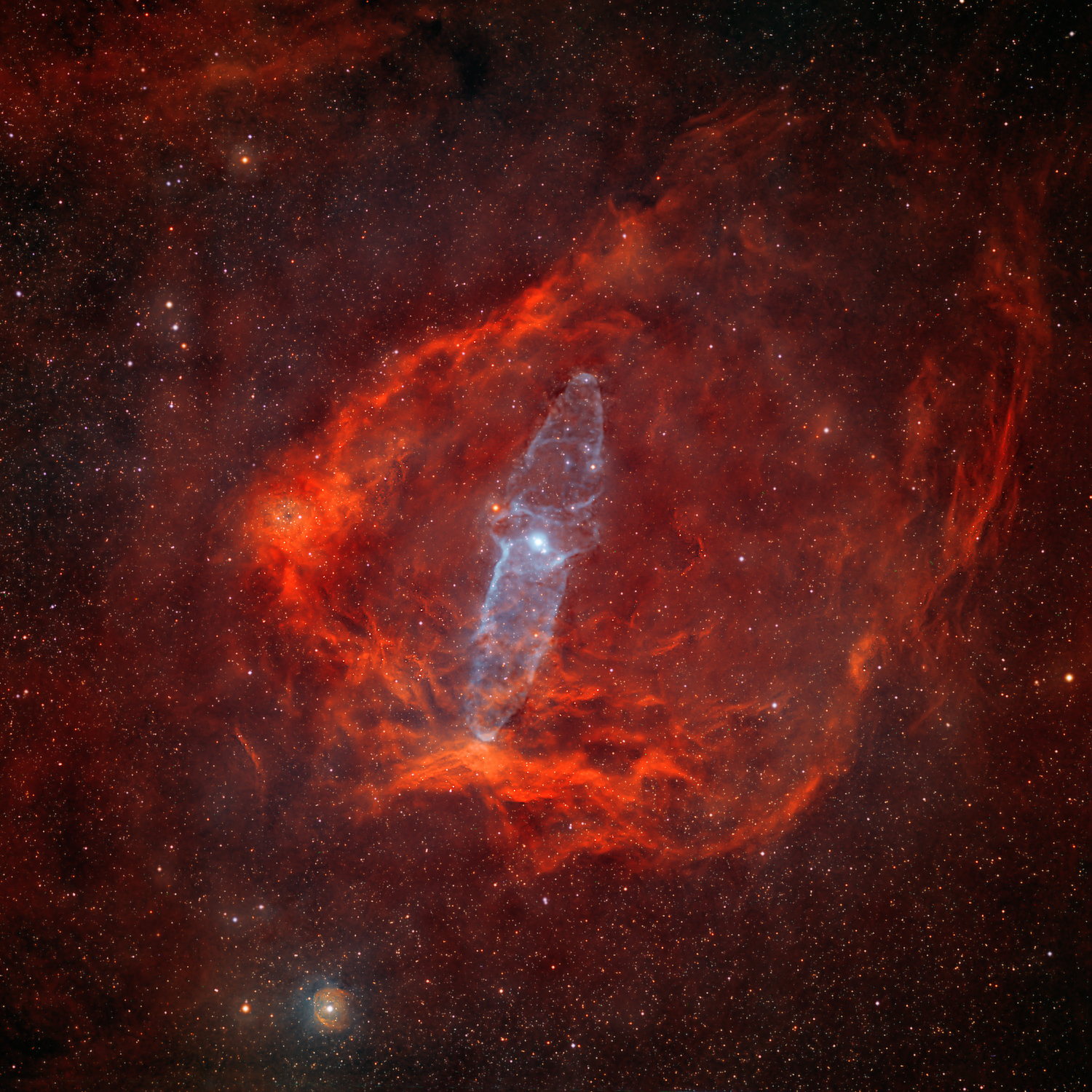
Image credit: NASA, ESA, Andy Fabian
Quote for the day -
"To see a World in a Grain of Sand,
and a Heaven in a Wild Flower,
Hold Infinity in the palm of your hand,
And Eternity in an hour."
- William Blake
Some exciting mathematics/science developments,
Feynman diagrams vastly generalised . . . even involving Zeta functions <-- link here
Here's a pretty good article to explain/appreciate category theory. Often-times, mathematicians call their theories by names that hides the amazing theoretical structures they are - such as group, ring, field. Article here --> Categories: From Zero to Infinity
Time and consciousness solved? Or, at least a good hint of how consciousness works. Article here --> time and consciousness
Consciousness as anticipation. I still like my idea of knowledge and consciousness. If one learns of something, then one becomes conscouse of it. I wrote of this awhile ago. It's probably buried deep down on this blog. I just bring it up to suggest that consciousness as something more complicated than just this or that solution.
- I've put more exciting new science developments in the comments section . . .
Friday, November 4, 2016
astro picture for the day/ Quote for the Day
Image Credit & Copyright: Rolf Geissinger
"According to Holder one of the essential characteristics of the mathematical method can be described as building new notions as superstructure to notions present at a certain stage, in the following sense. The notions and methods applied at a certain stage are envisaged as objects of the mathematical investigation at a higher stage. For instance: one applies a certain algorithm or method of proof, and afterwords one considers the scope and the limits of the method, making the method itself an object of investigation. From this, Holder concludes that it is impossible to comprehend the whole of mathematics by means of a logical formalism, because logical considerations concerning the scope and limits of the formalism necessarily transcend the formalism and yet belong to mathematics." - Otto Holder(through Van Der Waerden).
This quote is more Van Der Waerden than Otto Holder; so, I don't know how much to really comment on it. The original thoughts are in German. There's certainly some truth to it. For instance, at one time number was a whole structure of counting method. Next, it's abstracted and used as an object in a higher mathematical universe(that of algebra). I'm thinking that these methods are like Jacob Bronowski's "inferred units"(in his Origins of Knowledge and Imagination). Jacob is always pointing out that the relations of mathematical concepts are 'action verbs" and not 'is' statements. But, there is equality in mathematics as well.
As for the last part about mathematics cannot be encompassed in logic. That depends on what you mean by logic. Not to mention what one values. If one values a finite set of axioms that can prove an infinity of truths, then no, logic cannot encompass mathematics. But, if one likes an open consistent mathematics, then a little perspective suggests that logic has it's place, although one changed from an Euclidean, or even a Pythagorean viewpoint of symbolic logic.
This quote is more Van Der Waerden than Otto Holder; so, I don't know how much to really comment on it. The original thoughts are in German. There's certainly some truth to it. For instance, at one time number was a whole structure of counting method. Next, it's abstracted and used as an object in a higher mathematical universe(that of algebra). I'm thinking that these methods are like Jacob Bronowski's "inferred units"(in his Origins of Knowledge and Imagination). Jacob is always pointing out that the relations of mathematical concepts are 'action verbs" and not 'is' statements. But, there is equality in mathematics as well.
As for the last part about mathematics cannot be encompassed in logic. That depends on what you mean by logic. Not to mention what one values. If one values a finite set of axioms that can prove an infinity of truths, then no, logic cannot encompass mathematics. But, if one likes an open consistent mathematics, then a little perspective suggests that logic has it's place, although one changed from an Euclidean, or even a Pythagorean viewpoint of symbolic logic.
Thursday, October 13, 2016
astro picture for the day - Quote for the day / transition from magic dark ages era to the Renaissance
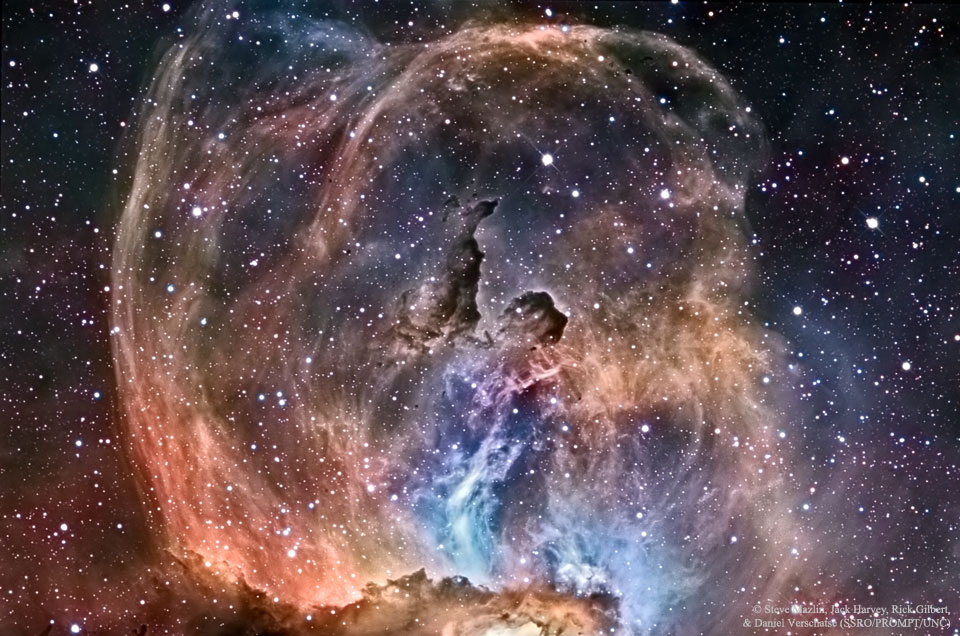
Image Credit & Copyright: S. Mazlin, J. Harvey, R. Gilbert, & D. Verschatse (SSRO/PROMPT/UNC)
"Science is a world view based on the notion that we can plan by understanding." - Jacob Bronowski
One of the last major additions to my "Gospel of Truth" is the evidences preserved in the old testament about magic. As one can see, the evidences suggests there was a kind of movement to eliminate the previous world of magic. Likewise, in the new testament, I find evidence in the Pauline epistles for efforts to ban the Greek sciences and philosophy. But, the religious efforts to do so clearly could not. Although, due to taking over the Roman empire, they did thrust Europe into a thousand years of dark ages. Jacob Bronowski finds in his "Magic, Science, and Civilization" evidence that the magical world couldn't be thrust away so easily as well.
In fact, Jacob Bronowski shows that the mathematical science world may have been inspired by the failures of Magic to accomplish it's goals - to control nature. Jacob quotes a Pietro Pompanazzi, who lived around 1460 to 1520, and was part of the Bologna school(if there's any readers who may have seen the James Burke "The Day the Universe Changed" episode 2 before that series . . . and the Connections series . . . was pulled down from youtube) . . .
"It is possible to justify any experience by natural causes and natural causes alone. There is no reason that could ever compel us to make any perception depend on demonic powers. There is no point in introducing supernatural agents . It is ridiculous and frivolous to abandon the evidence of natural reason and to search for things that are neither probably nor rational." - Of Incantations(here, through Jacob's "Magic, Science, and Civilization"s book
Also, in episode 3 of James Burke's "The Day the Universe Changed", James mentions the Medici as taking kind of center stage of the Italian Renaissance wealth. Jacob Bronowski notes that a Cosimo Medici( o.k. a quick wiki search suggests he was the first Medici) translated and printed out many books on "black magic" trying to find a way to learn the universe. He had a secretary, a Fecino. Copernicus was influenced to his sun-centered cosmology by a little book by Fecino - of the Sun. Then in quick succession, lots of people were publishing books on 'white' magic versus 'black' magic. A Giambattista della Parta, in 1558, published "Natural Magic." By 1620, Francis Bacon makes his famous quote, "Knowledge is Power."
Bacon's "Knowledge is Power" doesn't mean something political. He's saying mathematical/science knowledge is the way to understand nature - not magic. Magic tried to use spells and such to control . . . to gain power over nature. Jacob points out that in magic, one often tries to control nature by having power over it and rewinding it back. He points out the backward broomstick you see in some pictures of witches. And then, there's the famous biblical passage of Joshua making the sun stop and turn back.(I subtly remember a Genesis book passage about turning back the mechanism of nature; it's an idea a bit like turning wheel backwards from what it was doing before; the magicians hoped to by able to do that to nature). Around renaissance time, people were coming up with a different idea - to learn nature, one must become harmonious with it. Padua university intellectuals started thinking mathematics was the key to tapping into this harmony of the universe. Pietro also studied at Padua.
Jacob Bronowski also notes that Kepler was also influenced by magic about his idea of gravitation. He tried to understand nature by both what magical knowledge tried to accomplish things, and the way mathematics tried to accomplish things. He tried to understand the orbits of planets by means of the five platonic solids. Because they could be embedded in one another, they might be the key to the different size orbits of the planets! He of course saw the Tycho Brahe data and came to understand/appreciate a principle of science - when the data says no, discard the theory.
Kepler also had an idea of gravitation he got from magical thinkers. Kepler got his idea from a Nicholas of Cusa . . . who got his idea from a Pico Della Mirandola(who also had this idea that mankind is unique because it creates) . . . who got his ideas from a Dionysus(whom turned out to be a fake named person and stole his ideas from someone else back in 500 A.D. Christianity). The idea is that everything attacts because love permeates the universe. Everything has love(is that true? what about hate?). The quote . . .
"I transform the lover into the beloved and the beloved into the lover. The lover becomes the beloved because the lover dying, lives in the beloved. And the beloved becomes the lover for he learns to know himself in the lover and gets to love himself through the lover. And while he is thus loving himself in loving the lover he loves the lover who himself has become the beloved."
This magical passage shares a striking similarity to the vague statements that can prove anything. As I've mentioned here and there, Kurt Gödel published his "Incompleteness/Inconsistency" proofs of axiomatic systems. He basically says, a consistent finite set of axioms cannot prove an infinity of truths(consistent statements). But, an inconsistent finite set of axioms can. Above we have a magical passage that can prove anything and everything.
It also seems similar to the Bishop of Constantinople Gregorius of Nyssa quote that I've quoted many times thoughout this blog. See perhaps my Sophis/Silas post. But, I've mentioned these things recently as well.
Around Renaissance times, clearly, as indicated above, people were tired of so such unwieldy/non-constructive thoughts, and found the answer in mathematics.
- Oct 18, 2016 additional thoughts . . . magic should be viewed as an effort to learn the universe without the hard mathematics way. It's "black" magic. The mathematics of tens of thousands of years to three and four thousand years ago was not advanced enough to answer some of the simplest questions. Some questions are just not approachable; or, sometimes, there were mathematical answers, but the mathematics was too hard for many; so, many tried to come up with 'magic' supernatural solutions. Magic and religion really are efforts to circumvent the hard mathematics way, and get at nature without blood/sweat and tears. They want an easy way to understand things - not having to actually learn anything.
Tuesday, September 6, 2016
astro picture for the day
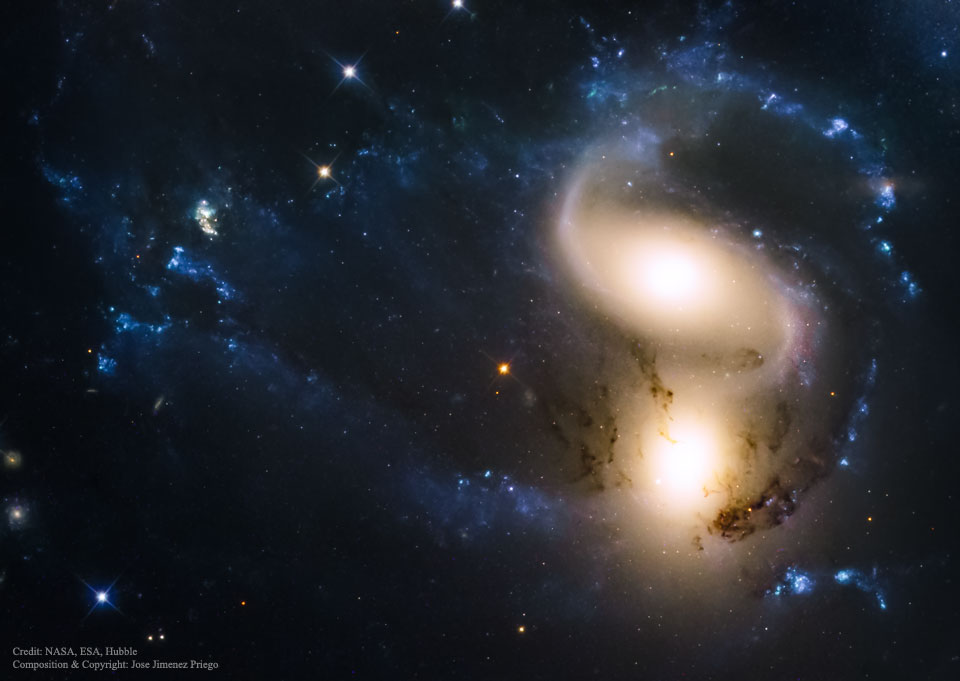
Image Credit: ESA/NASA Hubble Space Telescope
- There's ideas that are about defining things clearly and openly - like mathematics. Then, there's ideas that try to evade thinking. If you confront someone about something, if you try to show logic and facts that reveal things, most people(in my experience) use all kinds of evasive language. I've posted before about a remarkable historical piece of evidence for this in Bishop of Constantinople Gregorius of Nyssa noticed this type of thinking and complained,
"People swarm everywhere, talking of incomprehensible matters, in hovels, streets and square, marketplaces, and crossroads. When I ask how many oboloi I have to pay, they answer with hairsplitting arguments about the born and the unborn. If I inquire the price of bread, I am told that the father is greater than the son. I call a servant to tell me whether my bath is ready; he rejoins that the son was created out of nothing."
And I've pointed out some evidences using the movie "The Da Vinci Code." I could point out some personal examples(from my family), but I've recently found some more interesting historical evidences for this . . .
- One is in Copernicus's "On the Revolutions of the Celestial Spheres" book. It's noted many times that a person, not so close to Copernicus, put in a preface to his work(Copernicus saw his book on his deathbed) that the ideas of the sun centered solar system(they thought it was the universe at the time) is "just" a mathematical fiction.
People who play these 'acting up' games often use this dismissive "just" language. Oh, it's just this or that; don't mind it.
- More historical evidences - John Milton in his "Paradise Lost", book VIII,
"Sollicit not thy thoughts with matters hid,
Leave them to God above, him serve and feare;
Of other creatures, as him pleases best,
Whatever plac't, let him dispose: joy thou
In what he gives to thee, this Paradise
And thy fair Eve: Heav'n is for thee too high
To know what passes there; be lowlie wise:
Think onely what concernes thee and they being;
Dream not of other Worlds."
I put the last statement in bold. Not that there's plenty of Nazi "only think what I tell you to think" before that last statement; but, it is the most clear statement
Milton visited Galileo, when under house arrest - to experience, to see, and to gloat over him.
- As stated, I've posted about this before in my "Sophie and Silas" and later the "Agnostic and Irreligious" post.
Sunday, September 4, 2016
astro picture for the day/ Carl Sagan's first documentary? - The Violent Universe
Image Credit & Copyright: Robert Gendler,
Roberto Colombari, Eric Recurt, Adam Block - Additional Data: Subaru (NAOJ)
This is the best science documentary finding since the "Physics and Reality" documentary I posted maybe a year ago or so. This one goes back to 1969. It may be Carl Sagan's first appearance in television documentaries as well. I'd say it's his best!
This video documentary captures the realization that the predictions of Einstein's General Relativity - Black holes and the Big Bang cosmology - are real.
Major developments after this video were the x-ray telescopes finding Cygnus X-1 in the 1970s - a black hole in orbit around a star . . . 1983's experimental confirmation of electro-weak unification. It wasn't till the recent Higgs confirmation and then the detection of gravitational waves that something comparatively big to the Wilson/Penzias experimental discovery/confirmation of the cosmic background radiation. What could be exciting in the near future? How about the unification of Quantum Mechanics with General Relativity?
Black holes and the Big Bang cosmology confirm Einstein's General Relativity; they also strongly suggest that quantum mechanics and General Relativity must be combined. Physicists have recently gotten excited about the the quantum entanglement description of spacetime. Since, as stated, quantum mechanics and General Relativty must be combined, and quantum entanglement has been confirmed(by Alain Aspects 1980s experiement) and is part of quantum mechanics, then seeing how quantum entanglement relates to General Relativity must bare fruit.
Friday, September 2, 2016
astro picture for the day / quote for the day
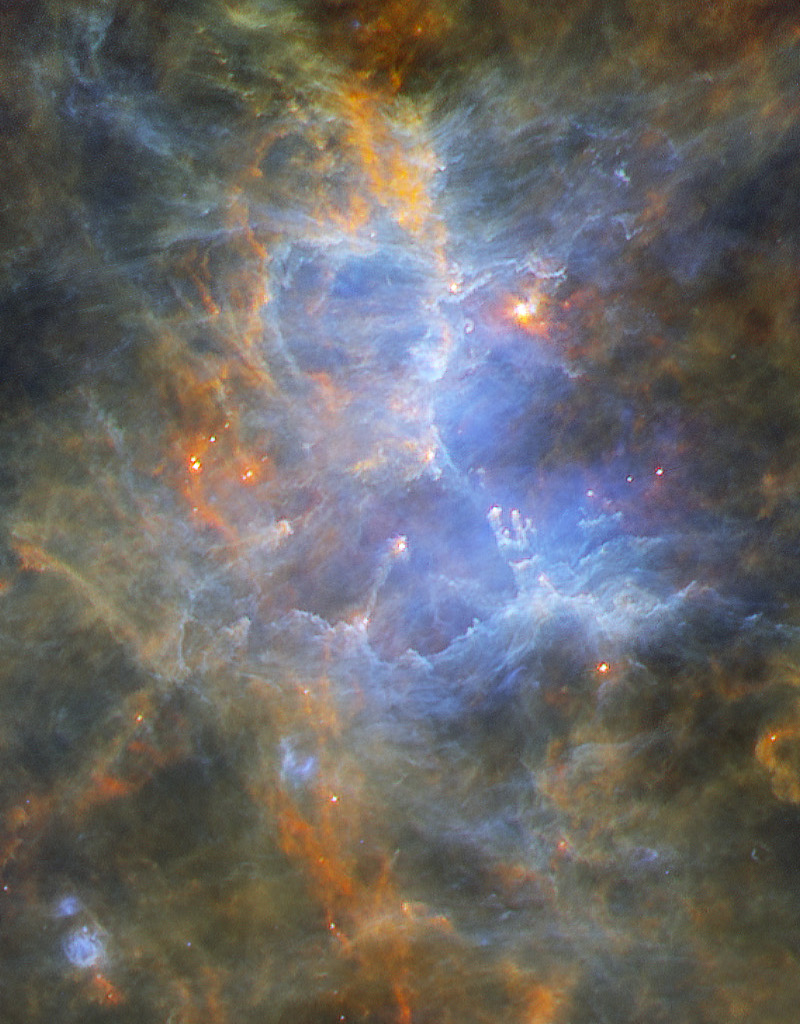
Image Credit & Copyright: ESA/Herschel/PACS, SPIRE/Hi-GAL Project
Acknowledgment: G. Li Causi, IAPS/INAF
"Henceforth space by itself, and time by itself, are doomed to fade away into mere shadows, and only a kind of union of the two will preserve an independent reality." - Hermann Minkowski
Albert Einstein at first said, replying to the quote above, actually, "I can't recognize my own theory, after the mathematicians got their hands on it." And so the legend that Albert Einstein was no mathematician grew.
Was he strictly a mathematician? No, he wasn't; he mostly just used mathematics already created to get his physics created. It's known that David Hilbert helped him out on his General Relativity. How much is unknown, as David Hilbert just gave all credit to Albert. Fact is though, the mathematics and mathematicians had been leading towards Relativty theory for a long time. Bernard Riemann's work on "Riemann surfaces." These can be thought of at a certain level as splitting a sphere into two sheets based on the positive/negative roots of a square root. Then, there was Lorentze's and Poincare's work. Their work was in response to the Micheleson-Morley experiment disproving the existence of the Aether. A substance that was suppose to carry the light waves through the cosmos.
- Some more mathematics, in relation to Jacob Bronowski's ideas. Jacob Bronowski points out that vague concepts are defined and expanded/generalized by creative analogy. In Einstein's General Relativity, Galileo's and Newton's for that matter, notion of inertia is generalized. Galileo's famous observation that different mass bodies fall at the same rate is explained by General Relativity. The inertial mass is equivalent to the gravitational mass. Well, they weigh each other out. This is actually kind of analogous to Galileo's contraditons/thought experiment . . . that if you attach two bodies together, the logic says on the one hand, that the two bodies will accelerate faster because you have more mass. On the other hand, the lighter mass will pull back on the heavier mass. Well, Einsten's equivalence shows that while the cannonball has more gravitational mass, it also has more inertia; so, they cancel out in a vacuum. In a vacuum, the cannonball and the feather fall at the same rate.
Saturday, August 20, 2016
astro picture for the day/ thanks James Burke
It's one thing "to say" that there is no objective view, that all views are 'just different', but when one view says "she's thanking us for burning her/ we don't learn because there is no change(the Buddhist monks at Mt Everest)", and the other says "nothing is sacred including what I say(Carl Sagan quote; essentially what science says). . . . Buddhism supposedly says "believe nothing on hearsay. Do not believe in traditions because they are old, or in anything on the mere authority of myself or any other teacher"; but, as we've seen in this video, Buddhism has no set scripture.
I've noted before about some of his connections. I pointed out how in the mechanical universe, King George of England was noted as preferring round knobs on top of lightning rods over sharp points is why we have round knobs, and for no other real reason. And that, some of James Burke's connections are of this type. Others are as I've described in my generalization of Jacob Bronowski's findings of the nature/origin of mathematical knowledge. For this, I have to thank James Burke for his great works!
Subscribe to:
Posts (Atom)