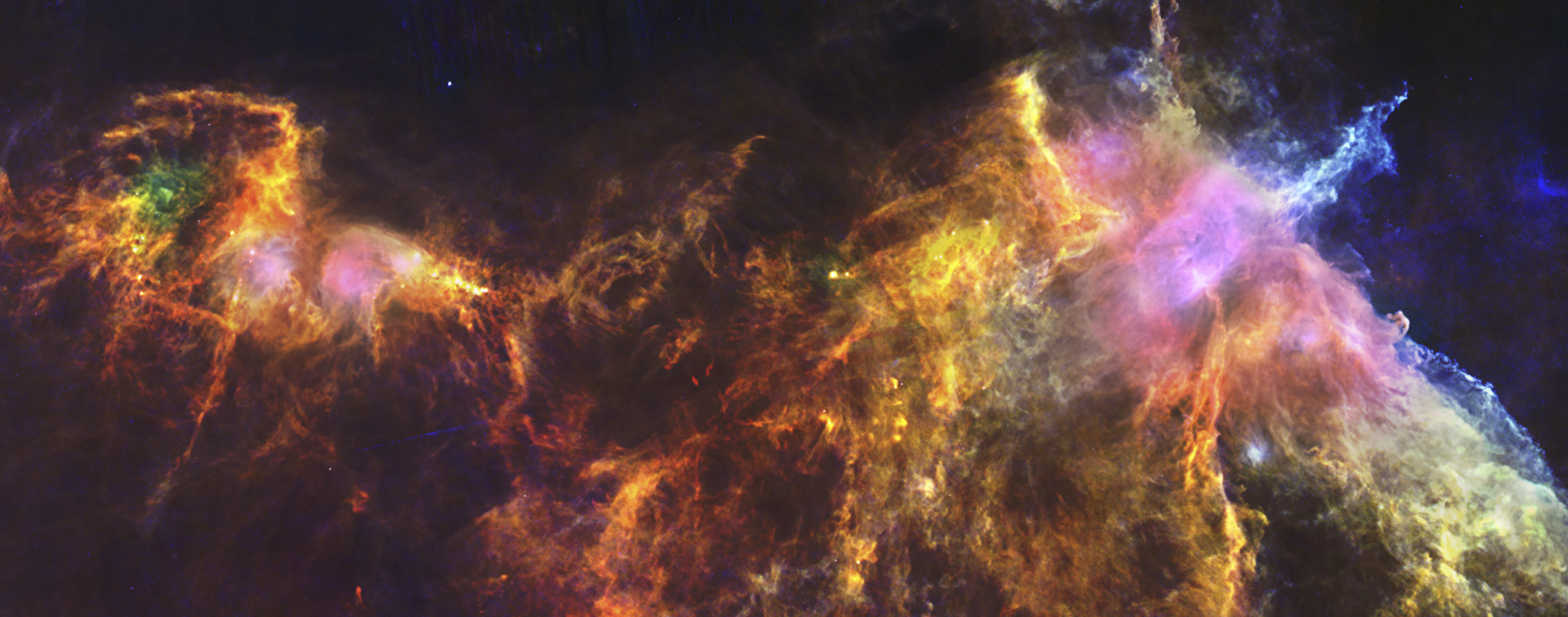
Copyright: ESA/Herschel/PACS, SPIRE/N. Schneider, Ph. André, V. Könyves (CEA Saclay, France) for the 'Gould Belt survey' Key Programme
Quote for the day
"Science, is one of the few areas of human life in which the majority does not rule." - Samuel Ting
There's this famous Star Trek saying, "the needs of the many outweight the needs of the few." Well, this is very anti-minority isn't it?! Of course, one could turn this around and say we can't have the few controlling the masses. But, the minority thing again throws some hot water on this general concept. I'm tempted to argue that the problem here is what are the facts, and what is the logic? I'll leave this train of thought as it stands. I'll say maybe this is a problem that society is still very blind to. Let me bring up one more issue I keep trying to point out to various people only to be met with silence and refusal to think; the problem with the majority is incrowding and refusal to think of new ideas. This is where I come to the support of the minority and where Mr Ting's quote is quite correct and I'll stand by that much for now.
I'll leave with another great mathematics lecture I've been watching and rewatching recently.
I couldn't get the video to show up for the embedding. There's so much to say about this. I'm struck by the possibility that maybe Mr Milnor's work could lead to understanding the place of fractals in mathematics - as oppossed to merely being a curiosity. Milnor notes that one has to define Henri Poincare's definition of the problem. This is of course just one example of how mathematics is about defining where things were vague at first.
Particle physicists infered that protons decay in the 1970s. Some were alarmed; others not so much. Most scientists of that time had learned psychologicaly, that the universe may have some disturbing consequences, like stars explode and the sun will burn out. Or, that the Earth is not the center of the universe and that it is a sphere and not a plane.
In some sense, religion was created to avoid uncomfortable facts. The Mesopotamian Epic of Gilbamesh is about immortality and so is Egyptian religion and the idea of Heaven in general. Mathematical science faces facts directly. Religion sweeps facts under the rug. I'm wondering if the fact that humanity is a science and technologicaly dependent species is an uncomfortable fact? Google "scientific humanism" or "humans are the science and technologicaly dependent species" and you get next to nothing. This is a fact that should be obvious. The fact that mathematics is the unified view of things is perhaps harder. One has to do some reading and thinking and rethinking. This is kindof what this blog is for!
Quote for the day
"the most successfull programs of unification always came about when there was some urgent question to be answered. In most cases, the urgent question was that something seemed to be wrong in the present understanding, and the correct answer then turned out to be that the only way to get it right was to say that this effect and that effect cancel, and the only way to make them cancel was to put them into one big theory together and show that they were the same force." - Gerard't Hooft
One of the major criticisms of dna-nanotech is the use of temperature controls to get the dna to fold in the right way. The major advances have been to conquer this thermodynamics over the last year or so; still, it would be nice to move beyond having to use thermodynamics. It will be interesting to see if the above electronic control of dna (un) zipping will generalise to all the great dna-nanotech advances like dna origami and other great things they've made dna-nanotechnology. If anything, this electronic control can add mechanical control to all the dna-nanotechnologies we already have.
This Jesus Christ youtube shows some more details I havn't heard about - such as Herodotus substituting the myths of Dionysius for Osirus and not worrying about the fact that these are two analogous sungods. Then, the author of this youtube shows some ruins showing connections between Osirus and Mithrus. It's kind of hard to believe I hadn't checked this youtube out before; but o.k!
Quote for the day--------------------------------------------------------------
It is worth noting that a a dissatisfaction with established theory often begins with those studying the theory in their mature years. - Anatoly Vershik
crazy science/technology for the day ------------------------------------------------------------
There's been more improvements to make dna-nanomanufacturing viable.
Dna Laser printing , this dna laser printing is another pathway towards making the dna strands to start with, and make them less expensivelly; bringing the costs of dna-nanomanufacturing overall down even more. There was a report of someone who had worked to bring down the costs of dna-nanomanufacturing down different from this just a few months ago. I'm pretty sure I pointed it out previously on this blog. I havn't seen this report anywhere where I usually find my science/technology news; this just comes to show how much science/technology is happening today. There's things like this that falls through the cracks!
"Keep your work and your self-esteem separate." - Israel Moiseevich Gelfand
Israel Gelfand was a pretty major mathematician of the twentieth century. Emil Artin made major generalisations to Galois theory in algebra and reciprocity theorems in number theory; he's the only solver of two of the Hilbert problems. These are two of the major themes of mathematics. Another would be invariant theory. Invariant theory appeared to be solved by David Hilbert in the late 1800s. But, Hermann Weyl found a way out by a representation theory generalisation. Well, Gelfond's perhaps major contribution was taking this clue of Hermann's to the tilt. The central theme of Gelfond's vast representation theory beyond Hermann Weyl's appears to be compact spaces. But, this mathematics of Gelfand's, vast as it was(almost impossible to describe here) is just one contribution. He made contributions to functional analyses - taking clues from Laurant Schwartz's work. His general sum total contribution here was like six volumes. But, he did even more! I just have to give some idea of the vast contribution of this guy!
Some more mathematical thought for the day. While I may have established Jacob Bronowski's philosophy of knowledge, it is kind of trivial. I found some other ideas to continue making more progress on these ideas about mathematical knowledge. The relation between idealisation and generalisation continued to bug me. Something came up about equivalent expressions when dealing with a rather aggresive intellectual who felt that Einstein's General theory of relativity must be wrong and so muct quantum theory! I mean and so does Jacob Bronowski that all theory is provisional even if proven right in the first place. Newton's mechanics was wrong the day he proved it right! Einstein's work 'generalised' it. Quantum theory generalised chemistry and Maxwell's electromagnetism. The same affects happen in mathematics. It's all 'equivalent expressions.' And equivalant expressions are generalisations. I pretty much had this answer in mind for the longest time; but, I never wrote them down till now. I knew all this time(over a year now) that this was a clue to some generalisation of even my understandings of Jacob Bronowski's philosophy of knowledge. Recently, in reviewing how to do deductive proof, I noticed something relevant. Besides but perhaps including the equivalent expression of quantifyers(the words all and some variables in symbolic logic), the fact is that all logical proof has to do with making a cut in terms of the hypotheses and conclusion; you either work from hypothesis to conclusion or the other way around. Either way requires you to define the problem more clearly to find connections. Equivalent expressions enters to find those connections. This is a good stopping point for now.
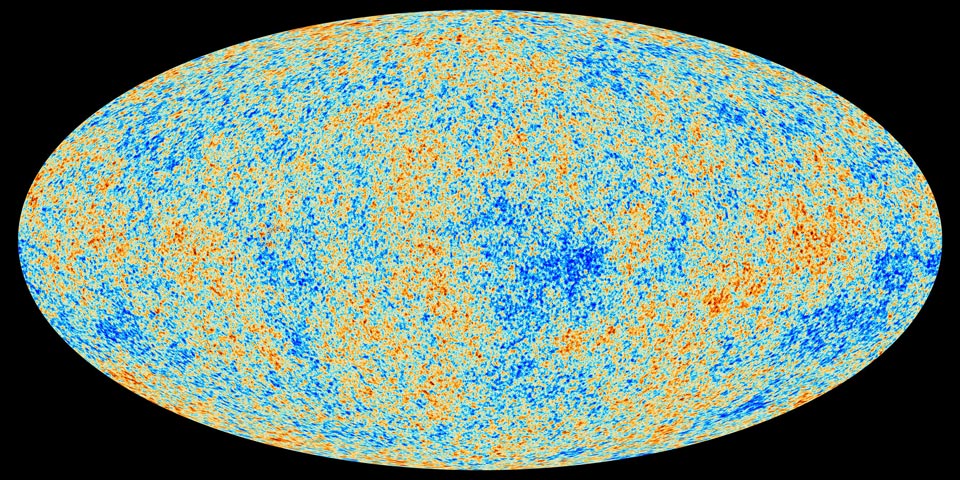
The above is the latest cosmic background radiation image. The first image of the cbr was by Cobe back in the late 1980s. It confirmed the inflationary generalisation of the big bang theory. Wmap improved Cobe's and hinted at an asymmetry to the universe. This Planck satellite has confirmed that the universe has a north/south pole thermodynamically.
Quote for the day
"A different view indeed offers beauty." - Nisal Kevin Kotinkaduwa
Thought for the day,
I had made a sny remark about how whenever somebody does good(at least from certain perspectives), someone else always tries to go the other direction(to gain power). I had further remarked that christianity was created to go in an anti-rationalist direction. I gave proofs of this in terms of Tertullian, Clement of Alexandria and others which shows they were trying to make a philosophy different than the Platonic and hence this would be anti-mathematical. Soon enough, the Christians murdered Hypatia and tried to bury mathematics by burning down the library of Alexandria. The dark ages followed. Anyways, I've found another remarkable going away from rationality after a period of enlightenment.
I've made a bit about how the French have had most consistent best intellectual tradition since the Renaissance. One could go much further back to after the translations of Arab texts in Arab spain of 1000 A.d. These texts turned out to be Arab translations of Greek mathematical works. Anyways, I don't know if the Romantic era after the Enlightnement era in France has to do with people trying to gain power; all I know is that it was a backlash from rationism. One thing is clear though, there's a constant back and forth throughout human history. I would quickly argue that one of the major problems that the I'll go ahead and call them irrationalists are taking advantage of is ignorance. They've constantly saying, oh, science has never solved 'all' our problems - hail God(according to tastes of those trying to make everybody believe in this god to solve 'all' problems that 'science' and mathematics clearly did not do)!
------------------------------------there's some more great crazy science/technology to report of course!
Actually, there's other equally exciting dna-nanomanufacturing news; but, I'll keep it to myself in case I come up with some new 'thought for the day"!
------------------------------------note for the day!
Tuesday, August 7, 2012 blog post has been extensively updated. I'll admit that it is still inadequate(partly due to not being able to put mathematical figures on a blog). But, I hope that I excite people for mathematics!
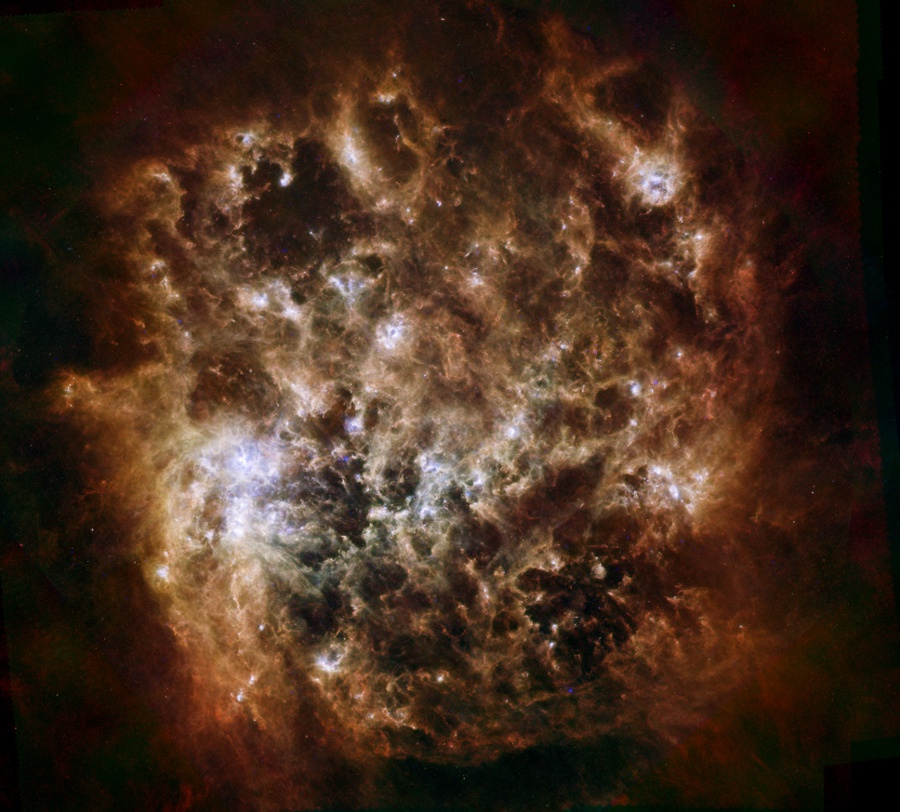
The above image is an infrared image of the Large Magellanic Cloud(a dwarf irregular satellite galaxy to our own galaxy). It comes from the Herschel space telescope as well(located at one of the lagrange points; an utterly remarkable technological achievement to be eclipsed shortly by the James Webb telescope).
Astronomical telescopes have the remarkable historical tradition of clocks(clocks, gears and the industrial technological existence more or less enjoyed by humanity today is described by James Burke's "connections" and "the day the universe changed" and I've posted those throughout this blog). To observe an astronomical object, the telescope has to be kept precisely on that astronomical object for a certain amount of time; otherwise, the Earth's rotation makes the given astronomical object drift out of the field of view. The bigger the telescope, the more remarkable the fact that telescopes are kind of giant clock.
Telescopes involve more historical/intellectual traditions. That of the conic sections. Trying to draw a circle by hand is next to impossible. While everyone knows the simple trick to make a perfect circle, few ponder significance of doing so. No other lifeform has created a perfect circle. Nobody is sure which came first; the mathematical discovery of the circle, or the discovery of the wheel; but, the earliest today's archaeology(and this is an archaeological fact that hasn't changed for hundreds of years!) suggests the Sumerians around 3500 B.C. That's a really long time ago; longer than the building of the Egyptian pyramids. I've pointed out the difference between the Egyptian accomplishments and that of the Malta ruins - mathematical. The Sumerians had the circle and the wheel long before the Malta people created their admittedly great temples. If you look at their temples, they lacked an ability to make a perfect circle. The conceiving and making of a conic section like a parabola(say for an astronomical mirror) is even harder. Only the Greeks ever conceived of a ellipse of a parabola, or a hyperbola. They did so because of trying to solve the three Delian problems - the trisection of an angle, the duplication of the cube, and the squaring of the circle. The Greeks discovery of the conic sections is just one more piece of evidence for Jacob Bronowski's ideas about the nature and origin of mathematics(see the second to last post of this blog).
Sumerian/Babylonian art showing the use(and hence discovery) of the wheel and circle. Remarkably, the Native Americans all the way up to when the Europeans found the Americas around 1500 never discovered/invented the circle or the wheel.
The Greeks studied optics, but they never hit on the idea of making a telescope. Had they done so, maybe the scientific revolution of the 1600s would have come sooner. Aristarchus had infered the sun-centered solar system, but nobody took it seriously. Archimedes practicaly laughed him off the stage(see Archimedes introduction to his "Sand Reckoner"). But, the anti-science supernatural religious had to have their day; so, we tried it their way for five hundred years till the translations of Arab texts in Arab Spain; these Arab texts turned out to be tranlations of even more ancient Greek mathematics. Even then, it took Europeans awhile through wars and fighting the new knowledge before optics advanced enough to make telescopes. In the end, the idea for a telescope wasn't concieved of by those who made the optics advanced enough to do so. Galileo learned of this optics and knew what to do more than the optics guys. Just comes to show that technical skill is one thing; insight is another.
While Galileo's little telescope is humorous to lookers today, his was actually an advance over Hans Lippershey's optics. Descartes made a hyperbolic lens. Huygens made refractors a hundred feet long. Then Isaac Newton made two great experimental science discoveries - one, the spectrum(but, he never thought to find spectral lines), and the reflector. Even since Newton's reflector idea, the refractor and reflector telescopes competed back and forth for which is better. William Herschel made a reflector in the 1700s. He went on to discover Uranus; the first planet discovered since the Greeks noticed a few stars moved. William Herschel also discovered infrared light, but didn't know it; he noticed using a prism that something was still heating a thermometer even though the thermometer was moved outside of the visible spectral colors generated by the prism. Spectral lines were discovered by Thomas Young.
I don't believe that nobody made telescopes between William Herschel and the Lick and Yerkes observatories; but, generally, those were the great astronomical telescopes of their times. In between those intervening years, much science and technological advance was going on(this is the 1800s). I found this youtube of the Lick observatories still going strong! The Lick refractor went into service around 1880 - the Yerkes around 1890. The Mount Wilson 100 inch reflector that was used to discover the Big Bang of the universe went into service around 1916. But, I'm getting a little ahead of myself.
I'm sure there's plenty of discoveries about spectroscopes and other things; but, I'll try to give as many highlights as I can before getting back to the battle between the refractors and the reflectors.
Helium was discovered in the sun before it was discovered on Earth by Lockyer around 1868. Freidrich Bessel first measured the parallax of a star in 1838(hence somebody must have made a telescope and used it in between Herschel and the Lick telescopes). I'm not putting these in historical order! Foucault invented a way of testing how perfect a parabolic mirror was. Steinheil first silvered a mirror. Daguerre invented photography which of course revolutionised astronomy. By late 1800s, the Yerkes had measured the parallax of thousands of stars(Tycho Brahe had thought of parallax back in the 1500s with influence from reading Aristarchus).
The great telescopes, pre-Palomar 200 inch was made from herculean efforts of individuals. The Clark and Richey's. I don't remember reading an account of grinding and polishing the glasses for the refractors, but the description for the sixty and then the hundred inch Mount Wilson reflectors of very early 1900s is stunning. It took them months to grind away, and years to polish. Richey washed down the whole laboratory after the months of grinding, left the floor wet to hold down the dust as he polished. Richey of course used the Foucault method to determine how perfect the parabolic mirror. The room would be made pitch black dark. He'd put a knife to the edge of the surface and shine a light so that the light would reflect off the distant walls; in this way, the irregularities of the surface would show up. This reminds me of how Cavendish weight the Earth. He had weights on a horizontal beam, and another beam that was given a certain tension to prevent it from settling on the set beam. He'd detect the gravity of the weights of torsion beam with the static beam by seeing the light reflected off the walls in a darkened room. Well, you can do it that way.
Relating the scientific method(as I explain in my "origin of mathematical knowledge article") and daming up nature, experience with the refractors, they built the sixty and hundred inch Mount Wilson reflectors on concrete domes to dampen out the heat of the Earth's surface.
Nobody knows when George Hale first started championing the creation of the two hundred inch Palomar telescope, but with the way Geoge and his intellectual group was able to raise money and progress the technology of the telescope, you know they wanted to see what they could do. Before I get into the Palomar telescope, I should say a few things about George Hale. George Hale coined the word "astrophysics." He was very into the idea that the sun is our own star and studying it gives us a astrophysics laboratory in our own backyard(it would be Arthur Eddington who first thought of nuclear fusion as the process that powered the stars). George Hale apparenly made the suggestion of testing Albert Einstein's General theory of Relavitity by means of a solar eclipse(it was Arthur Eddington who carried it out succesfully; actually, some modern scientists detect Arthur Eddington biased 'some' of the data; or, the data was a little fuzzyer than initially thought). George Hale also practically created Caltech which became the scientific and technological factory for much of the technology for the Palomar telescope. I'm sure George Hale knew tons of stellar facts; but, his major contributions appear to be solar astronomy(and the organising of large projects).
A solar observatory is a bit odd looking. George Hale is responsible for a good amount of it! He determined the height of the rolling heat waves due to the ground; and so, the solar observatory is structured to the pattern of nature. The Solar telescope uses a system of mirrors to focus and reflect the image to the bottom of the observatory.
Getting back to the Palomar telescope. The Palomar telescope required a whole community to build than the herculean efforts of one or two people. In this sense, the Palomar telescope was a lot more of a cathedral or Egyptian pyramid. Those projects outlived some of their creators. The creators had to pass along the plans for the construction of the project. People were practically born to create the cathedrals and the well maybe not the pyramids. A few people died before the Palomar telescope was completed - George Hale among them. The Palomar telescope was a great accomplishment for its time(1930s); but, due to the intervention of world war 2, its contribution and shelf life was considerably shortened. If it had gone into operation in the 1930s, the amount of time between its operational lifetime and the next great telescopes(the twin keck and the Hubble) would have been very great indeed.
The Palomar telescope shares with the Egyptian pyramids and the Cathedrals the requirement for innovation due to shear size. As a project gets too big and impractical to build, new methods are needed to construct it. The arch has historically been the example of this. The crossbeam can only be built so big before it's impossible to make buildings in which you can move around in. The arch allows people to build higher and give more space and room to walk around in. One thing seemed certain in constructing the Palomar telescope, the two hundred inch glass needs to be made out of some other material.
The story here is pretty long. Originaly, they tried to make it out of quartz. Quartz compared to glass has almost no warpage due to thermodynamics. They successfully made small eight inch quartz reflectors; but, they found that as they made bigger and bigger quartz disks(blanks not yet ground into parabolic shapes), the more heat and equipment it took to make it; the coefficient of difficulty appeared to be on an exponential curve. They got close to a hundred inch and failed. They spent millions of dollars in failing; making a two hundred inch appeared to be so expensive, that they quickly looked into another direction. They choose pyrex.
Pyrex is actually somewhat related to quartz; it has a percentage of quartz; but, it's not a pure quartz. Now, the problem with trying to make a astronomical mirror out of heat resistant material is you have to heat the material up to make it molten and poor it in the desired shape! So, the Pyrex was a compromise material to make the two hundred inch Palomar telescope. They failed on a first attempt which was attended by a bunch of bored rich folk who never got past calculus or did much manual labor to get all their money. They just barely made the second disk blank. But, then WW2 intervened, and the grinding and polishing had to await after the war in 1945.
I forgot to mention the 200 inch disk had to be annealed. Annealing is a kind controlled cooling down. This process takes out imperfections and strains which can double the stress problems due to thermodynamics. The corning company who made the pyrex disk tested the annealing by means of a polariscope. It consisted of two prisms on the two ends of a beam. They'd shine a light through; if there was any warpage, the light wouldn't align. The disk took ten months to go through the annealing process. Also, after the war, when they ground it into shape and polished it, they didn't have the same problems had in shaping the 100 inch due to the Pyrex's superior thermodynamics. Richey had to wait for the glass disk to cool down after shaving off a bit here and there. He'd use the Foucault method to find an irregularity, and then he'd grind; but, then, after doing a certain amount of grinding, he had to let the disk cool down again before he could get back to work. This process of course took him years to complete!
The polishing and grinding was done by a process of starting with courser grains and then finer grains. And of course, the grains of various materials would get ground down in the use. The grinders were a team of like six people. I know they did something to keep the dust down. Any little dust could have set them back in the process of going from rougher to finer grinding materials.
One of the major innovations was the bearings that would link the support structure with the gearing. The weight of the telescope would crush any ball bearings. They settled on a oil slip bearing. There was some skeptism even this would work. But, as it turned out they didn't need very powerfull pumps and motors to keep the oil flowing.
There's apparently some worm gears to drive the movement of the telescope. I feel like the description I have isn't that detailed. But, I am under the impression that the machining here is as precise as the grinding/shaping and polishing the lens itself. I've been to the Palomar telescope, and I've not seen these gears. Maybe next time, I'll ask somebody about them. You need these massive hundred ton gears to be as precise as possible to be able to position the telescope on a given region precisely; so, yes, I would imagine since they've obviously been able to successfully do astronomical research that these gears are a machinists nightmare or pride depending on who you talking to. Readers might have noted the remarkable ease that car doors shut, or maybe even experienced some heavy military steel doors that can be moved by humans. They been engineered with some leverage principles to allow such affects. Similarly, the Palomar telescope is driven by a less than one horsepower motor.
The Palomar telescope mirror was made reflective with a new aluminizing process over the Steinheil silvering(the silvered Mount Wilson mirror had to be resilvered quite often; sometime every day; almost every day, workers had to take the disk off, move the disk to the underground facilities and resilver and then put it back on the telescope above). The process involved aluminizing a tungsten wire. In a vacuum, they electricute the tungsten wire, the the aluminum would vaporize off onto the mirror surface below. This was revolutionary for the day. The aluminum mirror was far more reflective than the silver coated mirrors of yesteryear.
For perhaps my favorite the not last thing to describe(and I probably havn't found everything that can be said about the technology of the original Palomar 200 inch) is the positioning system. The astronomers want to be able to type in the coordinates and have the computer program tell the whole 14 foot gearing system and the less than one horsepower moter position and keep the telescope positioned at any desired point in the sky. Before the Palomar telescope, some MIT people had created electromechanical positioning systems for the military(the guns on ships and so on). There's analog computers and theres digital. There's also mechanical and electronic. These electromechanical systems combine the two. This electomechanical computer used quartz vibration timing circuits. The designers had already taken into acount that the weight of the structure from the lower 200 inch mirror to the top secondary mirror would bend. Well this electromechanial analog/digital positioning system actually corrected even the errors that couldn'be machine tooled out. What's more, it took into account the refraction of the atmospher due to temperature and density.
From the exotic material mirro(although a compromise) to everything described so far, the Palomar telescope was a scientific cathedral/Egyptian pyramid for its day. It doesn't look like much. But, there it is. There's so much more to describe though!
The science of optics showed that a short focal length leads to faster astronomical picture taking. So, the Palomar telescope is engineered to a scientific principle much as George Hale's solar telescope is structured to the pattern of nature itself.
George Hale and his fellow astronomers gained experience in different seeing conditions when building the Yerkes and the Mount Wilson telescopes. They found remarkably at times the bigger telescopes would get blurred out while a small two inch refractor could see Jupiter just fine(I've experienced this; i've viewed through my fathers six inch reflector and his three inch refractor. I viewed the 1990's cometary impacts of Jupiter throug the Refractor). As it turns out, a large telescope has a termodynamic 'tremer error.' They soon took little telescopes around that they could get this tremer error disk and went around various mountain, flats and so on to test seeing conditions. Mount Palomar was a bit of a compromise between good seeing conditions and accessability.
They even considered the geology. They studied the earthquakes of California and determined the mount Palomar only experiences moderate, and by building on a mountain, the mountain generally damps out the earthquakes.
There's innovations in the dome, but I kind of read through it quickly and didn't jot down notes.
George Hale's founding of Caltech led to numerous support technologies. They improved spectroscopy; they found that most spectroscopes only use five percent of the light coming; they improved it to ninety percent. A W.B. Rayton created a lens of aperture f:0.59. This was unheard of back then. Without it, the Mount Wilson 100inch could not have done the work to discover the expansion of the universe. There was all kinds of things like this that went into the telescope or contributed to the science that went on.
The Palomar telescope was finaly outdone by the Twin keck's at Hawaii. They are an optical interferometer. The radio telescope guys innovated interferometry. Well, I suppose interferometry went back to the Michelson experiment to detect the ether in the late 1800s. But, for the longest time, astronomers didn't think interferometry could be done at visible wavelengths. Interferometry was exclusivelly a radio telescope luxery. Mathematical innovations made it possible(and of course technological developments there after). So, right there, the twin kecks should have been an astronomical revolution. Unfortunately, the Hawaii people said astronomy is interfering with their religion, and the interfermetric extra units outside of the Twin keck were not built. Back in the making of the Mount Palomar telescope, there were various supernatural religious people who said "maybe mankind is not meant to learn natures secrets." All this shows clearly why people believe in religions(supernatural and not rational philosophy). And, all this justifies my efforts on this blog.
Astronomical telescope technologies continued to advance. Quantum optics guys soon advanced enough to calculate just how reflective a given material is. The Hubble space telescope was suppose to be coated with almost 100 percent reflective material. But, unfortunately, time constraints prevented the technological develpment to catch up with the theoretical developments; the Hubble mirrors are a compromise. Later on, this quantum optics developments made their way onto the Palomar telescope mirror. The laying of the reflective surface has also advanced past the tungsten wire. I'm not sure if even this is the latest. But, I've seen the use of plasma to lay down atomic layers.
I remember the CCD revolution reported in my Sky and Telescope magazines back in the 1980s. The CCD's are continueing to advance. The spectrographs continue to advance. I can't even say I know the latest developments. But, as nanotechnologies advance, so do the spectrographs and the CCD's.
The Herschel Space Telescope is infrared and requires cooling. What's remarkable about it it's located at a Lagrange point. A gravitational stable point between the Earth/Moon system. It's millions of miles out there. Astronomers of course can't wait to make an optical and even radio and other wavelength telescopes on the dark side of the moon. The seeing is of course pitch black. But, one could imagine making a comparable interferometer at one of the lagrange points, and even making a hugh interferometer between the moon telescopes and the lagrange point! With the coming nanotechnology revolutions, I'd expect this to be possible before the twenty first century is out!
And perhaps to finish off this latest blog, I could mention some of the latest I'm hearing about dna-nanomanufacturing. Since all the great breakthroughs months ago, there hasn't been much reported - till a week or so ago. I did see some of the major dna-nanomanufacturing teams suggest their latest plans for scalable dna-nanomanufacturing and the ability to bootstrap to a more robust nanomanufacturing system.