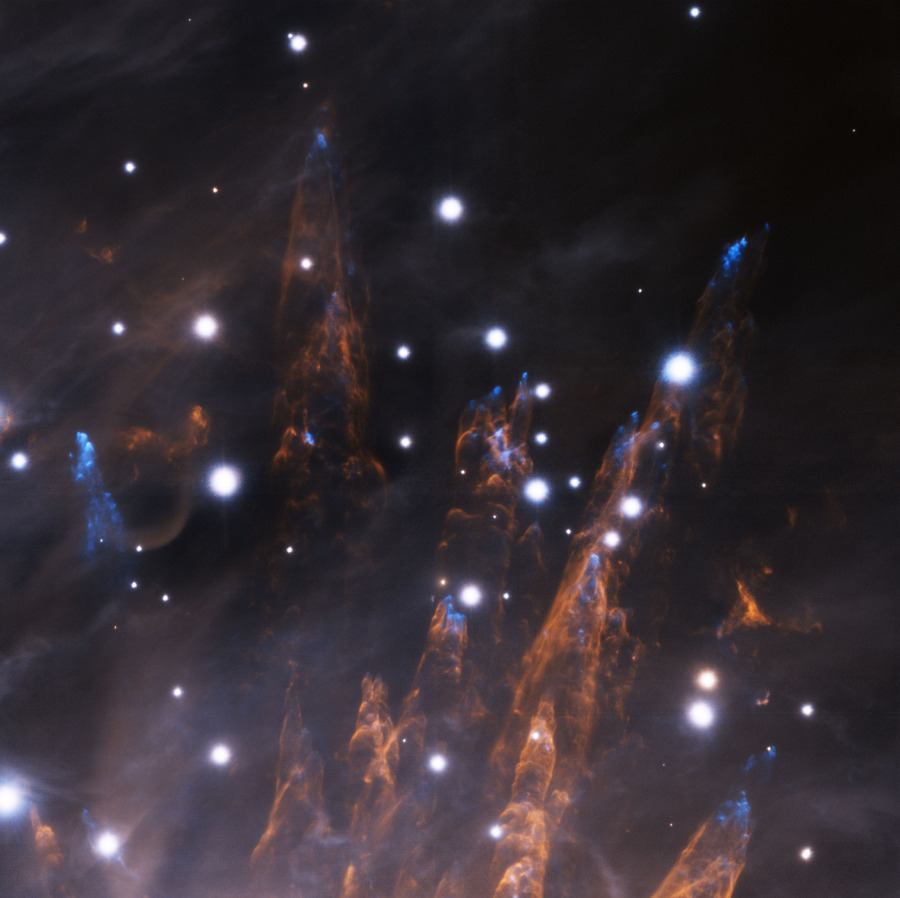
This is a latest picture from Herschel space telescope image of Betelgues - a star of the orions belt. This is a supergiant star that has been around for awhile. Astronomers think it's ready to go supernova. It could go off tomorrow, or in a thousand years.
thought for the day;
Industrialism gives humanity the power to solve a lot of problems, even go out to space. But, it comes with a ticking time bomb - that of the dependence on non-renewable resources. The problem is compounded by the fact of how many people industrialism allows to live above the level of animals. If the plug is pulled from out under industrialisms rug, billions of people have grown up conditioned to live in a concrete forest; they don't know how to forage much less farm. The contribution of science to the human condition can come crashing down real fast. There's two solutions; one space expansion, and two nanomanufacturing. Seems that both possibilities are maturing together!
A few days ago, Planetary Resources decided to make an update on their progress to tap the material resources of outer space.
As it turns out, Planetary resources has competition!
Of course, SpaceX is solving the rocket problems, Bigalow is providing inflatable space stations, and nanotube guys are making space elevators possible!
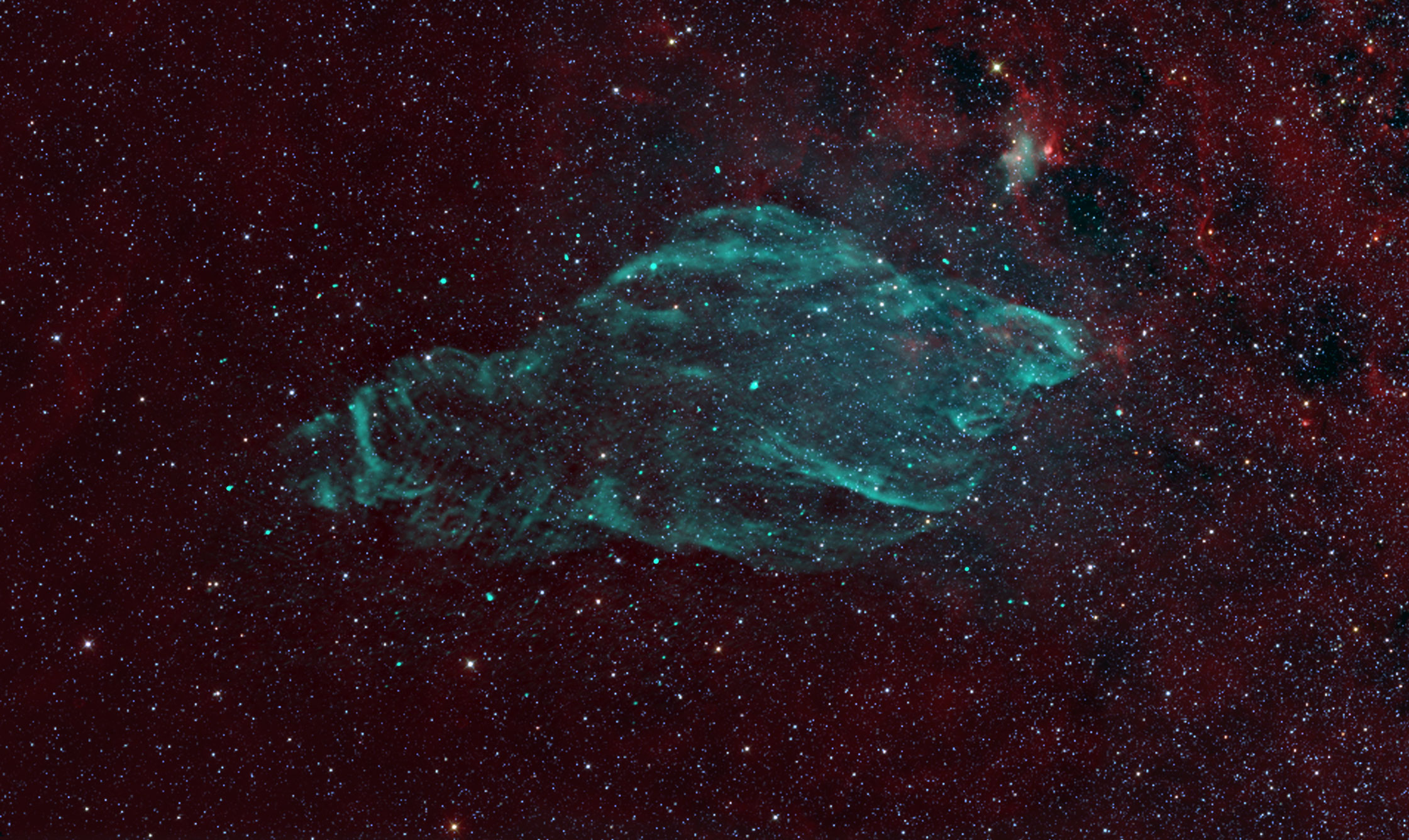
W50 supernova remnant in radio (green) against the infrared background of stars and dust (red). Credits: NRAO/AUI/NSF, K. Golap, M. Goss; NASA’s Wide Field Survey Explorer (WISE).
thought for the day,
I have for a few years recognized a little problem of my connection between James Burke's connections and Jacob Bronowski's theory of knowledge in his "Origin of Knowledge and Imagination." The problem is that technology is material and mathematics is symbols. Why do both worlds(material not symbolic) have this daming up of nature leading to concepts/technologies? I'm surprised I didn't hit on this years ago. Because, I remember almost a decade ago now that mathematics is as much a technology as material technologies. Even natural language can be viewed as a technology. That is my thought last night.
Homo Erectus as everyone knows used fire for hundreds of thousands of years; that act alone put mankind a cut above any lifeform on Earth ever before. Homo Erectus essentialy already existed in a science fictiony time. Isaac Asimov in his "Chronology of Science and Technology" says there's evidence that the cave painters of tens of thousands of years ago used wax that would come from the application of fire to cooking animal meat. Maybe the cave painters made bon fires and explored just how hot a fire they could make, but we don't know. We only know that fire led to metallergy in Mesopotamia around 3700 B.C.(almost six thousand years ago).
The nature of fire had to wait a longer time to the modern day scientific era of mankind. This story brings us back to my point about mathematics being a symbolic technology and my problem of how come there's this same pattern of James Burke connections/Jacob Bronowski infered units. The solution is to define the vague word 'technology.'
Fire was used but not understood all this time(almost six thousand years). They at first argued a phlogiston theory for fire; the idea that fire was composed of another substance all together from normal matter. This is kind of like the problem mankind had in understanding the heavens for a long time. They thought things in the heavens stayed up there because they were made of another substance all together. As Jacob Bronowski notes in the video above(episode four of his Ascent of Man), if you have this theory of fire, you have to give it all kinds of impossible properties(this relates to the problems scientists had with the aether theory which when disproved by the michelson-morley experiment of the 1800s led to Einstein's Special and General theory of relativity). Phlogiston and fire really were vague words just like technology was for me in my problem about technology connections and mathematical connections.
I just read an article in Scientific American about Ardi and Lucy(australopithacines). The article basicaly shows a Ardi decendent living at the same time as Australopithacines. The suggestion, or point, is that we can't just find our common ancestor by finding a bipedal ape. And, that there were two bipedals running around at the same time.
Lots of times, I hear physical anthropologists suggesting that by finding fossil bones of our ancient ancestors, we can learn something of how intelligence arose in today's Homo Sapiens. I've always been a bit skeptical at this notion. Maybe if someday we make a Jurrasic park of Australopithacines and now Ardipithacus, and Homo Erectus, then maybe we can somehow study the evolution of human thought. There's other things to say about intelligence though.
Seems to me that life is intelligence. All life reasons its' way around. One could even say that bacterial swapping of genes is like mixing and matching of ideas. But, what caused mankind to perform art, science/mathematics, and technology(a bit of a bungaboo also; spiders make webs, birds make nests, beavers make dams). Our intelligence seems a step above(how many people today know deductive logic?).
Let me point out an observation of mine; Renaissances appear to happen after a dark ages. Everyone knows of of the 1500's(with overlap into the 1400s; actually, there were two Renaissances; one occured around 1000 A.D. with the translations of Arab translations of Greek works in Arab Spain; it was pretty much shortshifted by the 'black plague') in Italy(also partly due to the migration of Greeks from Constantinople). But, what few people note is that the Greek enlightenment that everyone thinks of when the word "Greek" is mentioned, was after a Greek dark ages. This is the dark ages after the fall of the civilizations that led to the legends of the city of Troy(maybe real, but the story is legend). What's more, before the Greeks, there was the Babylonian mathematical spring. Then, they went into a dark ages, only they never really went into a Renaissance; they became a giant dictatorship in the Persian empire to combat the upstart Greeks because the Greeks were doing weird things like mathematics and democracy. But anyways, point is that intelligence in our species doesn't seem to occur without some stimulous. Like, how about competition?
All life much less bipedal primates grew up knowing how to forage/hunt for its survival. It doesn't need to do science or technology generaly. Most physical anthropologists I would imagine would raise their hands and say 'environmental forces.' Yet, this doesn't make total sense with the long timespans in technological innovation in the evolution of bipedal primates to Homo Sapiens. Reading this latest Ardi stuff may suggest a reason why some primates that obviously led to us somehow maybe thought to make some new technology at least!
Certainly, when this certain lifeform decided to make technology, it had a more generalisable skill set. Or, the topology of the bipedal primates lent itself to greater technological potential. And, the use of that technology took a while to affect the biology to change and require more brains and more technology. But, maybe it was competition that led somebody to decide to make technology in the first place!
-------------------------------------crazy science/technology for the day
-------------------------------crazy science/technology for the day
And just a few days later from me posting about the liquid crystal nanomanufacturing, the biotech guys equal if not exceed the possible pace of the immenent nanotechnology revolution.
As the article says, they've already had millions of these processing molecules at the same time; this is what should take your breath away. The thought that comes to my mind is that whatever limitations this assembly line may have, they can augment from numerous other dna-nanotechnologies already pointed out in this blog alone. This can be vastly generalised . . . almost certainly before this year is out.
I generaly prefer to have some new thought for the day and then give some great new astronomy picture and some new great science/technology advance(there's never a shortage of something new happening in today's science/technology era); but, I thought the above picture was sufficiently exciting and some major technological breakthrough is sufficiently exciting to go ahead and post them
I suppose in keeping with my recent space age/apollo program/saturn v themes . . . one could say the nanomanufacturing sputnik has gone up; and, it's a little bit of a surprise. Most observers would have cheered on the recent protein engineering or the peptoids, or dna-nanomanufacturing, or Zyvex's Stm approach. There's no doubt that more work needs to be done; but, make no mistake about it; this will snowball into a nanorevolution; the question is how soon can this nanoera sweep(or in the words of Eric Drexler, "recycle the industrial revolution") away the industrial world?
I don't know when the nanoera will have completely swept away the industrial era; but, I'd argue that liquid crystal technology above is a nanomanufacturing system and it will grow and eventualy do so. What's more, the Newcomen engine that started the industrial revolution was made in 1712. One could say the beginning of the end of the industrial era marks the industrial era not lasting much more than three hundred years. The agricultural era before then lasted almost ten thousand years. Before then, the hunter gatherors laster perhaps hundreds of thousands to a few million years(depending on your definitions of human intelligence; the first stone tools goes back four million years; fire goes back a few hundred thousand years).
------------------------------thought for the day extra
Seems that I posted about the differences between magic and natural magic(mathematics/science) awhile ago. 7/16/12
I've finally gotten around to reading "The Golden Bough". Actually, I don't think I'll bother finishing it; seems the main themes have already repeated conclusions repeated; and, the rest of the book appears to be review of various sungods(Osirus, Adonis, Dionysius . . . can anybody tell the similarity linguistically to Jesus?). Although for James Frazer, author of the book, these are more vegetation and farming cycle gods; but, the fact is that the cycle of farming goes with the cycle of the seasons - something astronomical and connected with the sun. So, his research does indirectly confirm the B.C. timeframe predating of the Jesus Christ mythology. Many people have noted that Jesus's turning water into wine must be a plagerism of the Dionysius myth, actually. But, Mr Frazer's book gets a lot more into what I've been trying to point out about the relation of mathematical science and mythology(which modern comparitive mythology researchers don't seem to want to listen to).
What I've been trying to say is that mythology is poetry; poetry is analogy, and analogy is a major property of mathematics and mathematical science. And, I've tried to trace the evolution of knowledge from ignorance to mathematics; and so, this book has been great for me!
James Frazer shows that before there was religion, there was a world of magic and people called sorcerers who tried to get nature to do their wishes by means of this magic. Frazer defines religion is a way convenient for the history he found. For instance, he shows that the Australian aboriginies are into magic and the never evolved to this higher idea of religion(basically, religion is institutionalised magic and magic coupled to ethics and one should say the Priest/King who says they rule by divine right). In this way, the Aborigines of Australia had preserved the true primitive state before all this religion developed. What the christian world would call the pagan African religions are actually people who have evolved a higher state of religion; and of course, the christians will tell you they have a higher state of religion than the pagans; but, see my blog! Getting back to the whole magic thing . . . ;
In my post about magic versus mathematics as white magic, I showed some examples of how religions and magic tries to get nature to do what we want by going backwards. Frazer gives a whole book showing many more examples. In fact, his original research went into twelve volumes. All his references are in the twelve volumes; so, I won't try to reference and I didn't jot any of them down; i'll just reference his book. So, I and Frazer and even Jacob Bronowski(and others like Ernst Casserir) have established the connections and differences between mathematics and previous efforts to understand the universe(mythology), and even some of its backwards nature. Frazer gets into how magic and religion goes wrong as well.
Mr Frazer pushes the age of similar religions to Jesus Christ much further than even the sungod researchers of today; in that way, he's been ahead of them(although, sungod researchers reference and know about his work; they often don't like the idea of comparison and differences between mathematics and mythology as I've already noted) for awhile now! And, he does so by a most remarkable commonality between all these different cultures religions; they all have these Priest/Kings who are beheaded and otherwise killed annually; generally yearly(nobody could right or research this book of his today; most cultures have moved on from these pagan practices). Basically, people mythologized the heavens, the heavens symbolize the farming cycles, and since people's lives depend on the food, if something goes wrong with the harvest at the end of a years cylce, the Priest/King gets beheaded(or killed in some manner), and they bring in a new Priest/King and hopefully, he's a better magician than the last one!
Here I should note say Romans 13(of the Christian New Testament) says, rulers rule by divine right, and pay your taxes; wonder who wrote this? There's many mentions of "pay unto caesar what is his" in both the gospels and Pauline epistles as well. Also, the Pauline Epistle called Titus also has kings get to rule by divine right. I'm tempted to argue here that the Roman rulers made christianity so they can rule by divine right and not be struck down on a yearly cycle if the crops fail in a given year! Jesus Christ is a friendly messiah; he dies for your sins; he makes the sacrifice for your bullshit; before, a sacrifice was made in flesh and blood, and no roman ruler wanted that!
James Frazer shows much more of the various customs and where they come from; things like jewelry comes from trying to catch the soul from escaping the body. Where christmas trees and even christmas comes from. But, he also gets into taboos and superstitions of all cultures.
Part of what I've tried to show, argue against is the refusal of the supernatural religious to deny a new scientific theory(that's been proven correct experimentally) because it conflicts with their holy sacred not to be touched beliefs. One major such ancient denial of ancient peoples was iron. Basically, they had a taboo against iron. Point is anything new and novel excites suspicion and distrust; the fact of taboos against iron is proof that taboos are made to stop innovation and new ideas. Mankind is the technologically and scientific dependent species; science is the peacefull adventure; how can mankind understand this when they play such taboo games?
I should have defined taboos earlier. James Frazer shows there's positive magic and negative magic; positive magic are charms; negative magic leads to taboos. There's two kinds of magic - immitative(analogy) and contact. And, as already indicated, the negative magic leads to taboos. Taboos and superstitions lead to my point about people playing vagueness games; they're always using evasive language to stop further thought or to trick; some of my favorites are "believe and you will believe", and "god works in mysterious ways." I like to rewatch a nanotech show not generally available that has for instance Marvin Minky saying, when we finally get nanomanufacturing going, perhaps, we'll build a little car(and he rolls a lego car back and forth); i mean, he's so affraid to say, well, maybe we'll build an a.i. or a space rocket to launch a space station; he's so affraid of som many people pointing out some taboos and fears, that he says, "maybe we'll just build a little car." I find that most people talk in these ways; they're constantly throwing out words to test what your beliefs are; they can't just state facts and logic and not fear reprisal from me or someone else. Can you imagine scientists and mathematians writing papers where they don't lay down what they did, but say, "did we accomplish our goal?" Or even "what was the solution to the experiment or calculation we just did?" Mathematics and science is about testing ideas without buying the solution or holding someone up at gunpoint to get the right answer. Or even the mere verbal threat of what does this or that result mean socio-politicaly.
Yet, I'm finding that mathematicians and scientists are forced to mix religion(which never says, "question me") and mathematical science - whether they want to or not. It's increasingling that they grow up wanting to. But, I'm also finding that others do so almost as if a parlay. Parlay of "Pirates of the Carribean" is a recent finding of vagueness gaming and mixing up religion/science(as christianity did; see for instance this wiki of Origin where it's stated that Origin wanted to make chrisitanity a higher philosophy than hellenism . . . Greek/Plato mathematical philosophy . . . http://en.wikipedia.org/wiki/Origen ) . Basically, all the 'everyone's religion is correct at the same time" is just a big parlay game because argueing with the religious gets nowhere or violent; so everyone says everyone is correct, and there is to be no fact finding or logical anaylses of anybody's theories; how does mankind progress with this parlay philosophy?
I wanted to get the first parlay by the Elizabeth Swan character in "Pirates of the Carribean" but, I guess this will work just fine!
I was remembered something about Pirates of the Carribean having this parlay concept; i was just like this Jack Sparrow character trying to get the word off the tip of my tongue!
-----------------------------------science/technology extra for the day
I believe i've already linked to an article reporting the recent advances in artifically evolving/engineering proteins; i think that article even mentions a researcher saying he's going full speed ahead on using this ability to making protein nanomanufacturing; the article above is a good sign that he and others can accompish this pretty soon; if not this year, then probably before the next year is out(meaning two years).
-------------------------------note edit extra,
I grew up listening to this album from time to time; little did I know that someday I'd learn where this "John Barleycorn must die" weird album and song idea came from. I found it in James Frazier's "Golden Bough"!