Tuesday, August 21, 2012

thought for the day/Mechanical Universe . . . Einstein's theories of Relativity


-I'd like to first comment about why there's no astronomy picture for the day.  I'm not sure what pictures I've got up.  I know I've got some repeats.  Unless there's some really new picture, I'm pretty much done right now, unfortunately.

The Mechanical Universe's account of Einstein's theories only covers his Special theory of Relavity.  In both cases, Special and General, mathematicians had a big role.  One could say that Einstein got the credit more because he derived the work of the mathematicians from axioms.  The Mechanical Universe episodes show most of this, except they don't note that it was a Minkowski who thought of spacetime unified.  Then, much later around 1910 to 1915, Einstein showed that mass bends spacetime. The videos explain the rest well enough.  In special relativity, speed is relative to the observer; in General Relativity, inertia and gravity are relative to the observer. 

For Physicists, the Michelson-Morley experiment was like dark energy today - a completely unexpected result.  Physicists thought that light being waves implied an aether.  The fact that they did follows my and Jacob Bronowski's points about defining a part of the universe generates 'infered units' as Jacob Bronowski calls them(see my third to first post about the nature and origin of mathematical knowledge).  Initially, one could argue that the Michelson-Morley experiments presents problems for Jacob Bronowski's theory of knowledge(and mine); but, the truth is that the Physicists failed to question assumptions.  And in mathematics, the reason why they do axiomatics and deductive proof of everything is  . . . at least one reason . . . is to question assumptions. 

For mathematicians, the relativity phenomenon destroyed their religion of group theory - at least for the most part.  Mathematicians, and perhaps Felix Klein specificaly, had started thinking group theory can unify all mathematics(geometry and algebra).  From late 1700s to early 1800s, mathematicians had come up with non-euclidean geometries.  Felix Klein had shown that group theory can describe and unify all these non-euclidean geometries. Riemanian geometry almost certainly took center stage by Einstein's time; well, that's not stricktly true.  Mathematicians had made connections between complex analyses, algebraic geometry, and Riemanian geometry long before.  But, that's another story.  Well, mathematicians had actualy thought of curved spacetime(both Riemann and I'm forgetting the name of another guy; i think he combined complex numbers with vectors . . . sorry, I can't remember his name). 

Getting back to the physicists, they were later to make the vacuum have properties kindof aether like with Paul Dirac's combining of special relativity and quantum mechanics - in his quantum electrodynamics. And of course, this leads to the effort to make a unified quantum theory of gravity.

Monday, August 20, 2012

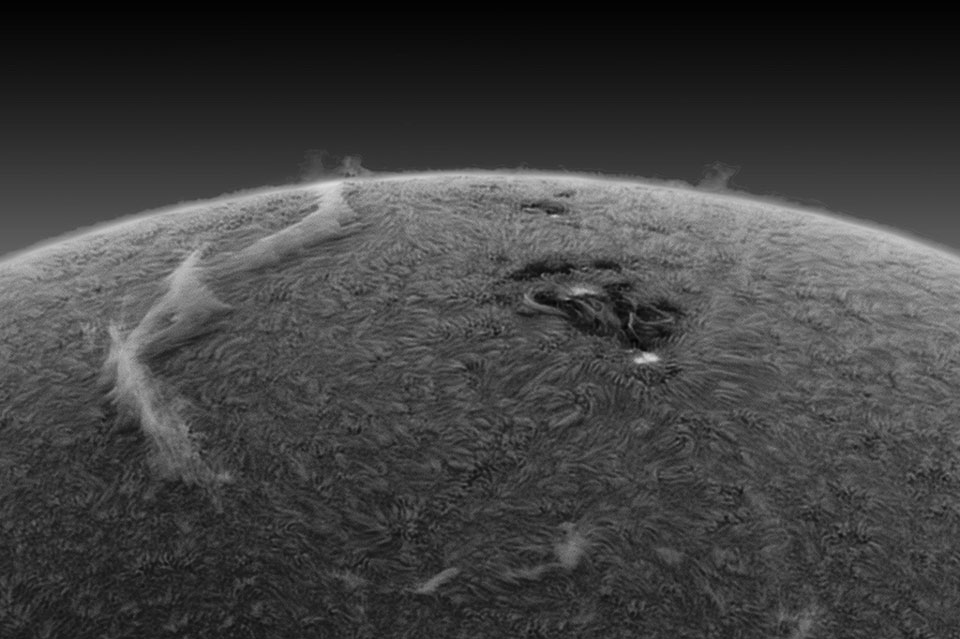
astro picture for the day


Image Credit & Copyright: Bret Dahl

--------------------------------Mechanical Universe extra!


I've tried to straighten out the Mechanical Universe's presentation, but clearly I wasn't able to.  I've pretty much covered the quantum mechanics side of things.  I'm planning on covering the industrialism/thermodynamics which is kind of related to atoms; but, it's also somewhat related to the particle physics/cosmology side of things(the three quantum forces are generally thought to unite at very high temperatures; temperatures that mankind cannot duplicate; gravity is hoped to unite at temperatures that makes that unification energy seem kind of quaint).  But, I'm going to cover the Einstein Relativity theories second, and then backtrack to the thermodynamics later.

----------------------------crazy science/technology for the day

http://www.technologyreview.com/view/428929/first-atomtronic-radio-broadcasts-matter-waves/

Nobody is quite sure where this will lead science or technology wise.

Sunday, August 19, 2012

My Arthur Koestler Sleepwalkers review

Mr Koestler begins trying to relate and show how science comes out of pre-science - namely religion and mythology.  He ends up making one of the best accounts of church and state - in terms of the whole Copernicus, Kepler, and Galileo stories and issues.
The book is pretty good, perhaps for its time.  Well, when was Ernst Cassirer and Suzanne K. Langer writing?  About his time and before.  But, well, that's an indication of how much knowledge is out there; it's hard to be objective.  All one can do is say where you're getting your knowledge and what knowledge you're using.  Here, Koestler excells; he's make your college compositon teachers proud!
The book begins with great poetic paragraphs, and I was like, "oh boy, here we go; a poetic account of the development of science; this could get . . . exciting!"  Only, he quickly turns his writing style to pure scientific account.
He starts out by suggesting that science and mathematics comes out of a mythological past, which I agree.  But, as I hinted at above, he clearly doesn't know about or think about the nature of abstraction and how that relates to science and mathematics(see Suzanne K Langer's "Introduction to Symbolic Logic" for the best account of the how abstraction works and its relation to symbolic logic; and that symbolic logic can be derived out of pure language.  See Ernst Cassirer and Jacob Bronowski for an further understanding of the nature of mythology and mathematics; Suzanne K Langer translated Cassirer's "Myth, Language, and Logic"; see Jacob Bronowski's 'Science and Human Values", and "Origin of Knowledge and Imagination" . . . and "Science, Magic, and Civilization"; all these are short but sweet books, and just as intellectually exciting as Koestler's book here!).  He also can't see like Jacob Bronowski for one how science relates to the human condition.  This is why I dock him one star.  This is where he goes wrong in his book - in terms of relations between faith and reason.
What got me to buy and read this book was a reference to it in John Stillwell's "Mathematics and It's History."  It seemed an odd reference.  I looked it up, read some reviews here at amazon mostly!  and thought, that sounds familier!  I went and looked up Carl Sagan's "Cosmos" references, and found it referenced!  The two major and most important chapters/episodes in Carl Sagan's "Cosmos" are three and seven; the chapters about Kepler and the Greek science.  Well, now I know where he got the majority of his material to make those chapters!  As for Plato and Christianity?  I'd reference the first post of my "Jacob Bronowski Scientific Humanism" blog!  Or, how about The Origins of Christianity & the Bible 
by Andrew D. Benson.  The pace of research in new testament and old testament studies is of course fast and hugh.  I'd recommend The Jesus Puzzle, Christ in Egypt.  Robert Eisenman's "James Brother of Jesus." Bottom line, Jesus Christ is a hellenistic sungod overwright for James the Just.
I'm going to go to his chapters about Copernicus, Kepler, and Galileo now.  I've never read a hundred pages about Copernicus, now I know why!  Copernicus's work is inaccurate!  Still, I've found one more example of how the vagueness gamers play their games.  For instance, they justified not burning Copernicus at the stake by saying his work is just a mathematical fiction; convenient, but not to be taken seriously.  Meanwhile, beleive in god, or you'll go to hell(and pay me money at church).  I mean, why has science had such a powerfull affect for atheism?  Because scientists have noted that they never need the god hypotheses to prove or calculate anything.  Try calculating 1+1 by saying god over and over again.  Sure, you could do it; but, the point is you don't need to do so to calculate anything mathematical. 
Anyways, Kepler . . . Kepler figured out the elliptic orbits before Galileo figured out that unequal masses fall in the vacuum at the same rate(and noted that objects thrown in the air follow an parabolic path), and before Newton/Liebniz figured out the calculus; it's one of the most amazing human accomplishments in all human history!  The human story is one of horrendous odds of dealing with rather unprofessional messing around society from Tycho Brahe to Castle owners.  Arthur Koeslter uncovers great details like he came up with his second law of equal areas before he figured out the elliptic orbits, and that Copernicus new of the eight minutes of arc discrepency in the orbit of Mars.  He traces how they went from obvious wrong ideas like epicycles, but then he tries to say how they couldn't possibly have taken them seriously. He contradicts himself, and due to his lack of knowledge about the nature of abstraction(see above), he doesn't know how to find and trace how constructive knowledge comes out of previous vague knowledge(like natural language).  While Kepler almost certainly believed in god, due to Arthur's great work, I thougth I detected a hint that even Kepler may have had moments of pause in his later years(as he did acknowledge that astrology maybe wrong).  It's curiose and makes for great reading(Arthur Koestler's book here) how the Greeks from Homer to some passages here and there in Plato(Plato did believe in god)  but, Kepler, Galileo struggled with science and what it could mean.
What Galileo's science meant for god and the bible is what got him into trouble. Koestler tries to say that Galileo's troubles came from being a jerk to Kepler and telling Jesuits they're a bunch of numbnuts; but, ultimately, when talking to some daughter or wife of some church guy and telling her that yes, the bible is wrong is what really set the wheels in motion.  Koestler mentions this episode as well. But, he tries to justify it all because Galileo was a jerk to Kepler. Once again, thanks Arthur for the great historical details of the scientific episodes; but, in the end, the conclusion is that the Christian church tried to put the flame of rational light out when things looked like they were getting out of control for them.
I actually got tired, and didn't read the last half of the Galileo trials, the Newton stuff(I've read Morris Kline's Calculus which teaches calculus by means of learning Newtonian mechancis and solving the kepler problem; i don't think I need to read this section), and his last philosophy of science chapter(see above comments of mine).
If you want the gory details about Copernicus, Kepler, and Galileo's life and scienc's struggle, great read this book!(just like reading the gory details about christianity; read Robert Eisenman's books!).  As for his account of mankinds path from pre-science to science, I'd recommend Morris Kline's "Mathematics in Western Civilization", E.T. Bell's "The Development of Mathematics", or James Burke's "Connections", and "The Day the Universe Changed." Point is that, either through knowledge being too big for even Koestler to read up and synthesize it all, or science and mathematics progressing, his accounts of that progress and evolution of consciousness and intelligence in this sector of the universe is now outdated.  I've tried, and will no doute continue to try(one reason why I read this book is to try again and get more details, which was great).  I would recommend my blog again because that is a big part of what I try to do there.

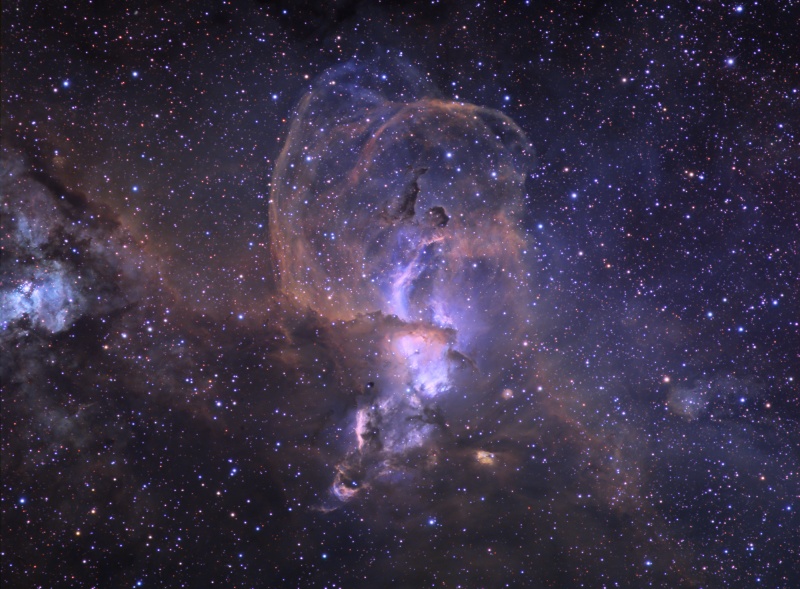
astro picture for the day


Credit & Copyright: Ken Crawford (Rancho Del Sol Observatory), Macedon Ranges Observatory

---------------------------------Mechanical Universe extra for the day!


and


I've already addressed these aspects of the physics and particle physics world.  I don't know why they felt like making two very similar episodes and side by side!  But, they did, and they made more than one extra 'review article' like episodes like episode 1.  I'll get around to posting those also.

However inadequate my post about quantum electrodynamics and chromodynamics, it's more than what "Mechanical Universe" does!  What more to say?  How about my theory of quantum gravity!

Quantum particles are perpetually jiggly things.  They also have an ability to disappear from one place and reappear on the other side of the wall; they're waves and particles at the same time.  There was a recent(about a year ago) report about experiment/observations of electrons that they are perfectly spherical(when not bound to an atom) within experimental error.  How do they manage that?!  Let me mention one more phenomenon about quantum particles which is rather famous with today's quantum computing efforts, quantum entanglement.  They showed experimentally I do believe around 1980 that if you entangle two electrons(quantum particles), shoot them at opposite directions, and then do something to one of the electrons, the other electron will feel that faster than the speed of light.  How does that work!?

My solution is higher dimensional spaces going in and out of lower dimensional spaces.  The famous example of this is the flatland story of the 1800s.  I recall the authors name is Abbot; i havn't read the book; i need to; i get the info from any number of books.  Anyways, the idea is that take a sphere and pull it through an euclidean plane; at first, you see a point(tangent contact), then circles, first small then ever growing larger in diameter circles; then, the circles diameters get smaller as the sphere goes through the plane till it goes to a point and disappears all over again.  Sound familiar?  Yes, quantum particles! 

How does this explain the quantum entanglement experiment?  And how quantum particles can seemingling walk through walls?  Quantum particles are not just spheres going through planes, but much more complex higher dimensional shapes going through lower dimensional spaces.  Complex shapes that as they go through lower dimensional spaces, their shadows show up on one side, maybe predominantly, but, then they disappear and reappear somewhere else, maybe on the other side of the wall.  The quantum entanglment experiment?  By quantum entangling, a more complex higher dimensional shape has been created, and shooting them off just stretches it out; doing anything to one side obviously makes a reaction to the other side.

So much for quantum mechanics.  But, what about gravity?  I look to inflationary theory.  The inflationary period occurs at the planck time scales . . . it seems to be like a sphere going through a plane; it starts out as a point, then ever larger circles, and then smaller circles.  Well, in the big bang, the circles, actually in the big bang, it would be spheres, get larger and larger, and then they stay larger.  In fact today, we feel like there's an accelleration.  I've suggested this is just an inflationary aftershock.  But, it seems to me the inflationary theory seems like a higher dimentional shape going through a lower dimenstional space.  We can see easily how this higher dimensional interpretation of inflationary theory and quantum particles as I've described above are analogous, but how does gravity work here?  Well, the higher dimensional shape going through a lower dimensional space is like pulling apart a rubber band(or, one could even say like in Einstein's general theory of relativity, a mass bands spacetime). 

------------------------------------crazy science/technology extra for the day!

First I'd like to mention something similar to something I just found.  In "the Turing Option", probably the best hard sci-fi book next to "the Daimond Age" I've yet found, at the end of the book, they talk about this one quantum one way thermos bottle like material.  They mention how it would allow beer cans to stay cold for years, and one can bring down the cold from the north and south poles and use superconductivity more efficiently.  I've tried to see if anybody has worked on it; they have; but, it appears to be something that maybe only quantum computers can compute.  But, now to something I found just now.

http://www.chemfeeds.com/comments.php?doi=10.1038/nphys2388

This work can reduce energy loss in electronic devices considerably.  If anything, It allowed me to mention the above wild idea from a mere sci-fi book!

Saturday, August 18, 2012

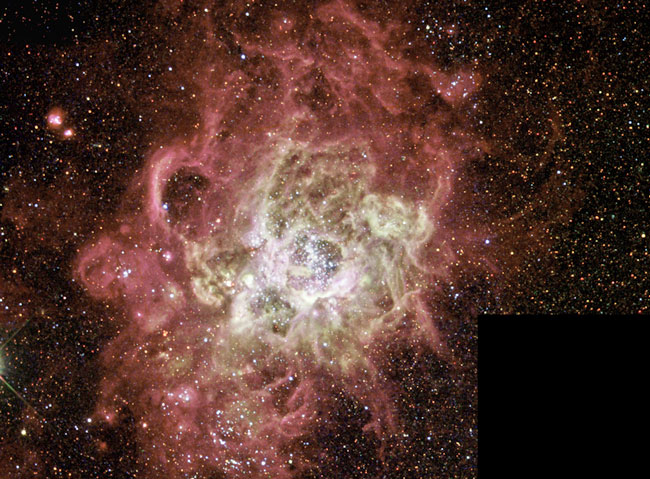
astro picture for the day


Credit: NASA and the Hubble Heritage Team (AURA/STScI)

I found it!  This is not the Trantulla nebula of the large magellanic cloud(one our galaxies irregular satellite galaxy); this one is even bigger; it has to be; it's in a galaxy three million light years away!  This is a Hubble picture that I think probably will be forgotten(already has).

-----------------------------------Mechanical Universe extra for the day!


Isaac Newton's derivation of Kepler's laws from his inverse square law and his three fundamental laws of physics was one of the first such great syntheses in mathematical science.  Another would be quantum mechanics deriving all of the chemistry properties of the previous hundred years!  Another would be General Relavity making Newtonian mechanics a low speed special case.  Maxwell's deriving of previous laws of electricity and magnetism.  I've seen but would have to review that they've done such vast generalisations in thermodynamics; i think it was combining Newton's dynamical laws with thermodynamics by a Pierre Dunham. 

When new theories take in old theories as general cases, they are able to establish the old facts much more directly.  All theories are established indirectly at first(with the discovery of the sun centered solar system being the classic example), and then when Isaac Newton's come around to derive the old theorems by means of vaster generalisations, well, the old stuff is made much more systematic. 

-------------------------------------wild science/technology find for the day

http://prd.aps.org/abstract/PRD/v81/i10/e105023

from qubits to  . . . drumroll . . . superqubits!  Supersymmetric generalisation of qubits!

Friday, August 17, 2012

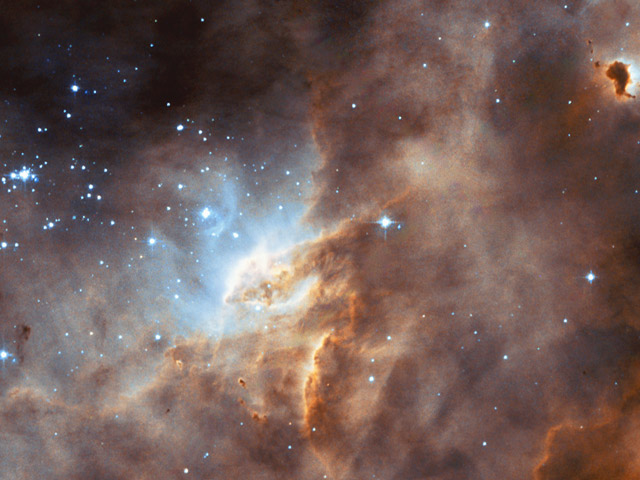
astro picture for the day


Credit: Hubble Heritage Team (AURA / STScI), Y.-H. Chu (UIUC) et al., ESA, NASA

-------------------------------Mechanical Universe extra for the day-------------------------------


The Heisenberg UnCertainty principle is more famous for the unpredictability it brings to science and the cosmos.  Quantum psychologists everywhere try to turn scientific method upside down.

The true significance of the Uncertainty principle is that it defines the quantum forces - electromagnetism, the strong and weak nuclear forces.  Particles can come out of the vacuum so long as they disappear back into non-existence within the uncertainty principle. The more massive the particles, the faster and shorter distance those particles can be allowed to go before it has to disappear within the uncertainty principle.  If these particles hit or are absorbed by other particles then they are exchange particle - force carriers.   The weak and strong nuclear force are short range because their exchange particles are massive, while the electromagnetic force can go the length of the universe because it's exchange particle is massless(the photon).

This whole understanding of the uncertainty principle came from Paul Dirac's unification of special relativity with shroedinger quantum mechanics.  Is so doing, he predicted anti-matter.  Anti-matter was shortly observationaly confirmed.  But, the theory had certain problems of infinity - self energy infinities.  This was the hardest physics problem of its time; it led to the search for unification theories.  It turned out that by unifying the fundamental quantum forces, the infinities could be cancelled out; this is called renormalisation.  Some say the problem has never been completely solved.  But, one thing is for sure, the three quantum forces led to electro-weak unification and then 'gut' theories(grand unification theories). 

Murry Gell-Mann solved the strong nuclear force by means of quarks.  Quarks are subatomic particles that come in pairs.  They can never be seen individually; if you put in enough energy to separate them, they just form another quark(by means of e=mc^2).  But, Feynman and experimentalists figured out that particle accellerators can act as a giant microscope that can slow down the process(just like in special relativity where time can be slowed down by getting close to teh speed of light; particles that normally decay in less than nanoseconds can be made to last longer, and so particle physicists can study them, or even use them to collide with other particles before they decay); the Stanford linear particle accellerator was able to view quarks without tearing them out of their quark couples and triplets.  Unification theorists soon found that by getting the number of quarks to match up with electrons, muons, and I feel like I'm forgetting another electron like particle, then they could solve the renormalisation problems for the strong nuclear force.  This shows the significance of the 1990s discovery of the Top quark; it was the last quark needed to confirm the standard model.  Well, the Higgs was next; but, the Top quark pointed particle physicists on where approximatelly the Higgs particle was.  The Higgs particle of course has recently been discovered.  The Higgs has a role to play in the Inflationary generalisation of the big bang theory.  One could say, the big bang was a highly improbably quantum fluctuation of the uncertainty principle.  But, we have plenty of evidence such as the Cobe and Wmap satellite data on the cosmic background radiation that the inflationary theory did happen.  And, of course, the Higgs has been discovered which further confirms the inflationary theory.  We've clearly come a long way since J.J. Thompson's discovery of the electron and even Maxwell's great unification of electric and magnetic fields.  But, we've got even bigger game - quantum gravity.

We know that with black holes and the big bang, gravity and the quantum forces need to be unified; but, gravity is not a quantum force defined by the heisenberg uncertainty principle.  It's a big problem!  We've also got other puzzles to solve - dark matter and dark energy(which I've often thought is just an inflationary aftershock).  The LHC that discovered the Higgs may be able to solve those problems as well.

I've actually gotten ahead of the story of quantum and Einstein's relativity theories over the last hundred now plus years.  Einstein's General theory of relativity led to the Big bang theory before Edwin Hubble deduced it by the motions of galaxies.  But, particle physics had also been hinting at a big bang theory of the universe.  Quantum physicists had discovered the mechanism that powers the stars - nuclear fussion.  They had soon figured out more or less how supernova work.  They learned how the different atoms were generated in the cosmos; they learned that we and our planet earth is stardust generated in supernova. But, they found that the proportions of helium and hydrogen in the cosmos is not accounted for by the supernova.  This 70-30 proportion seems to hint at a big bang a long time ago.  They also predicted the cosmic radiation background now used to study the big bang(and confirm the inflationary generalisation of the big bang universe).  This was discovered in the 1960s and established the big bang theory over other theories like the steady state theory.  But, particle physics soon hinted at the big bang theory in other ways in the 1970s.

In the 1970s, the unification of forces to solve the renormalisation problems seemed to occur at super hot temperatures.  At these temperatures, the three forces melt into one another, and at temperatures that dwarf those temperatures, it's hoped that gravity will also meld with the three quantum forces.  Where else do these super hot temperatures occur?  In black holes and the big bang.

With Isaac Newton's view of the universe as so many billiard balls richecheting off one another leading to Laplace's saying, "get the initial conditions established precisely, one can predict both all the past and the future" led to the idea of reductionism science.  In truth, if you study the nature of mathematics(which they did not), you see abstraction(common forms of many different structures), and the structural relations, one sees mathematics as making connections, unifications.  James Burke tries to show connections between all historic forces and technologies; i've shown that some of them are interesting, other connections are a little more spurrious.  But, mathematics is the real unified theory or everything(and so does Jacob Bronowski).  These are the realconnections.  The supernatural religious will say that science cuts us off from the universe, when, the truth is they're saying that spirit above matter, and the cosmos elements are different from earth elements because that's where god must reside(because he clearly doens't live on earth) is the real divisive split.  It was Isaac Newton, mathematicians, and mathematical science that has made the real connections between the cosmos and humanity.

---------------------------------dna nanotech news for the day------------------------------------------

http://www.sciencemag.org/content/early/2012/08/15/science.1226355

A book has been encoded into dna.  The only problem is reading it out.

Thursday, August 16, 2012

astro picture for the day


Credit: ESO

---------------------------------extra goodie for the day------------------------------------------------------


The electromagnetic nature of light was certainly a great surprise; but, that discovery was just a tip of an iceberg.  The electric nature of atoms was to lead to much; the unification theories of the universe; the nature of the stars; that we are stardust, and eventualy, the atom seems to be like a snowflake; the clues to the origin of our universe is imprinted in atoms.

-----------------------------------quote for the day----------------------------------------------------------

"the roads that lead man to knowledge are as wondrous as that knowledge itself." - Johannes Kepler

---------------------------------nanotechnology and quantum computing news for the day-----------

http://www.nature.com/srep/2012/120813/srep00571/full/srep00571.html

D-Wave has been making special purpose quantum computers for a few years now(with some controversy on whether they're machines actually work . . . just like when Galileo was spotting moons going around Jupiter with his little telescope?).  Well they've just succeeded in calculating some protein folding with a quantum simulation machine.  This used 81 qubits; they have a 500 plus quibit machine going into commercialisation right now and plan on building a two thousand plus qubit machine in a few years.  But, with this demonstration, we're already in the quantum computing age!  Maybe we will just compute a primitive protein nanomachine(when the two thousand plus qubit machine gets built).  And, quantum computer breakthroughs occur all the time(today, there was a recent announcement of reading out qubits of a single atom that lasts for seconds(as oppossed to less than a nanosecond).